Robinhood Agents: how Robinhood’s AI trading agents work and what the risks are
Robinhood Agents are AI agents inside the Robinhood app that research the market, suggest strategies and can buy and sell for you from a separate account. For now they are only announced for US customers, and Robinhood says any losses they cause are the customer’s.
What is Robinhood Agents?
Robinhood Agents is a Robinhood feature that lets you create AI agents inside its app to research the market, build strategies and buy and sell for you. It was announced on 29 September 2026 at the HOOD Summit, the company’s yearly event, held this year in Houston.
- Robinhood Agents
- AI agents you create inside the Robinhood app. You name them, pick the model, set the strategy and the limits, and they work from a separate account.
- Loops
- A feature announced for later: standing instructions so the agent checks the market and trades on repeat or on a schedule, without you asking each time.
- Agentic account
- An investing account set aside for the agent. The agent can only use the money in it, not the money in your main account.
The difference from an AI chat that gives investing ideas is the usual one: an agent does not just answer, it acts. I explained this in the guide to OpenAI agents. What is new here is where it acts: in an account with real money.
What can a Robinhood agent do?
According to Robinhood’s official release, an agent can research markets, build watchlists, design strategies and trade stocks, options and crypto at any hour, all through a chat in the app. To get data it uses Robinhood’s trading tool built on MCP, the open protocol that lets agents connect to other services.
Setting one up takes four steps: you name the agent, open the dedicated account, pick the model and set the strategy and limits. From there you can ask it to review your portfolio, suggest trades or place them.
Robinhood has also added a paid data layer called Agent Apps: eleven specialist providers the agent can use, priced from 5 to 30 dollars a month, each with a one-month free trial.
How do the controls work: approvals, limits and a separate account?
The main control is manual approval for each order, which is on by default when you set up the agent. With it, the agent proposes and you confirm. You can switch it off at any time, and then the agent trades on its own within the limits you set.
The second control is keeping the money apart. The agent works in its own account and can only use the funds in it. According to CoinDesk, it also cannot trade on margin, meaning with borrowed money, at launch.
The third is the least visible and the one that matters most: who is responsible. Robinhood says it plainly in its release: you take on all the risk of trades placed by AI agents, and Robinhood does not control, supervise, recommend or audit them. Its product page adds that agents can make errors, misread instructions or act on incomplete or out-of-date information, and that data you share with an AI provider leaves Robinhood’s security environment.
What are Loops and why do they matter?
Loops are standing instructions that make the agent work on repeat or on a schedule: for example, check the market every morning and place a trade if certain conditions are met, or keep a strategy running overnight. Robinhood lists them as coming soon.
This is the part that changes the risk the most. With approval on, every order goes past a person. With Loops, the idea is the opposite: the agent acts without asking for each move. Robinhood says you can pause or turn Loops off at any time, but also that stopping them does not reverse trades already made.
It is the same line I drew in the essay on what you would let an agent do without looking (in Spanish): anything that cannot be undone needs a person in the loop. A filled market order is exactly that.
Robinhood Agents or your own agent over MCP: what is the difference?
Since May 2026 Robinhood has let customers connect outside agents to a dedicated account through MCP. Its support pages list Claude Code, Claude Desktop, ChatGPT, Codex, Cursor, Grok, Perplexity and OpenClaw, among others. Robinhood Agents is the built-in version: the agent lives inside the app and you do not need another tool.
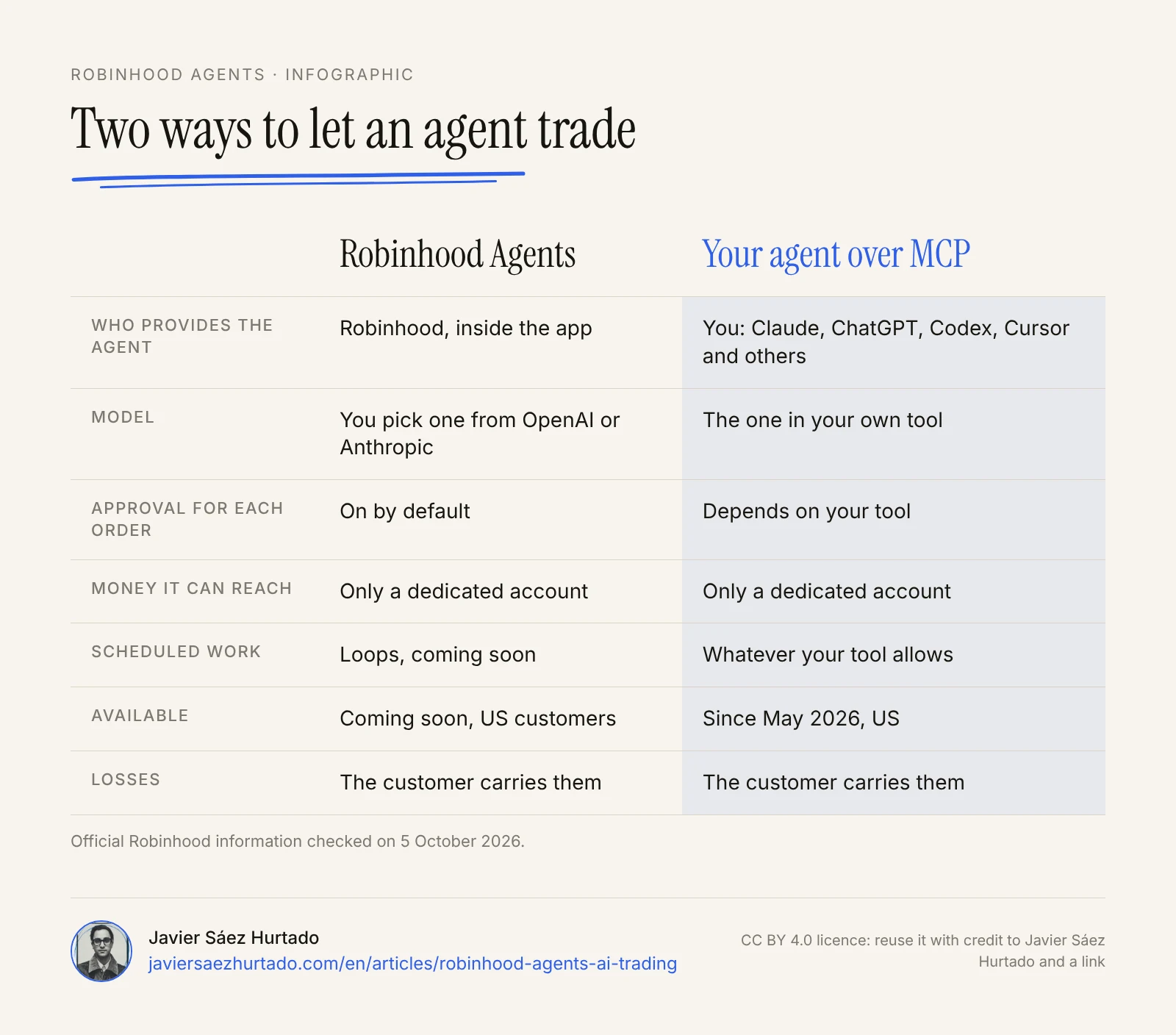
Robinhood Agents compared with bringing your own agent
Official Robinhood information checked on 5 October 2026
| Robinhood Agents | Your agent over MCP | |
|---|---|---|
| Who provides the agent | Robinhood, inside the app | You, with your own AI tool |
| Model | You pick one Robinhood offers | The one in your tool |
| Approval for each order | On by default | Depends on your tool |
| Money it can reach | Only the dedicated account | Only the dedicated account |
| Scheduled work | Loops, coming soon | Whatever your tool allows |
| Availability | Coming soon, eligible US customers | Since May 2026, in the US |
| Who carries losses | The customer | The customer |
Robinhood says more than 150,000 customers have opened agentic accounts since May and that agents use its tools almost 30 million times a day. These are the company’s own numbers, not audited, but they show this is no longer a lab experiment.
Which models does it use and what does it cost?
Robinhood lets you pick a model from the big AI labs. Its official release names OpenAI and says GPT-Luna use will be free until the end of the year. CoinDesk and Fortune report that Anthropic models are also on the list; Fortune names GPT-6 Luna, GPT-6 Sol and Claude Opus 4.8.
After that period, you pay for model usage at each provider’s rates. The Agent Apps data tools cost extra, from 5 to 30 dollars a month. Robinhood has not published a full price list for Robinhood Agents, so these figures (checked on 5 October 2026) may change.
What else did Robinhood announce at the HOOD Summit?
The agents were the centrepiece, but they came with other news aimed at active traders. All of it is for the US and most of it has a future date:
- Crypto perpetual futures, in the coming months, letting you trade up to 10 times your stake on bitcoin and ether.
- Weekend stock trading, planned for early 2027, on a set list of stocks and funds.
- Earnings contracts, binary contracts tied to company metrics.
- Longer options trading hours and orders that combine a stop loss with a take profit.
Together they point one way: more market hours, more automation and more high-risk products. That is the context for the agents.
Can you use Robinhood Agents in Europe?
No. As of 5 October 2026, Robinhood lists the agents as coming soon for eligible US customers, and the same goes for Loops. There is no date or announcement for Europe.
Robinhood is present in Europe, and has had a local app in Spain since January 2025, but that app is built around crypto. The agents are part of its US brokerage product, which sits under different rules.
If it did come to Europe, it would not be a simple translation. ESMA, the EU markets regulator, said in May 2024 that investment firms remain responsible for how they use AI and must act in the client’s best interest. According to Trending Topics, most European brokers that let you connect ChatGPT or Claude ask you to approve each order, although a few allow trading without approval in separate sub-accounts.
What does it mean for businesses and savers?
For a saver in Europe it changes little today, because you cannot use it. But the direction is worth understanding: investing platforms will offer agents that trade, and the real question will not be whether the technology works but who is responsible when it gets something wrong.
For a business, the lesson goes beyond the stock market. Robinhood has built in four ideas that fit any agent that touches money or important systems:
- Its own perimeter. A separate account with a limited balance limits the damage.
- Approval by default. The safe setting should be the one that comes switched on.
- Clear limits. Maximum amounts and rules the agent cannot change.
- Clear responsibility. Knowing in advance who carries the cost of a mistake.
What Robinhood’s design leaves out is oversight: the company says it does not audit the agents. Inside a business, that role should not be left empty.
My view: what I would not hand to an agent
I would not let an agent trade with my money without approving each order. It is not a lack of trust in the technology: an agent can go through more data than I can in less time, and that has value. It is that a filled order cannot be undone, and the maker itself warns that agents make mistakes, misread instructions and sometimes work with old data.
If I tried it, I would use a small amount I could afford to lose in full, in the separate account, with approval always on and without Loops. I would use the agent to research and prepare orders, not to decide them. And I would never give it access to high-value accounts, in the same way I do not let it talk to other people on my behalf.
I am not a financial adviser and this is not investment advice. It is the rule I apply to any agent: hand over what can be checked and undone, and keep a person on everything else.
Transparency: Convexify, the firm I founded, is part of the OpenAI Select Partner programme. This article is based on Robinhood’s public documentation and the linked sources.
Key takeaways
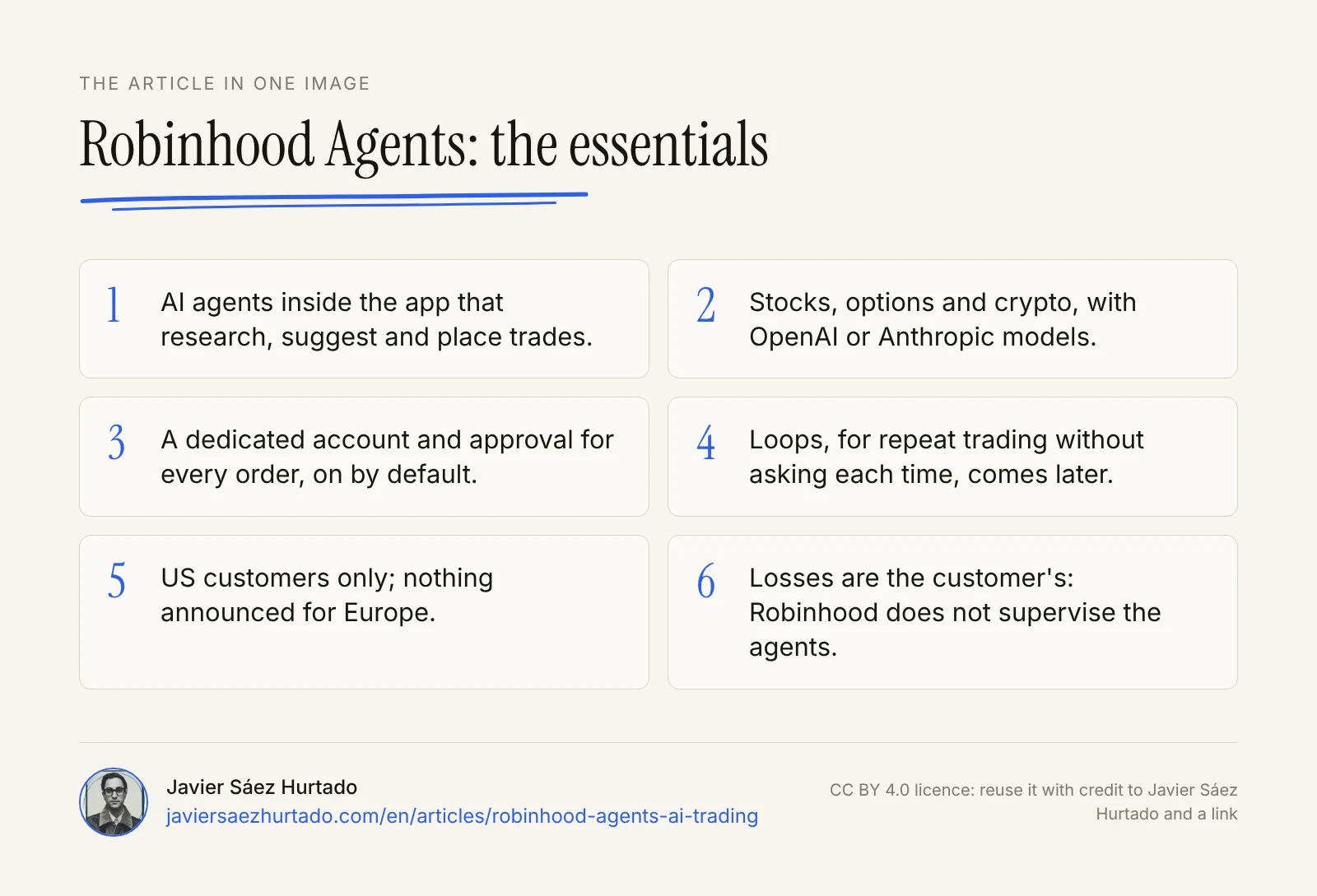
- Robinhood Agents are AI agents inside the Robinhood app that research, suggest and can trade stocks, options and crypto.
- They work from a dedicated account, and approval for each order is on by default.
- Loops, for trading on repeat without asking, comes later, and stopping it does not undo what was done.
- Losses are the customer’s: Robinhood does not control, supervise or audit the agents.
- It is only announced for US customers; there is no date for Europe.
The article in one image
Frequently asked questions
What is Robinhood Agents?
It is a Robinhood feature, announced on 29 September 2026, that lets you create AI agents inside the app. The agent researches the market, builds watchlists and strategies, and can buy and sell stocks, options and crypto from a dedicated account.
Does Robinhood Agents trade without my permission?
Not by default: manual approval for each trade is on when you set up the agent. But you can turn it off at any time, and Loops, which comes later, is designed so the agent can repeat tasks and trade without asking for each move.
Which AI models does Robinhood Agents use?
Robinhood lets you pick a model from the big AI labs. Its official release names OpenAI and says GPT-Luna use will be free until the end of the year; CoinDesk and Fortune also report Anthropic models. After that, you pay for usage at each provider’s rates.
Is Robinhood Agents available in Europe?
No. As of 5 October 2026 Robinhood lists it as coming soon for eligible US customers. Robinhood has offered a crypto app in Spain since January 2025, but it has not announced agents for Europe.
Who pays if the agent loses money?
The customer. Robinhood says you take on all the risk of trades placed by AI agents and that it does not control, supervise, recommend or audit those agents.
Is AI trading a good idea?
It depends on how much and how. An agent can help with research and with preparing orders, but it also makes mistakes and can misread an instruction. The careful approach is to start with an amount you can afford to lose, keep approval on for every order and keep the agent away from your main account. This is not financial advice.
Sources
- Robinhood, Robinhood Puts the Power of Hedge Funds in Every Trader’s Pocket (29 Sep 2026)
- Robinhood, Agentic Trading and Robinhood Agents
- Robinhood Support, Agentic Trading overview
- CoinDesk, Robinhood adds AI agents, perps and weekend trading (29 Sep 2026)
- Fortune, Robinhood rolls out OpenAI and Anthropic trading agents (29 Sep 2026)
- Trending Topics, Robinhood lets AI agents trade around the clock
- The Block, Robinhood launches a localised app in Spain (21 Jan 2025)
- ESMA, public statement on the use of AI in retail investment services (30 May 2024)