Businesses in ChatGPT: how to claim your business and what Business Agents do
Since 10 November 2026 a business can claim its profile in ChatGPT, fix its details and see how often the assistant mentions it, for free and without buying ads. Business Agents, which talk to customers for the business, are US only for now, and the business is responsible for everything they say.
What is Businesses in ChatGPT?
Businesses in ChatGPT is OpenAI’s programme for businesses that want to manage how they show up inside ChatGPT. OpenAI launched it in beta on Tuesday 10 November 2026. It has two parts: a business profile with an insights dashboard, and an agent that talks to customers for the business.
- Business Hub
- Where a business claims its profile in ChatGPT, fixes its details, uploads its products and sees how the assistant mentions it. You open it from the ChatGPT sidebar.
- Business Agent
- An AI agent that answers customers for the business, using the information and guidelines the business gives it. People reach it from the business profile, in a chat that is labelled and kept apart from ChatGPT’s own answers.
The timing makes sense. OpenAI says ChatGPT has 1.2 billion weekly users, and more of them ask it what to buy, who to hire or which shop to use. Until now a business had no official way to correct what ChatGPT said about it. It is the same logic Google followed years ago with business profiles: if people search here, a business wants to own its listing.
What can a business do in Business Hub?
Business Hub does three things: it says who you are, keeps your details current and shows what happens to you inside ChatGPT. Once verified, the business gets a blue badge next to its name.
- Details and products. The business can update its information, prices and stock. Online stores can upload a product feed or connect a Shopify store, with an OpenAI app that the Shopify App Store lists as free.
- Insights. The dashboard shows aggregate data for the last 28 days: how often ChatGPT mentions the business, how many clicks its website gets from ChatGPT and the topics that keep coming up. Numbers only show once they pass a minimum level.
- What counts as a mention. According to VentureBeat, an online business gets a mention when ChatGPT refers to its website, and a local business when its location appears in a result.
What the dashboard does not do matters too. It does not compare you with competitors, it does not explain why a specific chat went wrong and it gives no access to what each user wrote. It is a visibility tool, not a window into conversations.
How do you claim and verify a business?
There are three steps, and the third is the one that counts: without the identity check you cannot publish any change.
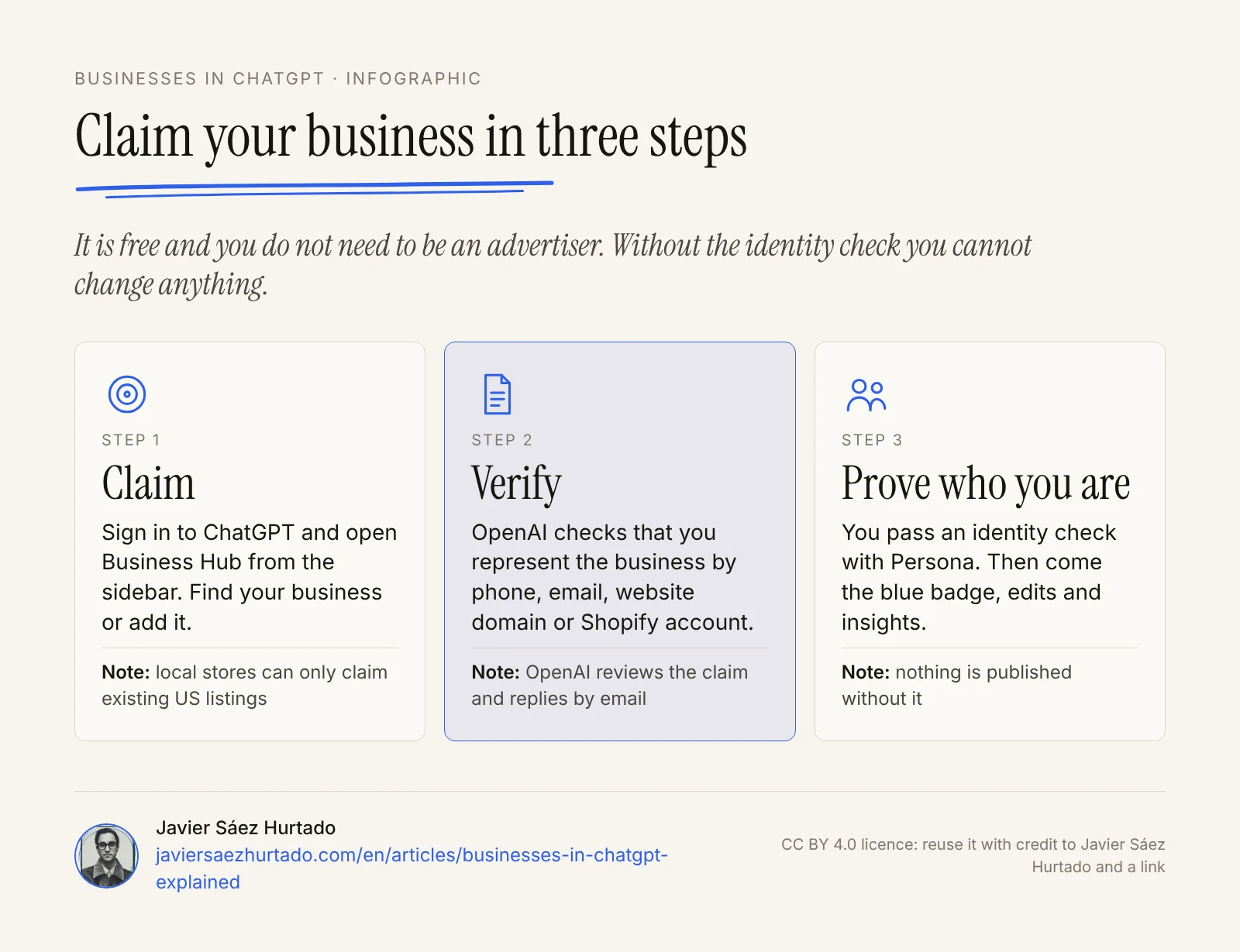
- Claim the profile. Sign in to ChatGPT and open Business Hub from the sidebar. Find your business, or add it if it is not there.
- Prove you represent it. OpenAI can check this through a business phone number or email, the website domain or a Shopify account. It reviews the claim and replies by email, with a decision or a request for more information.
- Pass the identity check. The person who manages the profile must verify their identity with Persona, an outside verification service. Until then they cannot publish changes, connect a product feed, see insights or create an agent. The blue badge comes when this step is approved: claiming alone is not enough.
Two practical points. You do not need an ads account or a ChatGPT Enterprise agreement to claim a profile; Enterprise customers and advertisers can also go through their OpenAI contact. And local businesses, such as physical shops or restaurants, can only claim existing US listings for now.
What are Business Agents and how do they work?
A Business Agent is an agent that talks to customers for a business, inside ChatGPT. When a business appears in an answer, the user can open its profile and chat with its agent, which answers from the product and policy information the business provided.
It is the sales version of what I described in my article on how OpenAI agents work: here the agent does not work for the user, it works for the shop. So the rules are different.
- Labelled and separate. The chat with the agent is labelled and kept apart from the user’s own conversation with ChatGPT.
- OpenAI’s policy rules. The agent must say it is AI. It must not make up prices, availability or other claims, or hide important fees or limits. It must not pressure people, create false urgency or keep pushing after someone says no.
- Purchases and data need consent. According to The Next Web, buying something or sharing personal data needs the user’s explicit approval. For now the purchase ends on the shop’s own website; OpenAI is working with Visa on payments made by agents.
- Who can have one. Only US online stores and online service businesses with their own website, which also meet the industry rules in the policy. OpenAI looks at the category and the intended use, and verifying the business does not guarantee you can publish an agent.
One clause is worth reading twice. The Businesses in ChatGPT terms say the business is responsible for the agent: its content, its setup, the testing to make it accurate, its actions and its outputs, whether or not the business reviewed them. They also say OpenAI does not become the seller, and that the business handles any offers, commitments and transactions the agent makes. If the agent promises something, your business promised it.
Business Hub vs Business Agents
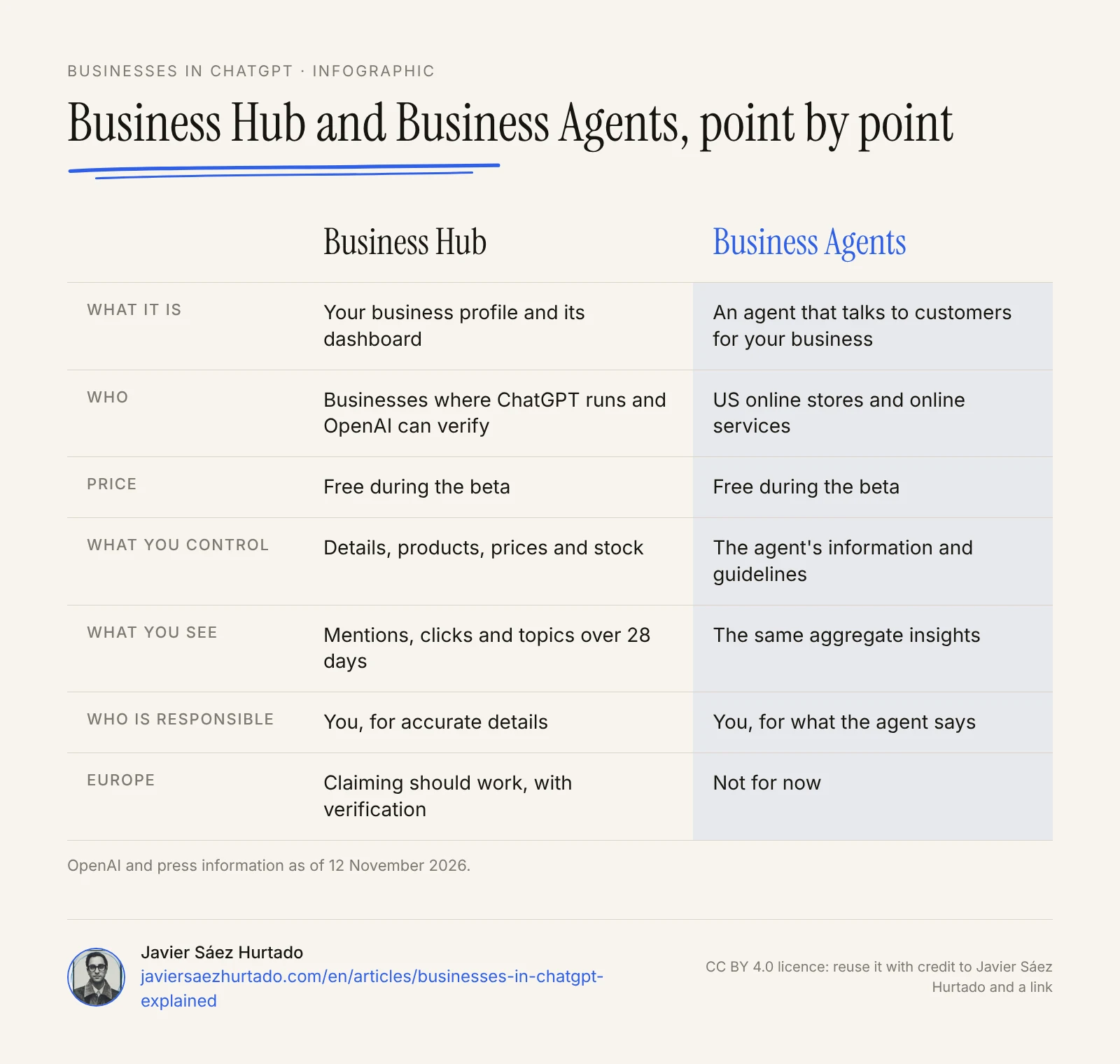
Business Hub and Business Agents, point by point
OpenAI and press information as of 12 November 2026
| Business Hub | Business Agents | |
|---|---|---|
| What it is | The business profile and its dashboard | An agent that talks to customers for the business |
| Who can use it | Businesses in markets where ChatGPT runs, if OpenAI can verify them | US online stores and online services with a website |
| Price | Free during the beta | Free during the beta |
| What the business controls | Details, products, prices and stock | The agent’s information and guidelines |
| Insights | Mentions, clicks and topics over the last 28 days | The same, in aggregate |
| Verification | The business, then the manager’s identity with Persona | The same, plus industry rules |
| Who is responsible | The business, for accurate details | The business, for everything the agent says |
| Europe | Claiming should work, with verification | Not for now |
Does paying for ads change ChatGPT recommendations?
OpenAI says no. It says ChatGPT keeps making independent recommendations, that paying does not change how often it recommends a business and that claiming a profile does not guarantee better placement or more sales. Claiming a profile, publishing an agent and advertising are three separate things.
They meet in one new format: the sponsored agent. A business can make its Business Agent the landing spot for a ChatGPT ad, so whoever taps the ad starts talking to the agent. It builds on the Sponsored Agents OpenAI began testing in September, and OpenAI’s help centre says it will open in Ads Manager to eligible advertisers over the coming weeks. I explained how ChatGPT ads work, who sees them and what data they use, in a separate article.
On recommendations, it pays to be precise: this is an OpenAI commitment, and there is no independent audit of it yet. The trade press points to another effect. The Next Web notes that the dashboard could squeeze companies that sell tools to track visibility in AI assistants, because OpenAI now gives away part of that data.
What does the business see of your chats?
According to OpenAI, nothing: it says it does not share users’ conversations or Business Agent chats with businesses. What the business gets is the aggregate data in the dashboard, with a minimum level before it shows.
That does not mean the agent learns nothing about you. If you give your email for an order in the agent chat, or agree to share data, that data does reach the business, which is why OpenAI asks for your explicit approval first. The practical rule for users is the usual one: a shop’s agent is a salesperson, however friendly.
What it means for businesses in Europe
For most European businesses, today’s decision is only the profile, and it is an easy one.
- Claim the profile if you have a website. ChatGPT already talks about your business, with or without you. Claiming it lets you fix details, see whether it mentions you and what people ask. It is free and commits you to nothing else.
- Put one person in charge. A named person passes the identity check. Decide who, record the access and review the details from time to time, as you would with a Google listing.
- Keep your details true. OpenAI’s terms make the business responsible for accurate, current information. An old price in ChatGPT is your problem, not OpenAI’s.
- If you sell in the US, think hard about the agent. If you run an online store there and can publish a Business Agent, start narrow: product information and policies that are already in writing. Keep returns, complaints and any exceptions out of it.
Local businesses in Europe, such as a restaurant or a shop with no online sales, cannot claim a profile yet, because that option is only for US listings. Once agents reach Europe, the rules will be stricter. Article 50 of the EU AI Act, which applies from 2 August 2026, requires that people know they are talking to an AI, which OpenAI’s policy already asks for. Consumer law still applies too: what an agent says about prices, delivery or guarantees reads as your company’s own advertising and offer. For the other side, the agent that shops for the user, see my article on whether agentic commerce is safe.
My view: claim the profile, keep the agent on a short leash
I would claim the profile today. It is information about your business that ChatGPT already uses, and I would rather correct it myself than have it pieced together from an old web page or a review. The insights are basic, but they measure something you could not measure before.
I would be far more careful with the agent. A Business Agent talks to your customers in your name, and the terms are clear that whatever it says, you said, reviewed or not. I do not hand communication with other people to an AI when something is at stake: a complaint, an exception, a promise. What I would let it handle is what is already written down and does not change, such as product sheets, opening hours or published policies. Everything else goes to a person.
It is the same rule I use for any agent: what can be undone can be delegated, and what commits you needs a person to approve it. A sales agent that cannot promise anything is less impressive, but it is also the one that will not get you into trouble.
Transparency: Convexify, the firm I founded, is part of the OpenAI Select Partner programme. This article is based on OpenAI’s public documentation and the linked sources.
Key takeaways
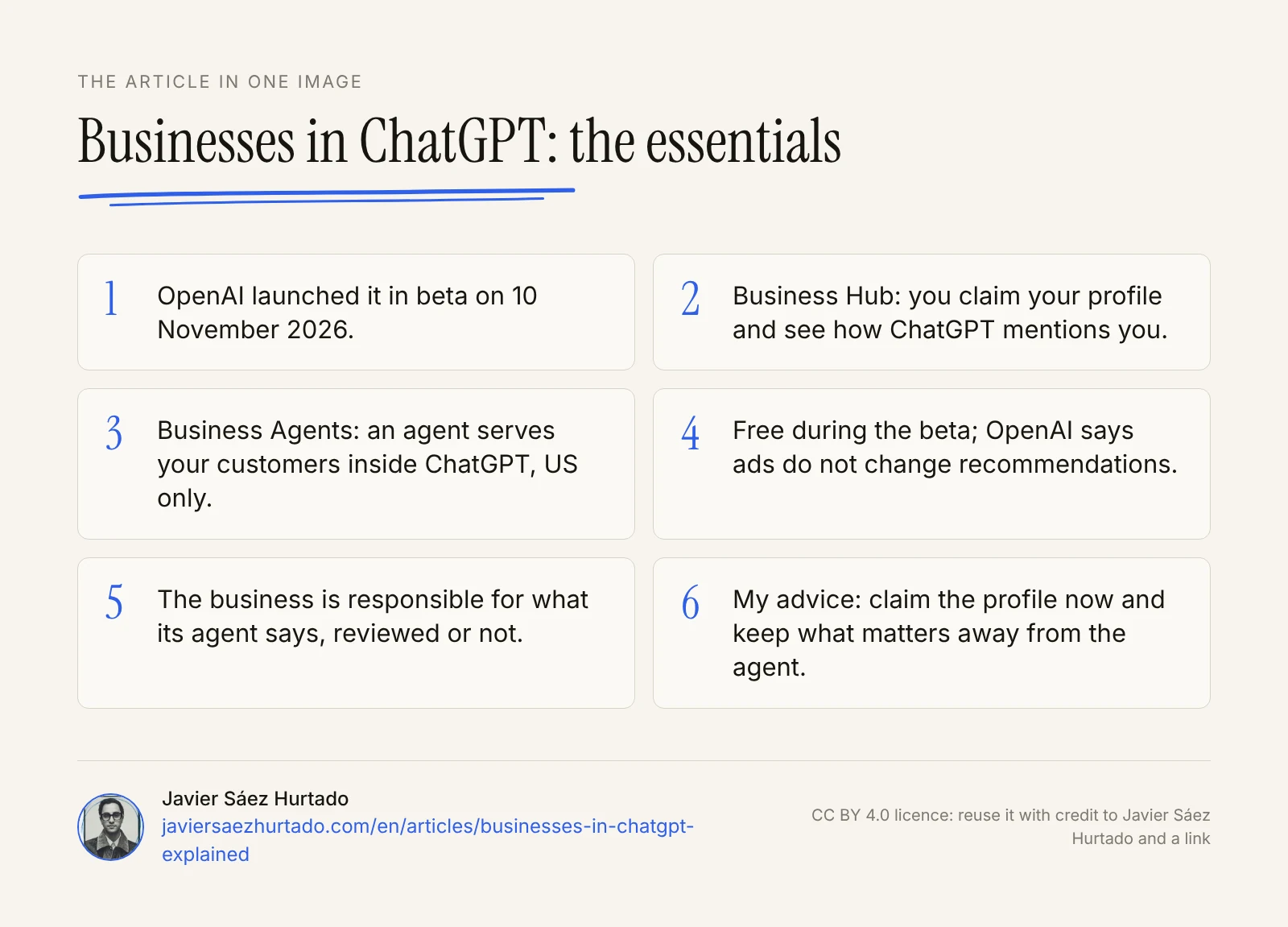
- OpenAI launched Businesses in ChatGPT in beta on 10 November 2026: Business Hub for the profile and Business Agents to serve customers.
- Business Hub lets you fix details, products and prices, and see mentions, clicks and topics for the last 28 days.
- Claiming is free, but you must verify the business and the identity of the person who manages it.
- Business Agents are US only, and the business is responsible for everything they say.
- Outside the US you can claim a profile if you have a website; agents and their sponsored version are not available yet.
The article in one image
Frequently asked questions
What is Businesses in ChatGPT?
It is an OpenAI programme, in beta since 10 November 2026, that lets businesses manage how they appear in ChatGPT. It has two parts: Business Hub, where you claim your profile, fix your details and see insights, and Business Agents, an agent that answers customers for the business inside ChatGPT.
How do I claim my business on ChatGPT?
Sign in to ChatGPT and open Business Hub from the sidebar. Find your business or add it, then prove that you represent it with a business phone number, email, website domain or Shopify account. OpenAI reviews the claim and replies by email. You then pass an identity check with Persona before you can publish changes, see insights or create an agent.
How much does ChatGPT Business Hub cost?
Nothing during the beta. Claiming and managing a profile and publishing a Business Agent are free at launch, according to OpenAI and Digiday. OpenAI has not ruled out charging later. You do not need an ads account or a ChatGPT Enterprise agreement.
Are Business Agents available outside the US?
Not yet. Business Agents are only for eligible US online stores and online service businesses with a website. OpenAI says it will bring them to more markets and business types over time, with no dates. Claiming a profile is open more widely, in markets where ChatGPT is available and OpenAI supports the verification.
Does paying for ChatGPT ads improve recommendations?
OpenAI says no. It says ChatGPT keeps making independent recommendations, that paying does not change how often it recommends a business and that claiming a profile does not guarantee better placement or more sales. Ads can send people to a sponsored Business Agent, but that format is rolling out slowly to selected advertisers.
Can businesses see my ChatGPT conversations?
OpenAI says no. It says it does not share users’ conversations or Business Agent chats with businesses. What a business sees in Business Hub is aggregate data for the last 28 days, and only above a minimum level. Buying something or sharing personal data with an agent needs your explicit approval.
Sources
- OpenAI, Introducing Businesses in ChatGPT (10 Nov 2026)
- OpenAI, Businesses in ChatGPT: Claim Your Business
- OpenAI Help Center, Setting up your business on ChatGPT
- OpenAI Help Center, Setting up a Sponsored Business Agent in Ads Manager
- OpenAI, Business Agents Policy
- OpenAI, Businesses in ChatGPT Terms
- The Next Web, OpenAI lets businesses claim ChatGPT profiles and launch their own agents (10 Nov 2026)
- VentureBeat, OpenAI lets you claim your business in ChatGPT and set up a custom agentic AI customer sales rep (10 Nov 2026)
- Regulation (EU) 2024/1689 on artificial intelligence (AI Act), Article 50