ChatGPT ads: how they work, who sees them and what the new visual ads change
ChatGPT shows ads on its Free and Go plans: in the US since February 2026 and in 31 European markets since 24 August. Plus, Pro and business plans have none, and on 5 October OpenAI announced ads with images, which it will start testing in the US this month.
Does ChatGPT have ads?
Yes. ChatGPT shows ads to adult users on the Free and Go plans. The paid Plus and Pro plans, and the business plans (Business, Enterprise and Edu), have no ads. OpenAI started testing ads in the US on 9 February 2026, and since 24 August they also run in 31 European markets.
- ChatGPT ad
- A sponsored product or service that appears below an answer when it relates to the conversation. It is labelled as sponsored and kept apart from ChatGPT’s text.
- Go plan
- The cheapest paid ChatGPT plan. It gives more use than the free plan but still shows ads.
- Ads Manager
- OpenAI’s tool for businesses to create and measure campaigns in ChatGPT, at ads.openai.com.
This week’s news is the format. On 5 October OpenAI announced ads with images, which it will start testing in the US this month when people create images in ChatGPT. It is the first big format change since the tests began.
How do ChatGPT ads work?
The ad shows up at the bottom of an answer, only when there is a sponsored product or service that fits what you are asking about. It is labelled as sponsored, set apart from the answer and you can dismiss it. OpenAI repeats one rule in every document: ads do not influence the answers ChatGPT gives.
The three-dot menu on each ad lets you hide it, report it, see why you got it or ask ChatGPT about it. That last option is useful: you can ask the assistant to explain the product in the ad, as you would with any other question.
There are clear limits on where ads do not appear:
- Sensitive topics. Not next to conversations about health, mental health or politics.
- Minors. Not to accounts OpenAI identifies as under 18, based on the stated age or its age prediction system.
- Temporary chats. They show no ads.
On the advertiser side, OpenAI charges per click or per impression and offers a pixel and a Conversions API to measure results. OpenAI says the business passed 1 billion dollars in annualised revenue in under 200 days and that tens of thousands of advertisers use it.
What are the new visual ads in ChatGPT?
They are ads with images, built to show a product, how it is used or an experience. OpenAI announced them on 5 October 2026 and says it will start testing them this month in the US, with a first group of advertisers, while users create images in ChatGPT. OpenAI says the ad will be labelled and kept separate from the image you are making.
In the same post OpenAI announced more measurement tools: data links with Hightouch, Tealium and LiveRamp, more than ten attribution partners such as AppsFlyer, Adjust and Branch, and DoubleVerify and Integral Ad Science to check where each brand appears. It also gave a reach figure: ChatGPT reaches 1.2 billion people each week.
Engadget, which covered the news the same day, stresses the same point as OpenAI: Plus and Pro subscribers and business customers will not see these ads, and the safeguards for sensitive topics stay in place. OpenAI has not given a date for visual ads outside the US.
Timeline: from the US to Europe
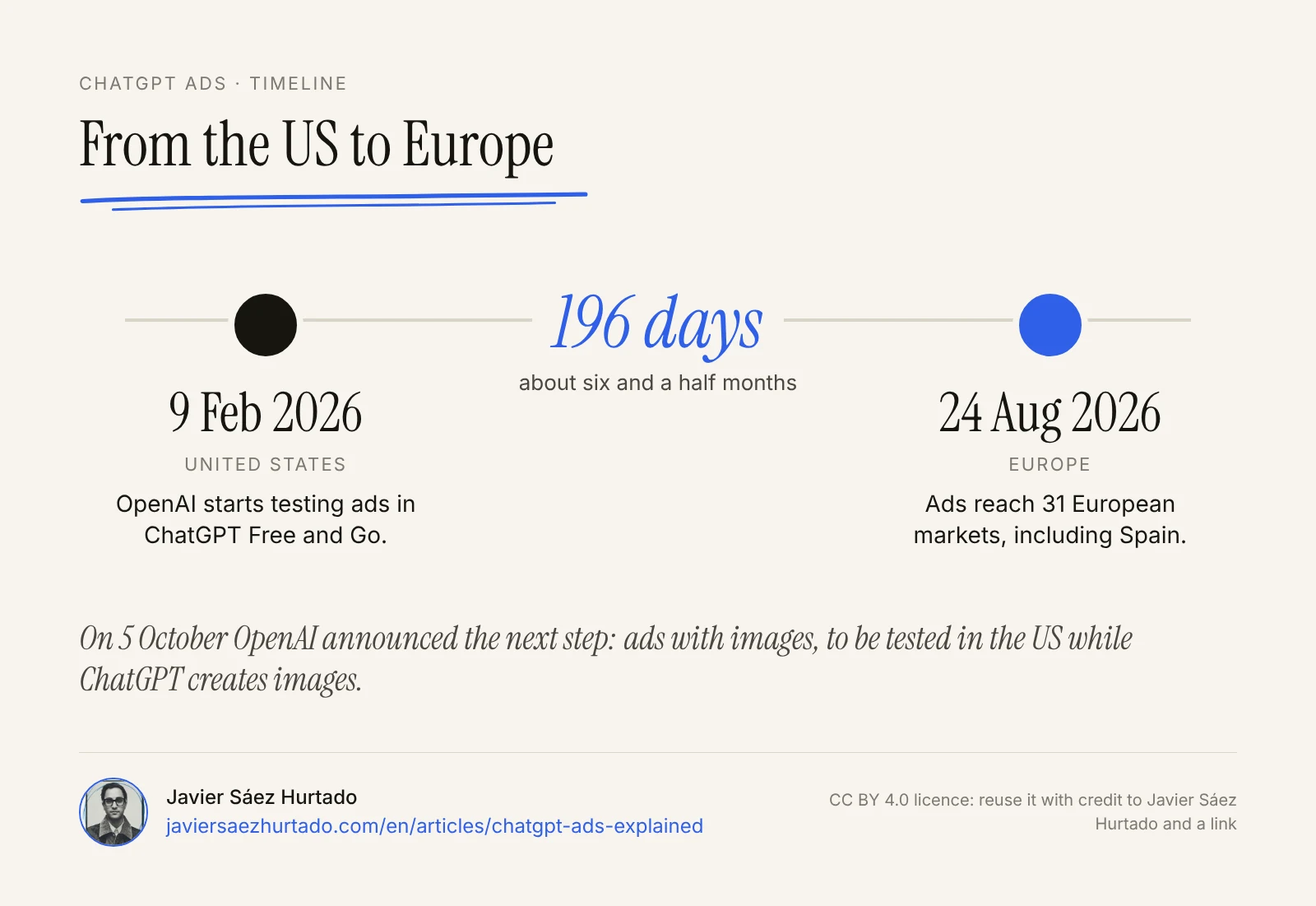
The rollout has been quick and in stages:
- 16 January 2026. OpenAI publishes its principles for ads: independent answers, private conversations and user control.
- 9 February. Tests begin in the US on the Free and Go plans.
- March to August. Ads reach Canada, Australia and New Zealand, then the UK, Mexico, Brazil, Japan and South Korea. In May the Ads Manager opens in the US so businesses can buy ads on their own.
- 18 August. OpenAI announces 31 European markets, which go live the following week, on 24 August according to Digiday.
- 31 August. The Ads Manager opens in those 31 markets.
- 5 October. OpenAI announces ads with images.
Who sees ads in ChatGPT? Plans and countries
Adults who are signed in on the Free and Go plans see them, in countries where OpenAI has turned ads on. As of 6 October 2026 that is more than 40 countries, according to OpenAI. This table sums up who sees them:
ChatGPT ads by plan
Based on the OpenAI Help Center, checked on 6 October 2026
| Plan | Sees ads? | Note |
|---|---|---|
| Free | Yes | Can choose “Ads-Free”, with fewer messages and features |
| Go | Yes | Entry paid plan, with ads |
| Plus | No | No ads |
| Pro | No | No ads |
| Business, Enterprise and Edu | No | No ads |
| Under 18 | No | On any plan |
For a company whose team uses ChatGPT, the result is simple. On a business plan, staff see no ads. If people use their own free accounts, they do.
What data does ChatGPT use to pick an ad?
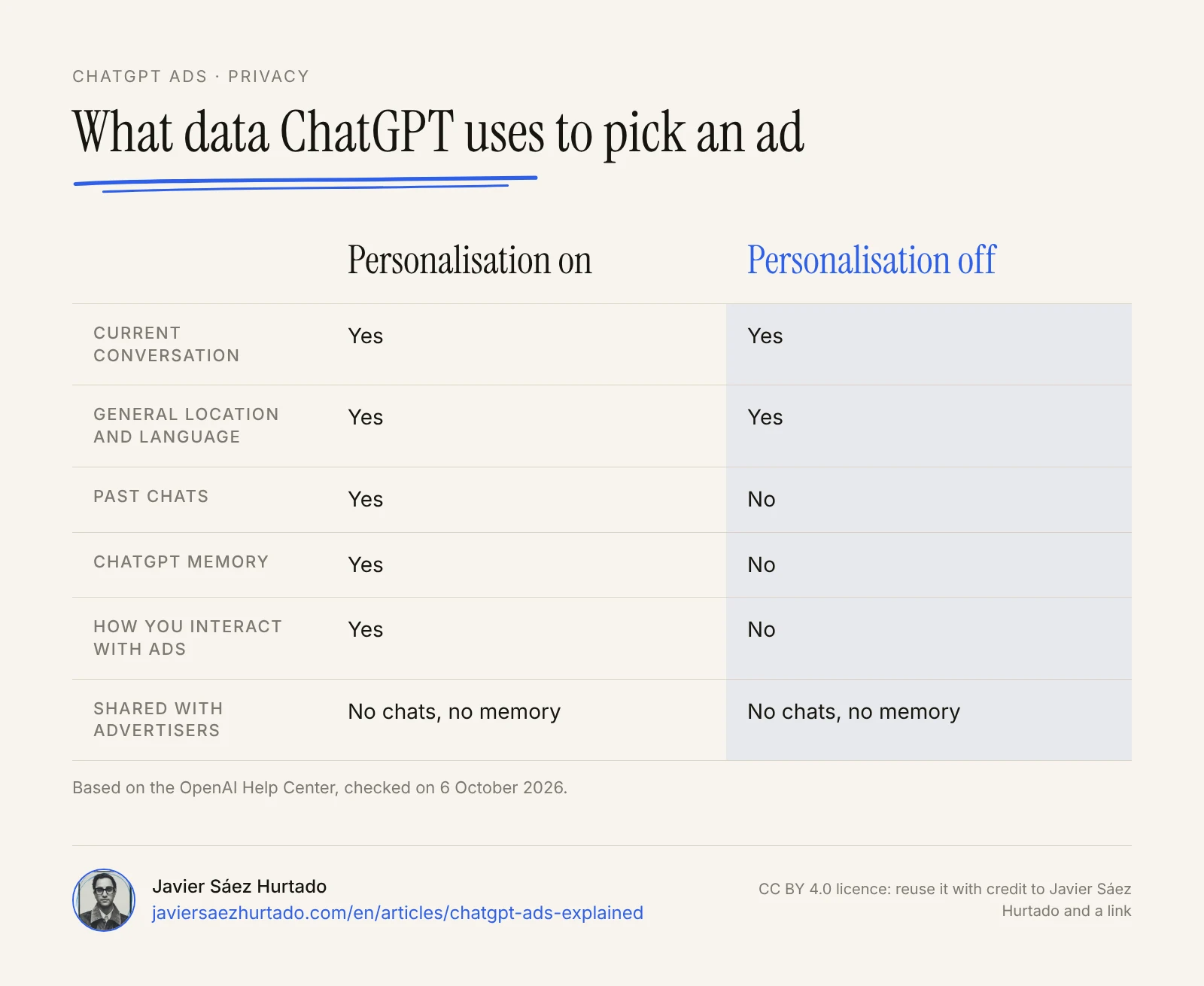
It always uses three things: the current conversation, your general location and your language. If ad personalisation is on, it also uses your past chats, your ChatGPT memory and how you have interacted with other ads. If you turn it off, the ad depends only on the conversation in front of you.
OpenAI says it never shares your chat history, memories, email or precise location with advertisers. Advertisers get aggregated performance data, such as how many people saw or clicked an ad. OpenAI also says it does not sell user data.
These are company commitments, and it is worth reading them that way. There is no published independent audit that checks them yet. In Europe the rules are stricter: Digiday reported that the EU launch was delayed by the GDPR, which requires explicit consent for personalised ads unless a company can show a legitimate interest.
How do you stop or limit ChatGPT ads?
There are four ways, from the strongest to the lightest:
- Move to a plan without ads. Plus, Pro and business plans have no ads.
- Choose “Ads-Free” on the free plan. OpenAI offers an ad-free option in exchange for fewer daily messages and fewer features.
- Use temporary chats. They show no ads, but they also do not keep the conversation in your history.
- Turn off personalisation. In Settings, Ad Controls, you can turn it off and clear the data used for ads. OpenAI says that data takes up to 30 days to leave its servers.
The fourth option does not remove ads, but it limits what is used to choose them. It is the one I would switch on by default in any free account.
Are ChatGPT ads available in Europe?
Yes, in 31 European markets. OpenAI announced them on 18 August 2026, naming Germany, France, Spain, Italy, Sweden, Norway, Denmark, the Netherlands and Austria among them. Ads started showing on 24 August. At first they could only be bought through OpenAI’s sales team and the large agency groups. Since 31 August any business in those markets can buy them in the Ads Manager.
Not every European country is named. OpenAI does not mention Andorra, for example, in its posts about Europe, so I cannot confirm whether users there see ads or whether local businesses can buy them. If your country is not on the list, check in your own account or at ads.openai.com.
The visual ads, for now, are only being tested in the US.
What it means for businesses
For a business there are two sides, depending on whether you are a user or an advertiser.
- If your team uses ChatGPT for work. A business plan is the sensible choice: no ads, and the data terms are different. If people use free accounts, they will see ads picked from work conversations. OpenAI not sharing those chats with advertisers does not change the basic point: a personal account is not the place for client information.
- If you want to advertise. ChatGPT is a new channel where the ad appears while someone is trying to solve a specific question. Digiday cites that about 20% of queries show direct buying intent. It is a young channel that takes time to learn, so start with a small budget and measure with the pixel before you scale.
- If you care about brand safety. OpenAI offers negative phrases to some advertisers and works with DoubleVerify and Integral Ad Science. Even so, check where your brand appears: a chat assistant is a different setting from a website or a social feed.
If you want to know how the product is changing under the hood, I covered it in inside OpenAI agents: skills, plugins and tools, and the model behind the answers is in GPT-6 Astra explained.
Videos worth watching
OpenAI gave a full episode of its podcast to why it chose to add ads and how it wants to do it without losing users’ trust:
If you want to see how a campaign is set up from Europe, this independent tutorial walks through the Ads Manager step by step:
My view: ads are fine, but the line has to stay clear
I understand the decision. Keeping ChatGPT free for hundreds of millions of people is expensive, and ads are the known way to pay for that. The rules OpenAI has set are reasonable: labelled ads, kept apart from the answer, away from health and politics, never shown to minors, and with controls for the user.
What I would watch is the future, not the present. Today the ad sits below the answer and the person decides whether to click. As assistants do more for us, such as searching, comparing or buying, the line between recommending and advertising gets thinner. So I keep the same line I set out in the essay on what you would let an agent do without looking (in Spanish): buying decisions and anything that cannot be undone go through a person, and I do not hand an AI my communication with other people or high-value accounts.
For companies my advice is practical. Keep work with client data on business plans. If a free account is used for anything, turn ad personalisation off.
Transparency: Convexify, the firm I founded, is part of the OpenAI Select Partner programme. This article is based on OpenAI’s public documentation and the linked sources.
Key takeaways
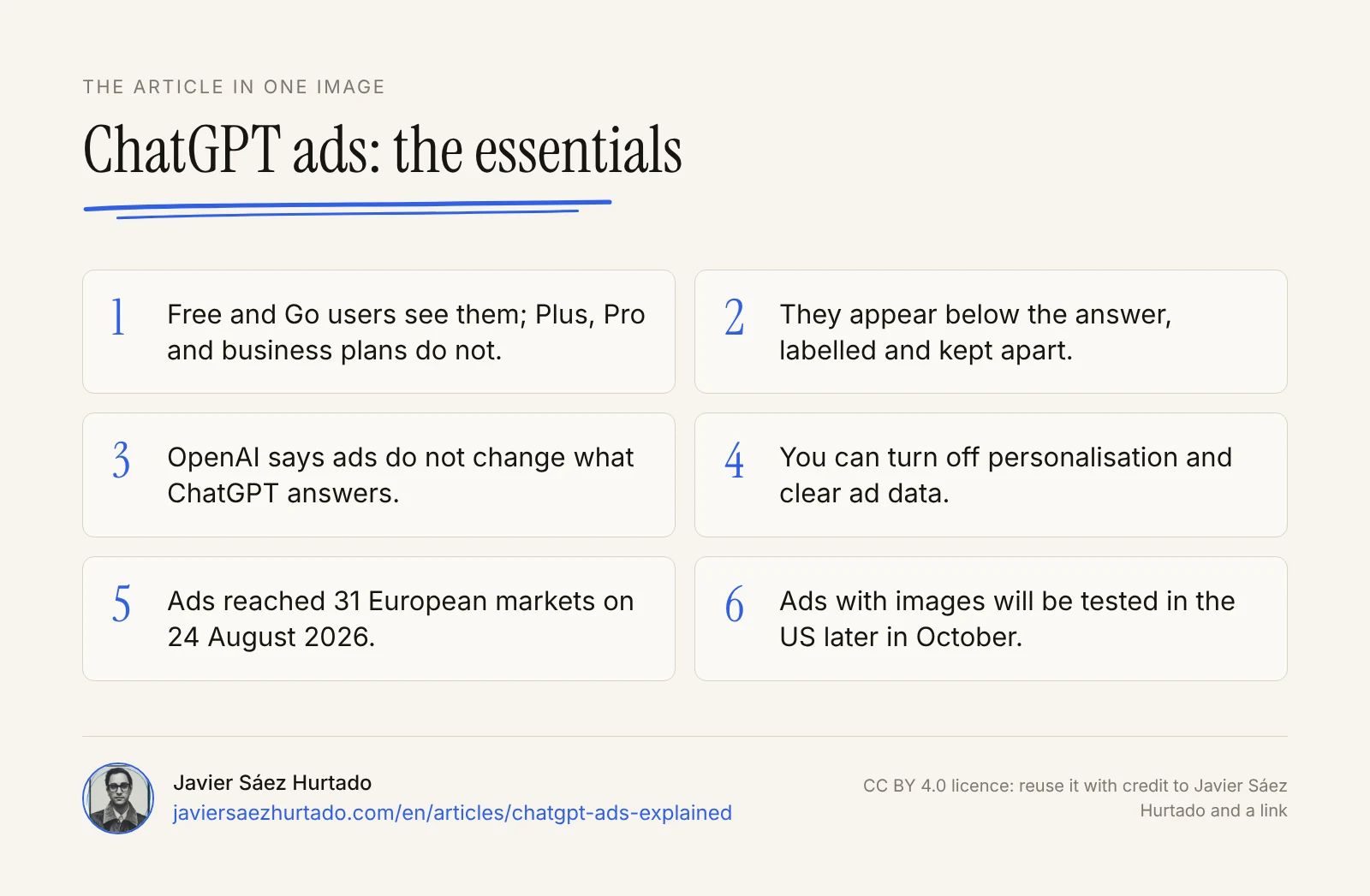
- Free and Go users see ChatGPT ads; Plus, Pro and business plans do not.
- Ads appear below the answer, labelled and kept apart, and OpenAI says they do not change what ChatGPT answers.
- They do not appear next to health, mental health or politics, to minors or in temporary chats.
- In Settings, Ad Controls, you can turn off personalisation and clear ad data.
- Ads reached 31 European markets on 24 August 2026; ads with images will be tested in the US first.
The article in one image
Frequently asked questions
Does ChatGPT have ads?
Yes, on the Free and Go plans. OpenAI started testing them in the US on 9 February 2026 and they now run in more than 40 countries. Plus, Pro, Business, Enterprise and Edu plans do not show ads.
Why am I getting ads on ChatGPT?
Because you use a Free or Go plan in a country where ads are live. ChatGPT picks the ad from your current conversation, your general location and your language. If ad personalisation is on, it also uses your past chats, your memory and how you have interacted with ads.
How do I stop ChatGPT ads?
You have three options: move to a paid plan without ads (Plus, Pro or a business plan), choose the free “Ads-Free” option, which comes with fewer messages and features, or use temporary chats, which show no ads. To limit the data used, go to Settings, Ad Controls, and turn off personalisation.
Does ChatGPT Plus have ads?
No. According to the OpenAI Help Center, Plus, Pro, Business, Enterprise and Edu do not show ads. Only adult accounts on the Free and Go plans see them.
Can advertisers see my ChatGPT conversations?
According to OpenAI, no. Advertisers do not get your chat history, memories, email or precise location, and OpenAI says it does not sell user data. Advertisers get aggregated data on how their ads perform.
How much do ChatGPT ads cost?
There is no fixed price. Advertisers bid per click or per thousand impressions in the Ads Manager at ads.openai.com. Digiday reported that the early US self-serve tool had a 50,000 dollar minimum that was later dropped.
Sources
- OpenAI, Our approach to advertising and expanding access (16 Jan 2026)
- OpenAI, Testing ads in ChatGPT (9 Feb 2026)
- OpenAI, ChatGPT Ads expands across Europe (18 and 31 Aug 2026)
- OpenAI, Expanding access to AI with ChatGPT Ads (31 Aug 2026)
- OpenAI, New ChatGPT ads format and measurement (5 Oct 2026)
- OpenAI Help Center, Ads in ChatGPT (checked 6 Oct 2026)
- OpenAI, Ad policies
- Engadget, OpenAI is testing more ads in ChatGPT (5 Oct 2026)
- Digiday, OpenAI takes ChatGPT ads into Europe (Aug 2026)