ChatGPT GIFs: what Images 2.6 brings and what to check before you use it
Since 4 November 2026, ChatGPT can turn a prompt or a photo into an animated GIF with Images 2.6, OpenAI’s new image model, which also reaches Codex and the API. Here is how it works, what else changes, what it costs for developers and what a company in Europe should check before it posts an AI-made GIF.
What is ChatGPT Images 2.6?
It is the new version of the model that creates and edits images inside ChatGPT. OpenAI released it on 4 November 2026, two months after Images 2.5, and the part everyone is talking about is that it can now make animated GIFs. It also comes to Codex and, for developers, to the API.
- ChatGPT Images
- The ChatGPT feature that creates and edits images from what you type or from a photo you upload. Images 2.6 is the model behind it from 4 November.
- Animated GIF
- A short looping image made of several frames, the kind people use as reactions in chats and on social media.
- Flare and Sunburst
- The two Images 2.6 models in the API: Flare for fast iteration and Sunburst for more detailed work.
- C2PA and SynthID
- Two ways to label an image as AI-made: signed metadata attached to the file (C2PA) and an invisible watermark in the pixels (SynthID, from Google DeepMind).
One number explains why this matters. According to The Next Web and Unite.AI, OpenAI says ChatGPT and its API now create more than 4 billion images a week, up from 3 billion in September. Images have become one of the main things people do in ChatGPT, and GIFs are the next step. The same image model is also where OpenAI said in October it would test ads with images in the US.
How do you make a GIF with ChatGPT?
You ask in the chat, as you would for a normal image. You can start from text (“make a GIF of a cat dancing”, the example Decrypt used) or upload a photo and ask ChatGPT to animate it. OpenAI’s post on X says you can then adjust the speed, edit single frames and share the GIF on repeat.
The steps, as OpenAI and the outlets that tried it describe them:
- Open a chat in ChatGPT (web, desktop or mobile) or in Codex.
- Describe the animation and the movement you want, or upload the starting image. The clearer the movement (what moves, which way, whether it returns to the start), the better the loop.
- Check the result. You can change the playback speed and look at each frame.
- Fix a single frame that looks wrong without redoing the whole GIF.
- Download or share it.
One practical note: the rollout is not instant. Decrypt tested it on 4 November and its account did not have the feature yet; ChatGPT made the frames but not the animation. OpenAI has not given a date for every account. If you do not see it, nothing is wrong on your side. Give it a few days.
What else changes in Images 2.6?
Beyond GIFs, four changes matter for everyday use. OpenAI lists them in its announcement and in the model’s system card:
- Saved reference images. You can keep photos of yourself, your pet or a character ready to reuse in new images, with no need to upload them again.
- Photo markup. You can draw over an image to show what to change, instead of describing it only in words. The system card says the model responds better to sketches and annotations.
- SVG in the API. Developers can ask for SVG, a vector format that scales without losing quality and works well for icons and logos.
- More control over time. In ChatGPT, the model picker lets you choose how much the model plans before drawing. In the API, the setting is called complexity.
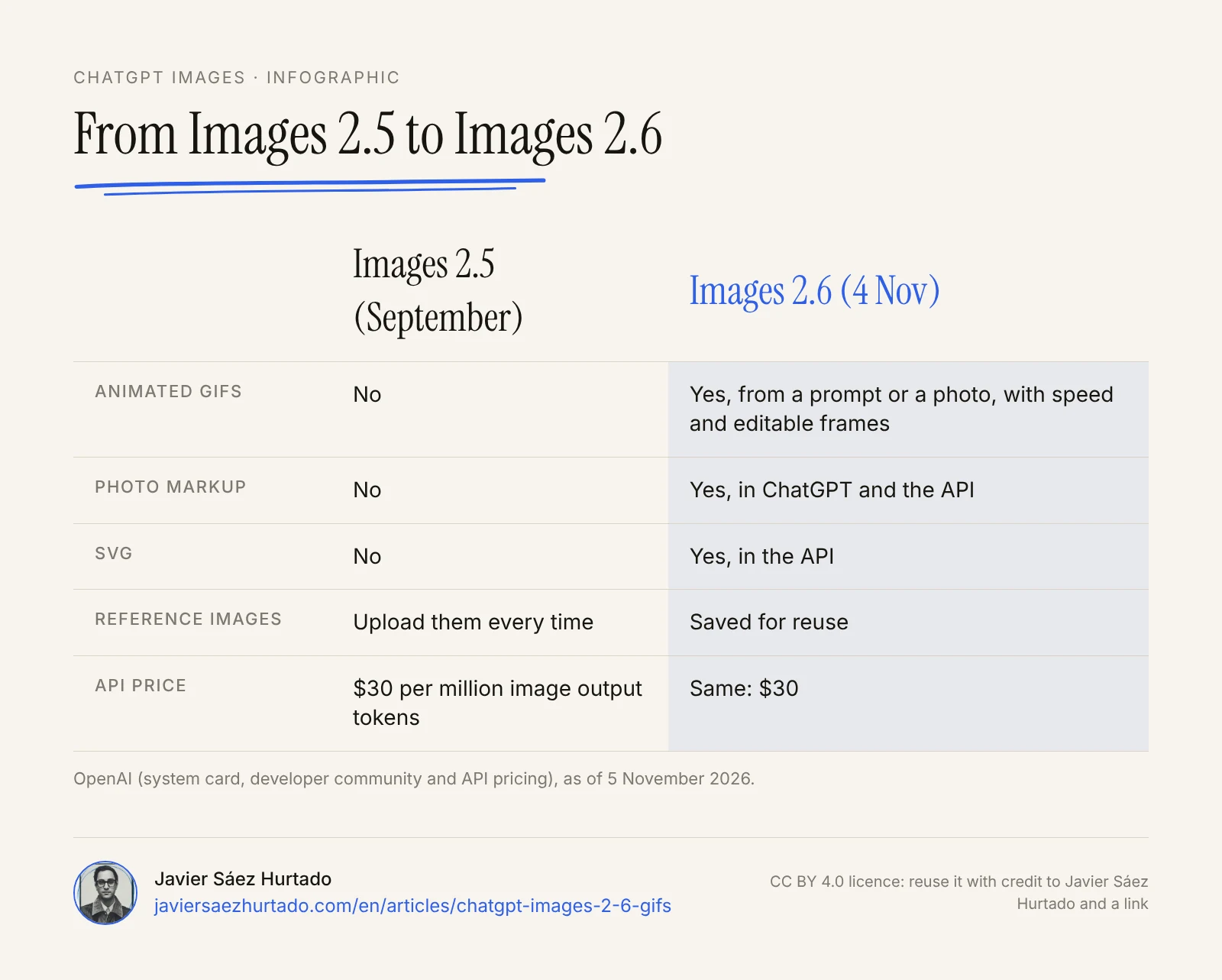
Read the speed claims with care. OpenAI’s developer community post talks about “50% faster” generation in the API and says Flare can make an image in as little as six seconds, but it does not say which version it compares against. OpenAI used the same 50% figure for Images 2.5 against 2.0. I would wait for independent tests before quoting a number.
Is it available in Europe, and on which plans?
Yes, as far as we know today. The Next Web and Unite.AI say Images 2.6 is rolling out to all ChatGPT and Codex users on web, desktop and mobile, and neither the announcement nor the system card mentions country exclusions. As of 5 November 2026 there is no published restriction for the EU, Spain or Andorra.
What is missing is the detail per plan. OpenAI has not said how many GIFs you can make on Free, Go, Plus or Pro, or whether ChatGPT caps GIF length or frame count. If you plan to use it for work, expect lower limits on the free plan and check again when OpenAI publishes them.
How much does Images 2.6 cost in the API?
The same as before. The two new models, gpt-image-2.6-flare and gpt-image-2.6-sunburst, have the same token prices as gpt-image-2.5 and gpt-image-2, according to OpenAI’s pricing page checked on 5 November 2026.
Images 2.6 in the API: Flare and Sunburst
Prices per million tokens, from OpenAI’s documentation checked on 5 November 2026
| gpt-image-2.6-flare | gpt-image-2.6-sunburst | |
|---|---|---|
| Best for | Fast, interactive iteration | Detailed compositions and consistent edits |
| Text input | $5 ($1.25 cached) | $5 ($1.25 cached) |
| Image input | $8 ($2 cached) | $8 ($2 cached) |
| Image output | $30 | $30 |
| New features | Animated GIFs, SVG, markup-guided edits and a complexity setting | |
Three points from OpenAI’s guide to know before you build with it:
- Complexity has no extra fee. It has three levels (low, medium and high) and defaults to high. OpenAI warns that more complexity can add delay and unwanted changes.
- You may need to verify your organisation in the developer console before using the image models.
- The final price depends on size and quality. You pay per token, not per image, so a GIF with many frames will cost more than a still image. OpenAI has a calculator in its guide but no price per GIF.
Are AI-made GIFs safe?
OpenAI itself says motion adds risk. Its system card explains that a GIF can carry harm that no single frame shows: sexualised movement, or a message that only makes sense across the sequence. So the GIF rules block some categories more broadly than for still images.
The system has two layers: one model checks the request before anything is made, and another checks the final image before you see it. For ChatGPT, OpenAI has added real-time classification of child sexual abuse material, in addition to its existing moderation. In automated tests with 3,077 prompts designed to break the rules, the new models perform about the same as Images 2.5: Sunburst let unsafe content through in 1.72% of cases and Flare in 2.14%, against 1.92% and 1.49% for the older version. OpenAI says the overall differences are not statistically significant and that the tests do not reflect real use.
The most honest point in the card is this: violations in motion are still hard to detect, and the safeguards may not catch all of them. Keep that in mind if you assume that what ChatGPT makes has already been checked.
Can you tell if a GIF was made with ChatGPT?
OpenAI says it keeps C2PA metadata in its images and is adding Google DeepMind’s SynthID watermark across ChatGPT, Codex and the API. It also has a verification tool on its website.
It works much like Claude’s text watermark, with the same limits. Metadata is easy to lose when you take a screenshot, crop the file or forward it in a messaging app, and an invisible mark is a clue, not proof. A GIF with no mark is not proof that it is real.
What does it mean for companies in Europe?
Animated content for social media, slides or customer support no longer needs a designer for every piece. But who answers for what you post does not change. For a European company, I would check three things.
1. The EU AI Act already applies. Since 2 August 2026, Article 50 requires providers of generative AI to mark their output in a machine-readable way (older systems have until 2 December). OpenAI covers that with C2PA and SynthID. But the same article also applies to users: if you publish an image or video that looks real and shows people, places or events that are not, you must say it is artificial. A GIF of an executive saying something they never said falls under that rule.
2. Real people’s faces. Saving reference photos of someone to animate them is handy, but it needs that person’s consent and care with personal data. In a company, I would not upload photos of staff or customers without written consent.
3. Brand use. If your team uses ChatGPT for brand material, know which plan it is on and which terms apply to commercial use.
For daily work, this is what I would put in writing:
- Who can make AI GIFs for official channels, and with which account (a company account, not personal ones).
- A human check before posting, frame by frame if the GIF carries the company’s brand.
- No real people without consent, and never to make it look as if they said or did something they did not.
- A “made with AI” label on anything that could pass for a real image.
- Do not strip metadata on purpose when you export or edit.
My view: a GIF is also a public decision
I think it is a good tool. A well-made GIF can explain a process in three seconds, and being able to fix one frame without redoing everything makes it useful for work, not just for fun. OpenAI publishing a system card with numbers, and saying where it falls short, also helps people use it with care.
But easy tools make us forget what matters. A GIF spreads faster than any text and gets read less. If it comes from your company account, your company signs it, even if a model drew it. And with real faces, the step from a joke to impersonation is very short.
My rule is the same as with text and agents: the AI prepares, a person decides. I use these tools for sketches, ideas and internal pieces, and I check anything before it goes out under my name. I would not hand over the decision to post an image of another person, or a message to a client, to something that takes six seconds to make.
Transparency: Convexify, the firm I founded, is part of the OpenAI Select Partner programme. This article is based on OpenAI’s public documentation and the linked sources.
Key takeaways
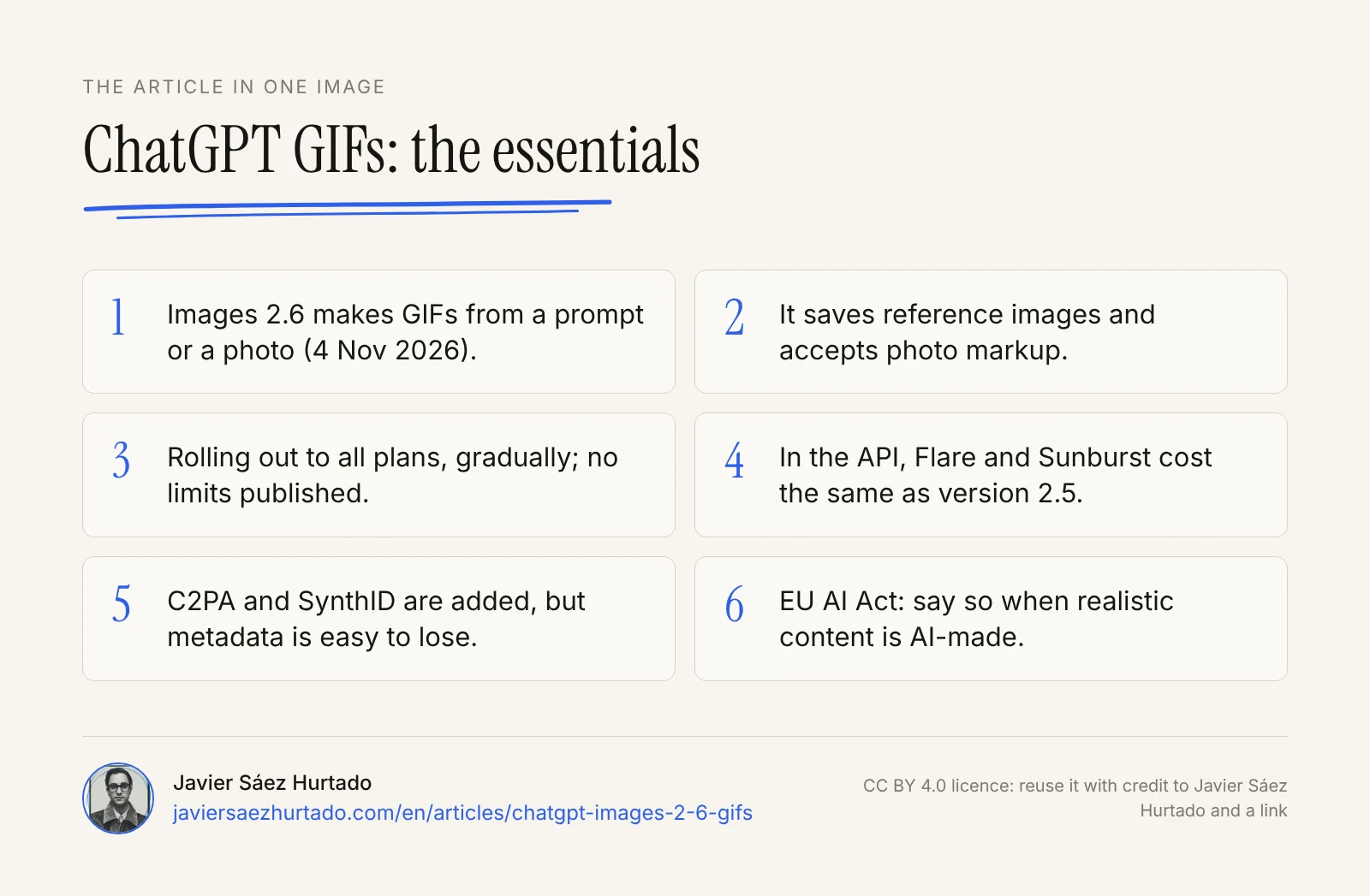
- ChatGPT Images 2.6 arrived on 4 November 2026 and makes animated GIFs from a prompt or a photo, with speed control and frame editing.
- It also saves reference images, accepts photo markup and, in the API, exports SVG.
- Media say it is for all plans, but the rollout is gradual; OpenAI has not published GIF limits per plan or country exclusions.
- In the API, Flare and Sunburst cost the same as version 2.5: 30 dollars per million image output tokens.
- Images carry C2PA and SynthID, and the EU AI Act requires anyone who posts realistic AI-made content to say so.
The article in one image
Frequently asked questions
How do I make a GIF with ChatGPT?
With Images 2.6, you just ask in the chat. Describe the animation (for example, “make a GIF of a cat dancing”) or upload a photo and ask ChatGPT to animate it. You can then change the speed, edit single frames and share the result. The rollout is gradual, so your account may take a few days to get it.
Is making GIFs in ChatGPT free?
The Next Web and Unite.AI report that Images 2.6 is rolling out to all ChatGPT and Codex users, free plan included. OpenAI has not said how many GIFs each plan can make; free plans usually have lower limits than Plus or Pro.
What is ChatGPT Images 2.6?
It is the version of ChatGPT’s image model that OpenAI released on 4 November 2026, after Images 2.5 in September. It adds animated GIFs, saved reference images, photo markup and, in the API, SVG output and a complexity setting.
Is ChatGPT Images 2.6 available in Europe?
OpenAI has not announced any country exclusions, and media report a rollout to all ChatGPT users on web, desktop and mobile. As of 5 November 2026 there is no published restriction for the EU, Spain or Andorra.
How much does Images 2.6 cost in the API?
Both models, gpt-image-2.6-flare and gpt-image-2.6-sunburst, cost the same: 5 dollars per million text input tokens, 8 dollars per million image input tokens and 30 dollars per million image output tokens, according to OpenAI’s pricing page checked on 5 November 2026.
Can you tell if a GIF was made with ChatGPT?
OpenAI says its images carry C2PA metadata and that it is adding Google DeepMind’s SynthID watermark across ChatGPT, Codex and the API. Metadata is easy to lose when a file is cropped or forwarded, so a missing mark does not prove an image is real.
Sources
- OpenAI, Introducing Images 2.6 (4 Nov 2026)
- OpenAI, ChatGPT Images 2.6 System Card (4 Nov 2026)
- OpenAI Developer Community, Images, upgraded: introducing ChatGPT Images 2.6 (4 Nov 2026)
- OpenAI on X, GIFs with ChatGPT Images 2.6 (4 Nov 2026)
- OpenAI API, gpt-image-2.6-flare model page (checked 5 Nov 2026)
- OpenAI API, gpt-image-2.6-sunburst model page (checked 5 Nov 2026)
- OpenAI API, pricing (checked 5 Nov 2026)
- OpenAI API, image generation guide (checked 5 Nov 2026)
- The Next Web, ChatGPT can now make animated GIFs with OpenAI’s Images 2.6 (4 Nov 2026)
- Decrypt, ChatGPT is getting a GIF maker powered by OpenAI’s Images 2.6 model (4 Nov 2026)
- Unite.AI, ChatGPT adds animated GIF creation and editing with Images 2.6 (4 Nov 2026)
- Regulation (EU) 2024/1689 on artificial intelligence (Article 50)