Claude’s text watermark: what changes on 3 November and what it means if you write with AI
From 3 November 2026, Anthropic extends its invisible text watermark to four older Claude models, including Opus 4.7 and Sonnet 4.6. The mark carries no data about you, and today only approved organisations can check for it. It still changes how a European business should use Claude. Here is what it is, what it does not prove and what I would check.
What is Claude’s watermark?
It is an invisible signal that Claude leaves in the text it writes. You cannot see it. It adds no hidden characters and does not change what the text says. It lives in which words the model picks when several are equally good. A detector with Anthropic’s secret key can read that pattern and estimate whether Claude was involved.
- Text watermark
- A statistical pattern the model adds as it picks words. A reader cannot notice it. Software with the right key can measure it in a long enough text.
- SynthID-Text
- The method Google DeepMind published in Nature in 2024. Anthropic’s version is based on it.
- Content Credentials (C2PA)
- Signed metadata attached to a file, such as an image, that says who made it and with which tool. Claude uses them for files, not for text.
Anthropic announced the watermark in August 2026 and explained it on its blog on 14 August. Since then, every model it launches in the EU ships with it. It applies wherever Claude runs: the apps, the API, Claude Code, Claude Cowork, Claude Tag and the Amazon, Google and Microsoft clouds. Anthropic applies it worldwide because it does not yet have a reliable way to limit it to one region.
It is the same company that makes Claude Duet, and the watermark covers the text its agents write too. If you use Claude to write, it is now more likely that what it writes carries this signal.
What changes on 3 November?
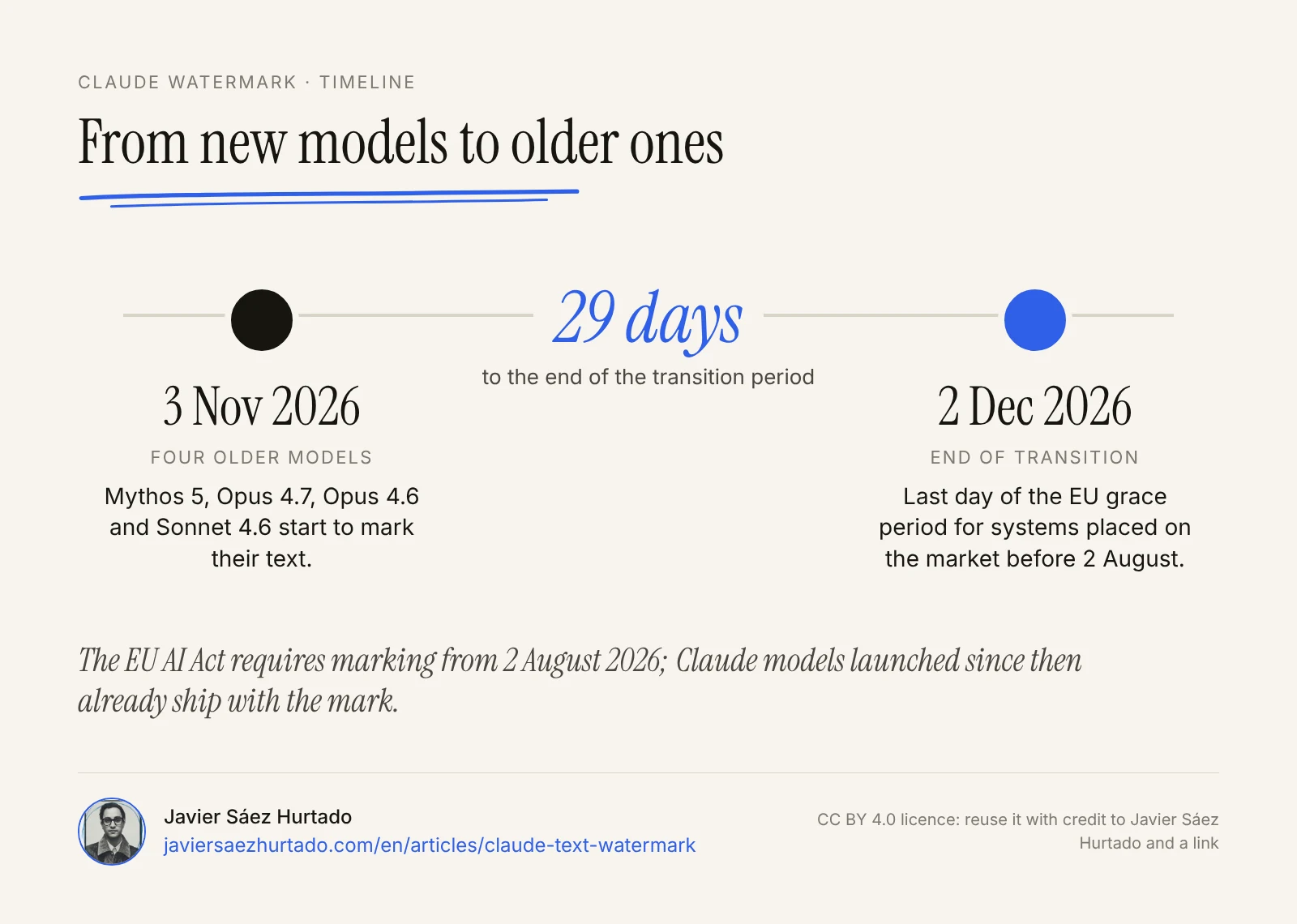
The watermark reaches models that were already in use before 2 August. According to the notice Anthropic sent to API customers, reported by The Decoder on 31 October and by Techweez on 2 November, from 3 November it also covers Claude Mythos 5, Claude Opus 4.7, Claude Opus 4.6 and Claude Sonnet 4.6. On Amazon Bedrock the change may take a few extra days.
Which Claude models carry the watermark
Based on Anthropic’s help page and its notice to API customers, as of 3 November 2026
| Models | Since | Detail |
|---|---|---|
| Launched since 2 August 2026 (Opus 5 and 5.5, Sonnet 5 and 5.5, Haiku 5.5, Mythos 5.1, Fable 5 and 5.1, Opus 4.8) | From launch | Text marked in Anthropic’s products and partner clouds; C2PA credentials on files |
| Mythos 5 and Opus 4.7 | 3 November 2026 | Bedrock may lag a few days |
| Opus 4.6 and Sonnet 4.6 | 3 November 2026 | Only if API sampling settings stay at their defaults |
| Other older models (Opus 4.5, Sonnet 4.5, Haiku 4.5) | No published date | Listed in the help table with partial support; check it |
Anthropic has not put the 3 November date on its blog. It comes from the customer email both outlets quote. What the blog does say is that EU law gives a transition period to models launched before 2 August, and that the watermark would reach them “over the coming months”. The European Commission sets the end of that period: 2 December 2026.
How does the watermark work?
It works at the moment the model picks each word. A language model does not write all at once. It works out which words could come next and picks one. Often several options are almost equally good. The watermark nudges that choice in a pseudo-random way, following a secret key, without changing the meaning.
One word says nothing. What counts is the pattern across hundreds of words. With the key, a detector checks whether the choices look more like Claude’s marked choices than like any other writer’s. That is why Anthropic says there is no extra cost, no added tokens and no change in quality.
The method has limits that Anthropic itself admits:
- Short text. A few sentences do not carry enough signal to conclude anything.
- Facts and figures. If the answer is a date, a number or a precise fact, there is little room to vary the words without changing the content. Google DeepMind said the same about SynthID in 2024.
- Code. Code has to be exact, so it leaves little room for the mark.
- Proofreading. If you ask Claude to fix typos in your own draft, most of the words are still yours and the signal is weak.
Can you tell if a text was written by Claude?
Not as a regular user, for now. Anthropic runs a detection API in private preview. Regulators, law enforcement, media, fact-checkers, researchers, schools, EU civil society groups and companies with their own compliance duties can apply. Anthropic says it will widen access over time, with no date.
There is a public tool, claude.com/check-content, but it does something else. It checks whether a file (an image, audio or video) carries Claude’s C2PA credentials. The page itself says it does not check text.
Even with the detector, it helps to know what it answers. In Anthropic’s words, the key can only tell you how likely it is that the text was at least partly written by Claude. It cannot tell “Claude wrote this” from “Claude heavily edited this”. The help page stresses that a detection is a signal, not proof. And finding no mark does not prove a person wrote it either: the text may be short, from another model or heavily rewritten.
Does the watermark carry your data?
No. Anthropic says nothing in the mark or its key lets anyone recover who the user is, which organisation they belong to or what they discussed with Claude. The mark says “Claude was involved here”, not “this person did it”.
That matters for privacy, and it also stops people reading too much into a result. If a company receives a report with the mark, it knows someone used Claude at some point. It does not know who, how much, or whether that was allowed.
Can you turn off Claude’s watermark?
Anthropic offers no setting to remove it in the apps or in Claude Code, and The Decoder says customers cannot turn it off. There is one documented exception in the notice to API customers. On Opus 4.6 and Sonnet 4.6, the mark only applies when the sampling settings stay at their defaults. Anthropic advises anyone who relies on the mark for their own compliance to keep them there.
Any statistical mark gets weaker when a text is heavily rewritten, and that is true for every company. OpenAI says so in the technical report on its own system: swapping 25% of the words for synonyms pushed detection below 20% in its tests. A watermark is a clue for people who look in good faith. It is not a lock.
What do OpenAI and Google do?
Both do something similar, with differences that matter in Europe.
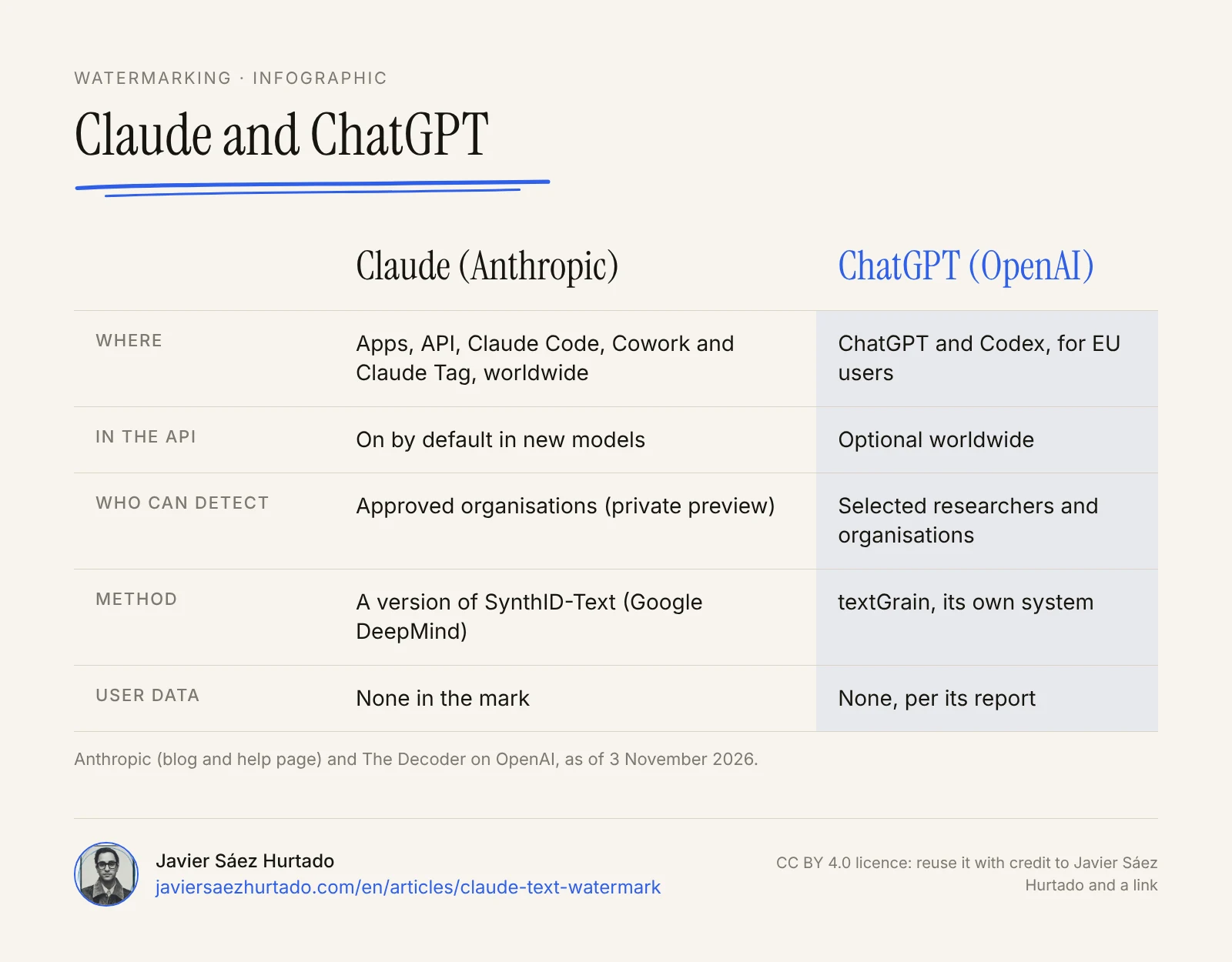
- OpenAI. According to The Decoder, its system, textGrain, is on in ChatGPT and Codex for EU users, while in the API it is optional worldwide. As with Anthropic, the detector is only open to selected researchers and organisations. Its technical report gives numbers: it finds about 95% of marks in 400-token passages and about 80% in 200-token passages, at a 1% false-positive target.
- Google. Google DeepMind built SynthID for text, added it to Gemini and released the code as open source in October 2024. It is the basis of Anthropic’s method.
The practical difference with OpenAI is the API. With Claude, the mark is on by default in new models. With OpenAI, according to The Decoder, API users decide whether to turn it on.
What does it mean for businesses in Europe?
The watermark is the provider’s job, not yours. Article 50 of the EU AI Act requires anyone who offers generative AI to mark its output so a machine can detect it, from 2 August 2026. Systems already on the market have until 2 December 2026. To help providers comply, the Commission published a code of practice on 10 June. Anthropic, OpenAI, Google, Microsoft and Mistral are among its signatories.
The same article has a second part that can apply to companies that use AI, not only to those that build it. If you publish AI-generated or AI-edited text to inform the public on matters of public interest, you must say so, unless a person has reviewed it and someone holds editorial responsibility. Deepfakes have a similar rule. That is the second section of the code, for professional users.
If your company uses Claude, this is what I would check:
- Which texts come out of Claude. Proposals, reports, client emails, web content. Assume they may carry the mark.
- Who reviews before publishing. If a text informs the public, a person should review it and sign it. The law asks for it, and I would do it anyway.
- Your API settings. If your product uses Opus 4.6 or Sonnet 4.6 and you want its output marked, keep sampling at the defaults.
- Your internal policy. A clear line on when AI can be used and when you have to say so. Better that than finding out through a detector.
- Do not use detectors to accuse people. Not in hiring, not with suppliers. A probabilistic signal is not enough to judge a person.
The watermark is not the only transparency tool this year. A few days ago I wrote about the shared robots.txt line that lets a site ask not to be used for AI training. Both point the same way: they give each side a clear way to know what AI does with their content.
My view: the mark does not decide who the author is
I think this is a reasonable step, and well explained. The mark holds no user data, Anthropic has published how it works, and the detector is not open to anyone who wants to flag texts. Those are good choices. It also helps that Google, OpenAI and Anthropic use similar methods and signed the same code. Anthropic is also the company now filing to go public, and clear rules like these are part of what it will be judged on.
But I think people will ask more of it than it gives. I expect teachers, companies or clients to use a detection as proof that someone “did not write” something. The mark does not say that. It says Claude was involved, with some probability, and nothing more. Judging a person on that would be as weak as judging them on any other detector’s score.
For anyone who writes with AI, the answer is not to look for ways to remove the mark. It is to be open about using it. I prepare part of my work with help from Claude and ChatGPT, and I say so. What I do not hand over is the final decision: what gets published, what goes to a client and what carries my name, I review myself. With that rule, the watermark changes nothing important. You already knew which part the machine did and which part you sign.
Transparency: Convexify, the firm I founded, is part of the OpenAI Select Partner programme, and OpenAI competes with Anthropic. This article is based on public documentation from Anthropic, the European Commission and Google DeepMind, on OpenAI’s technical report and on the linked sources.
Key takeaways
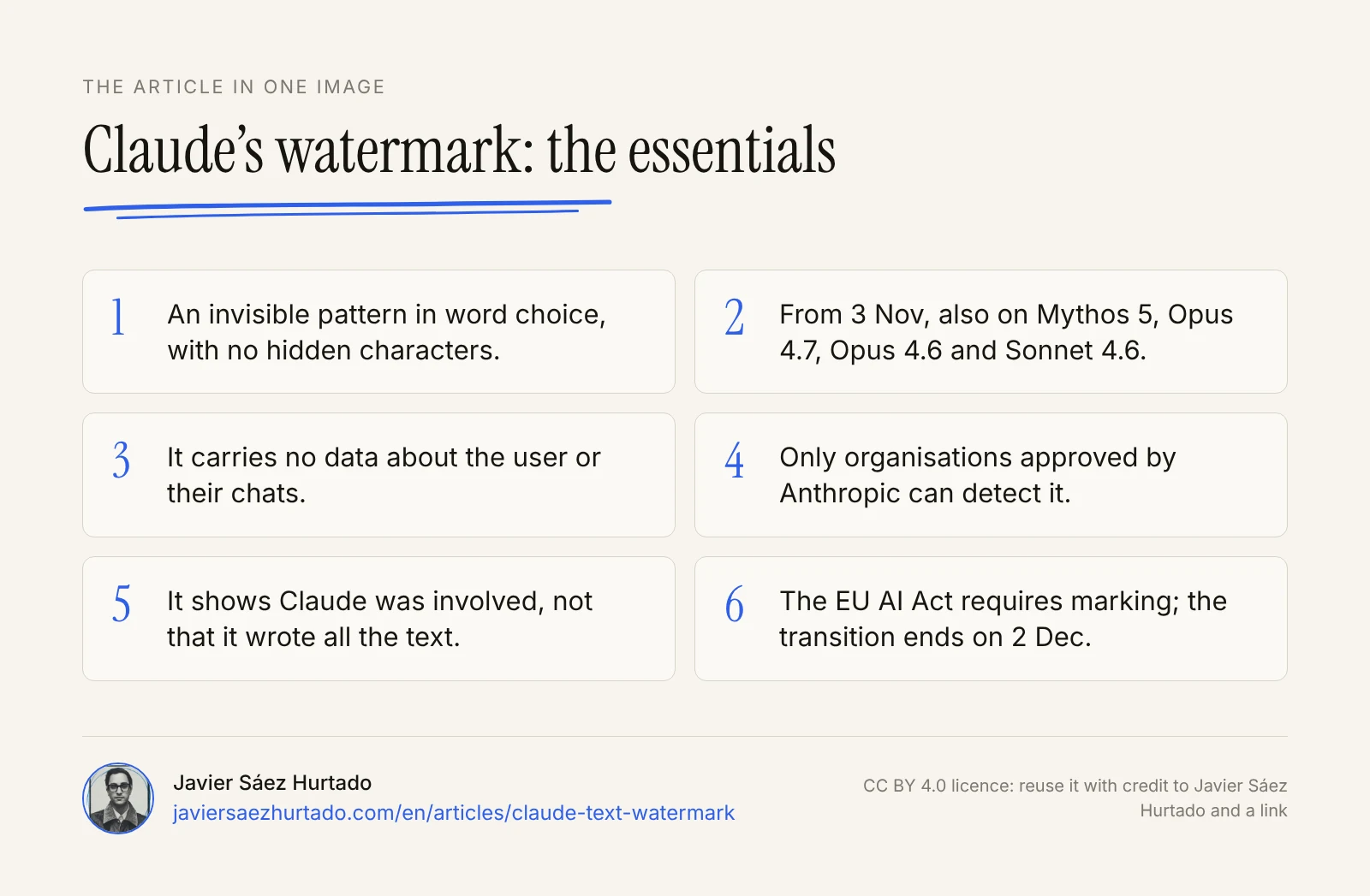
- Claude marks its text with an invisible pattern in word choice. From 3 November this also covers Mythos 5, Opus 4.7, Opus 4.6 and Sonnet 4.6.
- The mark carries no user or chat data, and today only organisations approved by Anthropic can check for it.
- A detection means Claude was involved, not that it wrote the whole text. Short text, facts and code carry little signal.
- On Opus 4.6 and Sonnet 4.6, the mark depends on keeping API sampling at the defaults.
- The EU AI Act requires marking from 2 August 2026, with a transition to 2 December. Anyone publishing AI-made text on matters of public interest must disclose it or review it with editorial responsibility.
The article in one image
Frequently asked questions
Does Claude watermark its text?
Yes. Claude models launched since 2 August 2026 produce text with an invisible watermark, and from 3 November so do Claude Mythos 5, Opus 4.7, Opus 4.6 and Sonnet 4.6. It applies in the Claude apps, the API, Claude Code, Claude Cowork and Claude Tag, worldwide.
Can you see Claude’s watermark in the text?
No. It adds no characters or hidden symbols. It is a statistical pattern in word choice that only software with Anthropic’s key can detect. Anthropic says it does not change meaning, quality or readability.
Can I check if a text was written by Claude?
Not as a regular user, for now. Anthropic’s text detector is in private preview for organisations that apply (regulators, media, fact-checkers, researchers, schools and companies with their own compliance duties). The page claude.com/check-content only checks files such as images, not text.
Does Claude’s watermark contain my personal data?
No. Anthropic says nothing in the watermark or its key lets anyone recover information about the user, their organisation or their chats with Claude. It shows that Claude was involved, not who used it.
Can you turn off Claude’s watermark?
Anthropic offers no setting to turn it off in its products. According to The Decoder, on Opus 4.6 and Sonnet 4.6 the mark only applies when the API sampling settings stay at their defaults, and Anthropic advises anyone who relies on it for compliance to keep them there.
Is AI watermarking required in the EU?
Article 50 of the EU AI Act requires providers of generative AI to mark their output in a machine-detectable way from 2 August 2026. Systems already on the market have until 2 December 2026. Anthropic, OpenAI and Google signed the European Commission’s code of practice to meet it.
Sources
- Anthropic, How Claude’s text watermarking works (14 Aug 2026, updated 1 Sep 2026)
- Claude Help Center, How Claude marks AI-generated content (accessed 3 Nov 2026)
- Claude, Check if files were made with Claude (accessed 3 Nov 2026)
- European Commission, Code of Practice on transparency of AI-generated content (updated 19 Oct 2026)
- European Commission, FAQ on the Code of Practice (10 Jun 2026)
- European Commission, Strong backing for the Code of Practice on transparency of AI-generated content (31 Jul 2026)
- Regulation (EU) 2024/1689, the AI Act (Article 50)
- Google DeepMind, Watermarking AI-generated text and video with SynthID (14 May 2024)
- The Decoder, Anthropic’s watermark rollout leaves a loophole on two older Claude models (31 Oct 2026)
- Techweez, Anthropic is bringing text watermarking to more Claude models (2 Nov 2026)
- TechCrunch, Anthropic says it will watermark text generated by its AI models (11 Aug 2026)
- Android Authority, Anthropic reveals how Claude secretly watermarks AI-written text (17 Aug 2026)
- The Decoder, OpenAI will watermark ChatGPT text in the EU but makes it optional for API users worldwide (5 Oct 2026)
- OpenAI, textGrain: entropy-calibrated watermarking for language model text (technical report)
- Sebastian Raschka, How Claude’s text watermarking works (22 Aug 2026)