Claude Duet: what Anthropic’s proactive AI agent is, how it works and where you can use it
Claude Duet is Anthropic’s new app in which Claude works as a proactive agent: it briefs you every morning, keeps an eye on your apps, does tasks on its own cloud computer and asks before it sends, pays, signs or deletes anything. It was announced on 21 October 2026 as a research preview, by waitlist and, for now, only for Pro and Max users in the US.
What is Claude Duet?
Claude Duet is an Anthropic app in which Claude works as a proactive AI agent. It does not wait for you to write: it tells you what needs your attention, does the tasks you hand it, keeps working when you put your phone down and checks with you before acting on your behalf. Anthropic announced it on 21 October 2026 as a research preview.
- Claude Duet
- The agent app. It is separate from the main Claude app and runs on iOS, on Android and at claude.ai.
- Claude Opus 5.5
- The model behind it. In the preview you cannot pick another one: Duet decides how much effort each task needs.
- Morning brief
- The short message Duet sends you every day with the most important items from your connected apps.
Anthropic says it built Duet for professionals and small business owners with more on their plates than they can track. It is Anthropic’s take on an idea that has come back again and again this autumn, the always-on agent with its own computer, which I covered with Grok Bot and dots and with Meta Muse. The US press framed it in exactly those terms, as Anthropic’s answer to Muse and dots.
What can Claude Duet do?
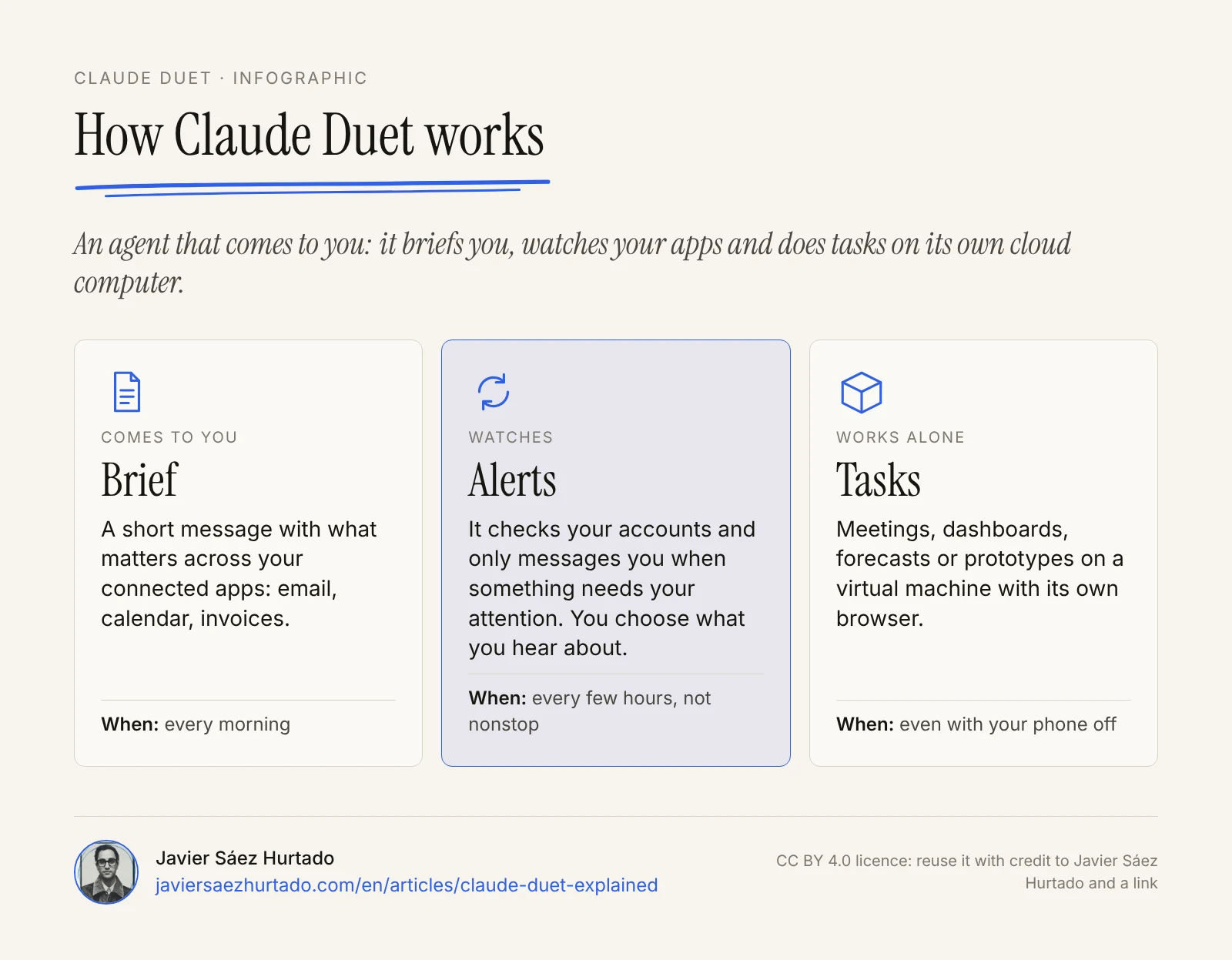
Duet works in three ways: it comes to you, it does what you ask and it moves through your apps.
- It comes to you. Every morning it sends a short brief on what matters in your connected apps. During the day it checks them and only messages you when something needs your attention. You decide what you want to hear about and how often.
- It does what you hand it. From simple jobs, like setting up a meeting, to long ones: dashboards built from many tools, financial or sales forecasts, prototypes and web apps. It lets you know when it is done or needs you to review something.
- It moves through your apps. It can use the more than 6,000 connectors and plugins in the Claude Marketplace, and for sites without a connector it uses its own browser in the cloud.
The examples in the announcement are almost all about running a business:
- Finding the Gmail and Slack messages you missed and helping you reply.
- Checking Intuit QuickBooks or Stripe for unpaid invoices and drafting reminders.
- Preparing and running payroll in Gusto, with hours, bonuses and reimbursements filled in.
- Drafting a job posting and, once you have edited and approved it, posting it to LinkedIn.
- Preparing agreements and sending them for review and signature through Docusign.
- Drafting follow-up emails from the contact and deal history in HubSpot.
- Turning a product launch into a social campaign in Canva.
- Setting up, designing and managing a Shopify store.
It can also buy things for your business. It uses Link, Stripe’s digital wallet: Duet confirms the item with you, Link asks you to approve the spend and the payment goes through a single-use virtual card, so your real card number is not shared. Anthropic adds that, with your permission, it will soon be able to sign in to sites with logins saved in 1Password.
Among the people who tried it before launch, Anthropic describes three cases: an estate agent whom Duet warned, unprompted, about a viewing booked on the wrong day; the owner of a restaurant group with about 110 employees who uses it for accounting, customer support, marketing and store-by-store invoices; and a brand strategist for whom it prepared a call and pointed out that it fell right before her flight.
How does Claude Duet work?
Duet has a virtual machine in the cloud with its own browser. You describe a task in a short message, it works out which apps and steps it needs and it does the work in the background, without your laptop or phone having to stay on.
Four parts are worth knowing:
- It inherits your Claude context. It carries over the memory, skills and connected apps from your account, so there is little to set up. According to the help centre, it can also search your earlier Claude chats outside projects, if that memory setting is on.
- One thread. You type or talk to it in one ongoing conversation, so a quick reply and a week-long project start in the same place. The app has a tab for tasks, with what is running and what is waiting for you, and another for finished files.
- Check-ins every few hours. It does not watch your accounts nonstop. Anthropic is upfront about why: checking all the time would use up your plan’s limits much faster. That also means something urgent can reach you late.
- It cites its sources. When it gives you numbers or summaries, it says which email, file or spreadsheet they come from.
Duet does not replace Anthropic’s other agents. Claude Cowork (in Spanish) works with you on your computer, with your files and folders, when you give it a job. Claude Code is the agent for programming. Duet is the one that lives on your phone, takes the initiative and keeps working in the cloud while you are away. It can read your Claude work but cannot change it, and it does not see your local files.
Does Claude Duet ask before it acts?
Yes, for everything that cannot be undone. Duet reads, drafts and prepares work on its own, but before it sends a message, makes a payment, signs a document or deletes anything, it shows you exactly what it is about to do and waits for your approval. If you cannot approve right away, it finishes the rest of the task and comes back to that step later.
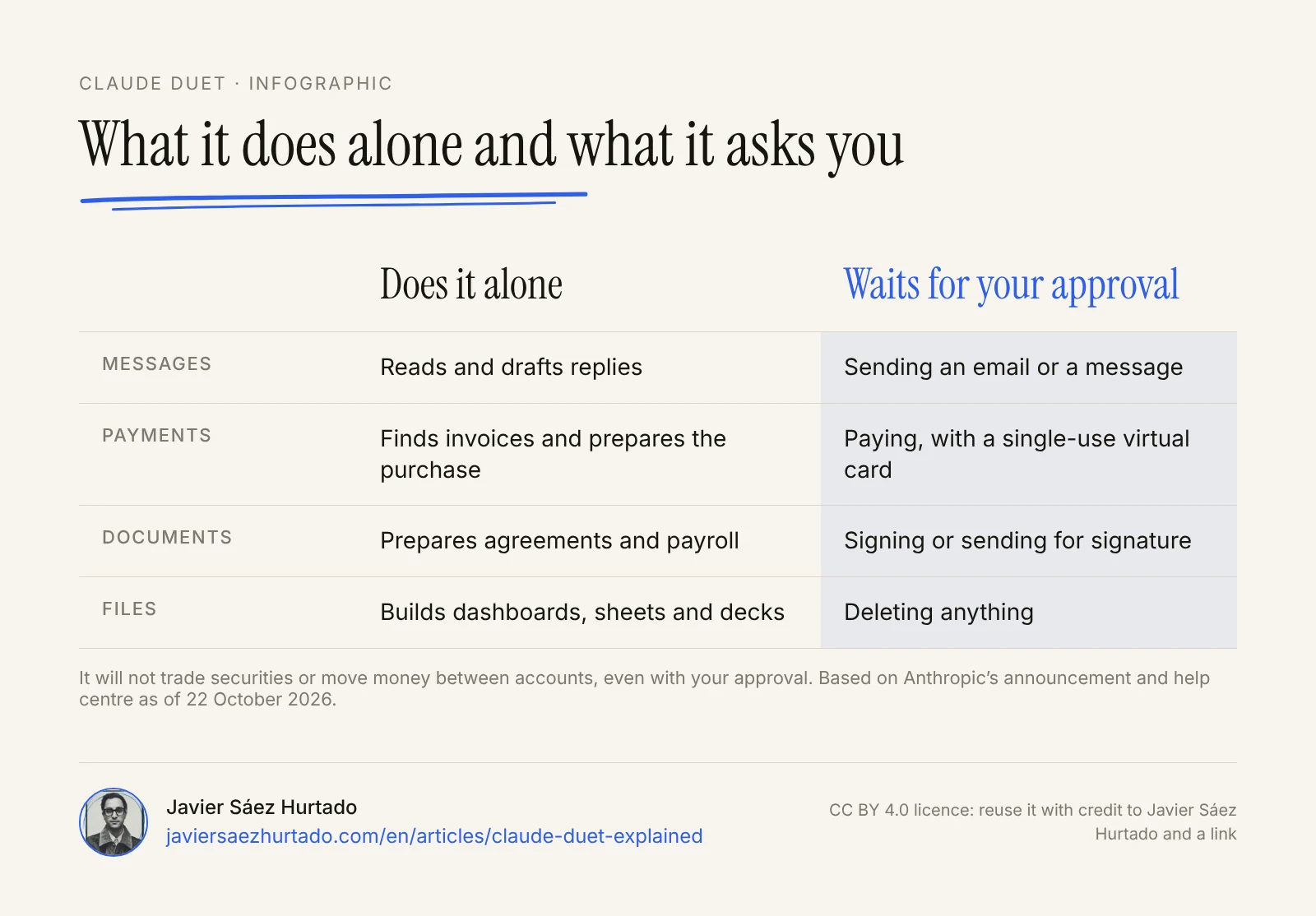
Some things it will not do even if you approve: trade securities, move money between accounts or access someone else’s account. And you can disconnect any app at any time.
On security, Anthropic describes these measures:
- It does not see your passwords. Credentials follow the design of Claude Managed Agents, so Duet never directly sees passwords or sign-in tokens. Passwords are typed into a separate form on your phone and go straight to the browser, outside the chat.
- A classifier approves actions. It is the same safeguard that stops Claude and Claude Code from taking steps you did not ask for.
- Defences against hidden instructions. The emails and pages it reads can carry hidden orders for the agent, known as prompt injection. The help centre admits that no defence is perfect.
- A filter for sensitive data. A new classifier checks each message and is designed to refuse to share the most sensitive information, such as card numbers or ID documents. Other sensitive information, such as health or personal finances, only goes out when you have explicitly told it to send it.
- Attack testing. Internal red teams and an outside firm tried to break it, it is covered by Anthropic’s public bug bounty, and Anthropic promises more detail on its safety design in the coming days.
How much does Claude Duet cost, and how much of your plan does it use?
It has no price of its own. During the research preview it is included in the Pro and Max plans at no extra cost and shares the usage limits with the rest of Claude: the five-hour session and the weekly limit, at the same rate as a normal chat.
The difference is how it spends them. Background checks and the morning brief count, and large tasks, such as a financial model or a deck, need many more model turns. To make up for the start, Anthropic resets both limits once when you are admitted to the preview (according to the help centre, that reset is available until 30 November 2026). Team and Enterprise plans do not have it yet; Anthropic says it will come later.
Is Claude Duet available in Europe?
No. As of 22 October 2026 only people with a Pro or Max plan and a US Claude account can use it, and they get in by invitation from a waitlist. Invitations go out in waves with no guaranteed date, and the waitlist email has to match your Claude account or the Google or Apple account on your phone. Anthropic does not mention Europe and does not explain why it is starting with the US only.
For a business in Europe, that leaves three practical points:
- You cannot try it officially today. Forcing it with an account or a location that is not yours goes against what Anthropic intends and puts your business data where you do not control it.
- What you set up in Claude carries over. Duet inherits the memory, skills and connectors from your account. Tidying those up now, with minimal permissions, is work that will pay off when it arrives.
- There is time to decide on permissions. It is worth deciding beforehand which accounts you would connect, which only in read mode, and who reviews each approval.
Claude Duet vs Muse vs dots vs Grok Bot
All four are agents with their own cloud computer that keep working while you are away. They arrived within ten weeks, between 11 August and 21 October. The differences are in who they are for, how they limit risk and where you can use them.
Claude Duet, Muse, dots and Grok Bot, point by point
Official data from each company; Duet as of 22 October 2026, the others from my earlier articles
| Claude Duet (Anthropic) | Muse (Meta) | dots (OpenAI) | Grok Bot (xAI) | |
|---|---|---|---|---|
| Announced | 21 Oct 2026 | 8 Sep 2026 | 29 Sep 2026 | 11 Aug 2026 |
| Model | Claude Opus 5.5 | Muse Spark | GPT-6 Astra | Not clearly stated |
| Who it is for | Professionals and small businesses | Consumers, with a small business version | Pro users and companies | Paying Grok users |
| Computer | Virtual machine with its own browser | Own virtual machine and a watcher, Sentinel | One per dot | One per user, shared by their bots |
| Initiative | Morning brief and alerts | Suggests ideas and tasks | Continuous work | Continuous work |
| Hard limits | No trading securities or moving money between accounts | Approval for purchases and sends | Automatic review and own rules | Approvals and review rules |
| Where you use it | iOS and Android app, and claude.ai | App, muse.ai, WhatsApp and Mac | ChatGPT, Slack, Teams and voice | Desktop and mobile app |
| Price | Included in Pro and Max | Free for most use | Included in Pro and Business Premium | From $20 a month |
| Europe | Not available | Not available | Not on Pro; yes on Business Premium | No stated restriction |
What sets Duet apart is its focus. Muse lives in Meta’s world, with WhatsApp and Instagram, and leans towards consumers; dots plugs into team tools; Duet is pitched as an assistant for people running a small business, with payroll, invoices, contracts and customers. And it publishes a list of things it will not do even with your permission, something I have not seen spelled out as clearly for the other three.
What do the first tests say?
It is early, but there is already an independent test. Claire Vo, host of How I AI, tried it on real work for Lenny’s Newsletter. She called it the most polished agent launch she has seen, with very thoughtful onboarding, and liked the task lists, the finished files and the fact that it inherits Claude’s plugins and connectors.
Her complaints are specific: it did not feel proactive enough, slow responses make real-time back-and-forth tiring, there is no desktop app and it is single-user, with no team use. The title of her piece sums it up: she found it beautiful and still forgot to use it.
Anthropic itself flags the limits of this version: it may misread a thread or misjudge what is urgent, personal errands such as buying tickets are weaker than work tasks, it cannot show you its browser yet and it cannot make calls or send texts. Microsoft 365 is not yet available as a connector.
My view: what I would let Claude Duet do
Duet gets right what matters most to me in an agent: it separates what it can do alone from what needs a person, and it has a list of things it will not do even with permission. That is what I ask of any agent, as I explained in my essay on how much to let an agent do without looking (in Spanish).
I would start with what saves attention without risk: the morning brief, tidying email and calendar, preparing meetings, leaving drafts and putting documents together. I would connect accounts in read mode first and add permissions gradually.
What I would not do is approve out of habit. An agent that asks for approval ten times a day ends up training you to say yes without reading, and then approval stops protecting you. Approvals for payments, contracts and messages to customers deserve a full read, especially in the first weeks. And I would watch the usage: a proactive agent spends from your plan even when you ask it nothing, so it is worth telling it what you want to hear about and what you do not.
Transparency: Convexify, the firm I founded, is part of the OpenAI Select Partner programme. This article compares Duet with OpenAI dots and is based on public documentation from Anthropic, Meta, OpenAI and xAI and on the linked sources.
Key takeaways
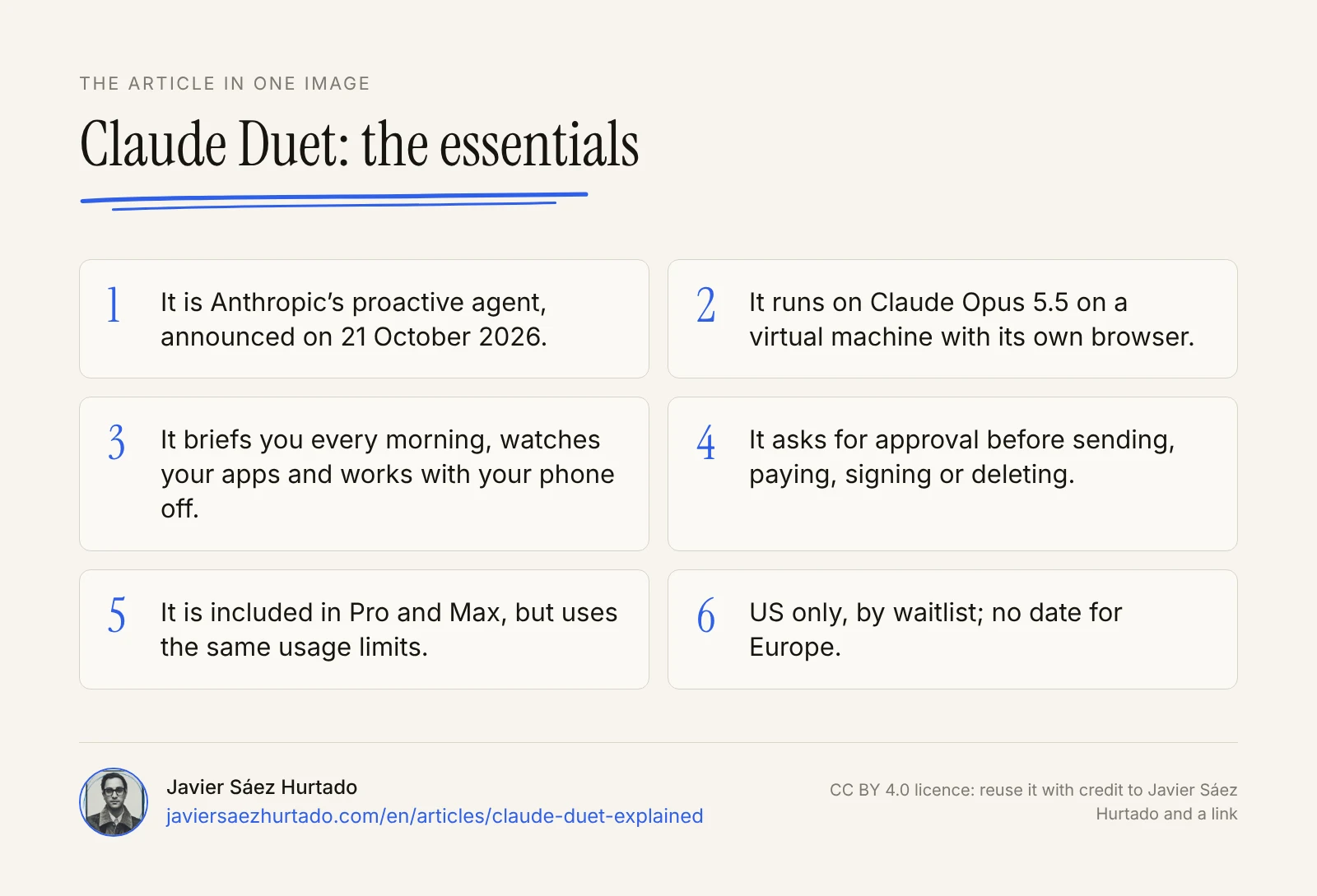
- Claude Duet is Anthropic’s proactive agent, announced on 21 October 2026 and built on Claude Opus 5.5.
- It briefs you in the morning, checks your apps every few hours, does tasks on its cloud computer and inherits your Claude memory, skills and connectors.
- It asks for approval before sending, paying, signing or deleting, and will not trade securities or move money between accounts even with permission.
- It is included in Pro and Max, but it uses the same limits, background checks included.
- It is only available in the US, by waitlist; Anthropic has given no date for Europe.
The article in one image
Frequently asked questions
What is Claude Duet?
It is an Anthropic app, announced on 21 October 2026, in which Claude works as a proactive agent. It sends you a brief every morning, watches your connected apps, does tasks on its own cloud computer and checks with you before acting on your behalf. It runs on Claude Opus 5.5 and is in research preview.
What can Claude Duet do?
Anthropic’s examples are about work: finding Gmail and Slack messages you missed, checking QuickBooks or Stripe for unpaid invoices and drafting reminders, preparing payroll in Gusto, getting agreements ready to sign in Docusign, drafting follow-ups from HubSpot history, and building dashboards, forecasts, prototypes and web apps.
Is Claude Duet free?
It has no price of its own. During the research preview it is included in the Pro and Max plans at no extra cost, but it uses the same usage limits as the rest of Claude, including its background checks. Large tasks, such as a financial model or a deck, use more.
Is Claude Duet available in Europe?
No. As of 22 October 2026 only Pro and Max users with a US Claude account can request it, and access is by invitation from a waitlist. Anthropic has given no date for Europe, nor for the Team and Enterprise plans.
How is Claude Duet different from Claude Cowork?
Cowork works with you on your computer, with your files and folders, when you give it a job. Duet lives on your phone and on the web, has its own virtual machine in the cloud and takes the initiative: it briefs you, tells you when something needs attention and keeps working while your phone is off.
How is Claude Duet different from Muse and dots?
All three are agents with their own cloud computer. Duet is aimed at professionals and small businesses, inherits the memory, skills and apps from your Claude account and has hard limits, such as not trading securities. Meta’s Muse is more consumer-focused and also lives in WhatsApp; OpenAI’s dots gives each agent its own computer and works inside Slack and Teams.
Sources
- Anthropic, Introducing Claude Duet (21 Oct 2026)
- Anthropic, Claude Duet product page
- Claude Help Center, Get started with Claude Duet
- Claude Help Center, How to use Link by Stripe with Claude Duet
- MacRumors, Anthropic Launches Claude Duet, a Proactive AI Agent (21 Oct 2026)
- Lenny’s Newsletter (Claire Vo), Claude Duet is beautiful. I still forgot to use it (21 Oct 2026)
- TechBuzz, Anthropic Launches Claude Duet AI Agent to Take On Meta and OpenAI (21 Oct 2026)