Grok Bot vs OpenAI dots: what they are, how they compare and where they differ
Grok Bot and dots are the same idea, seven weeks apart: AI agents that are always working, each on a computer in the cloud. This comparison explains what each one does, where they are alike, the differences that matter and what I would not hand to either of them.
What are Grok Bot and dots?
Grok Bot and dots are always-on AI agents: they work on a cloud computer that never shuts down, remember what you teach them and can start working without you writing to them. Grok Bot is made by xAI and dots by OpenAI.
- Grok Bot
- The xAI agent app. Its bots are “teammates” that work 24/7 on a persistent computer with a browser, files and a terminal.
- dots
- The always-on agents in ChatGPT. Each dot runs on GPT-6 Astra on its own cloud computer and connects to your apps through plugins.
The difference from a chat is the one I explained in the guide to OpenAI agents: an agent does not answer, it works. What is new is that it no longer stops when you close the window. Meta joined in with Muse, which I explain in what Meta Muse is.
Timeline: Grok Bot came first
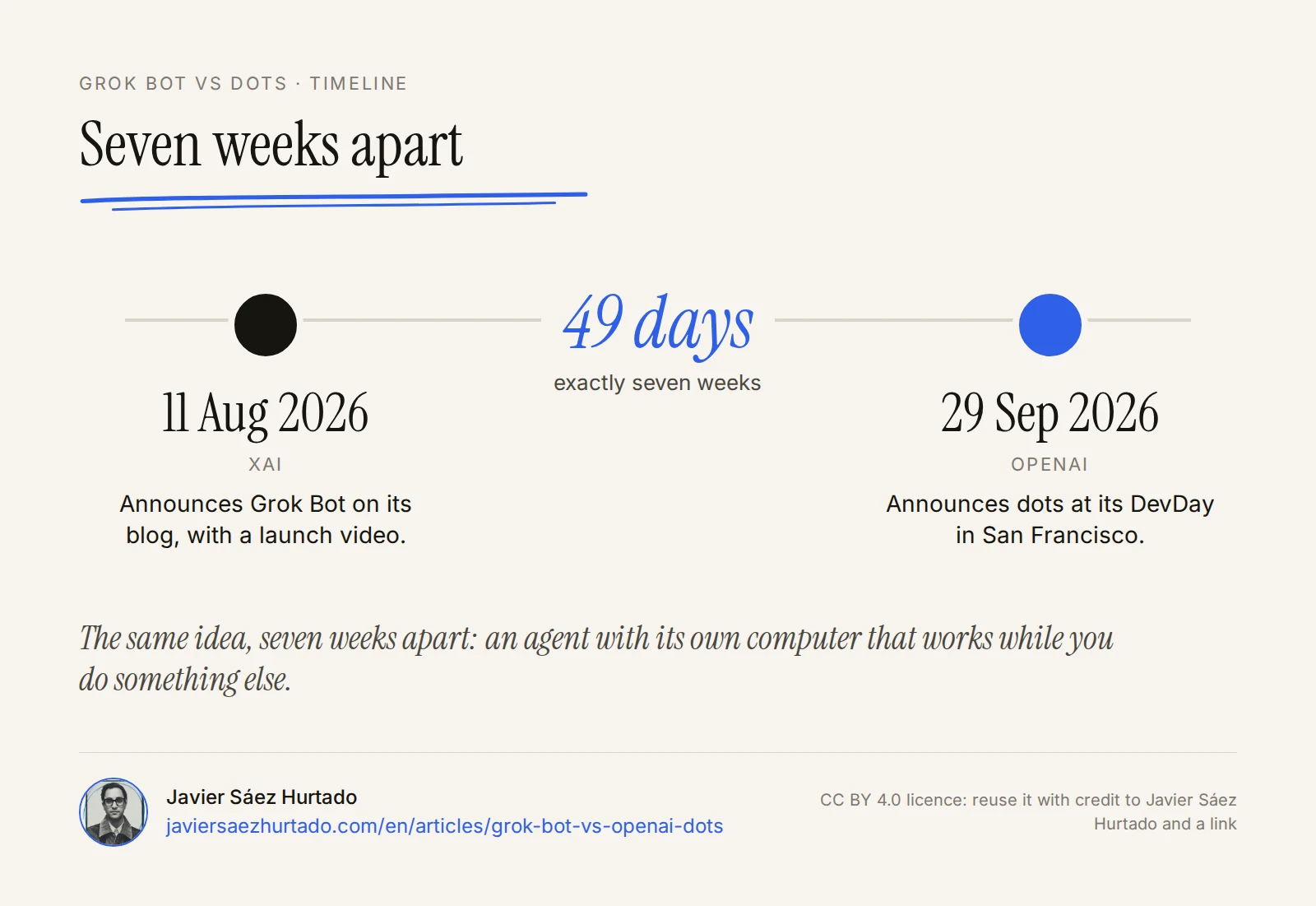
Grok Bot launched on 11 August 2026 and dots on 29 September, 49 days later. The idea is the same: an agent with its own computer that works while you do something else. According to Bloomberg, as reported by PYMNTS, Grok Bot had around 418,000 weekly users by mid-September.
One odd detail: on the day of the announcement, the dot.com domain redirected to the Grok Bot page. I checked it on 29 September. It is not known who controls the domain or why it redirects there.
How dots work
Each dot works on its own cloud computer and runs on GPT-6 Astra. It can also use your own computer, but that access is off by default. It receives your ChatGPT memories and builds its own, and when it has no tasks it does research on its own with read-only access to your apps.
It connects to more than 4,000 apps through ChatGPT plugins, and you can talk to it from ChatGPT on the web, desktop and mobile, from Slack and Teams, and by voice. Text messages are in beta, only for Pro users in the United States.
Before it acts, an automatic review system checks any action that could affect your accounts or share information, based on your instructions and your own rules, which can allow an action, ask for approval or block it. Some tasks it never does alone: changing a password or moving money requires you to take control.
How Grok Bot works
Grok Bot gives each user a persistent cloud computer, with a browser, a file system and a terminal, that keeps working when you close your laptop. You can have several bots that coordinate in group chats, and a bot can learn a workflow by watching it once.
Its most visible difference is in how it connects: besides MCP connectors, managed through Cursor, it can work on websites that have no API by signing in the way a person would. xAI does not say how many connectors it has.
It asks for approval before sending messages, posting, buying, deleting or overwriting data, changing permissions or accepting legal terms. Passwords, two-factor codes, captchas and payments are entered by the user, who takes control of the computer.
Grok Bot vs dots: side by side
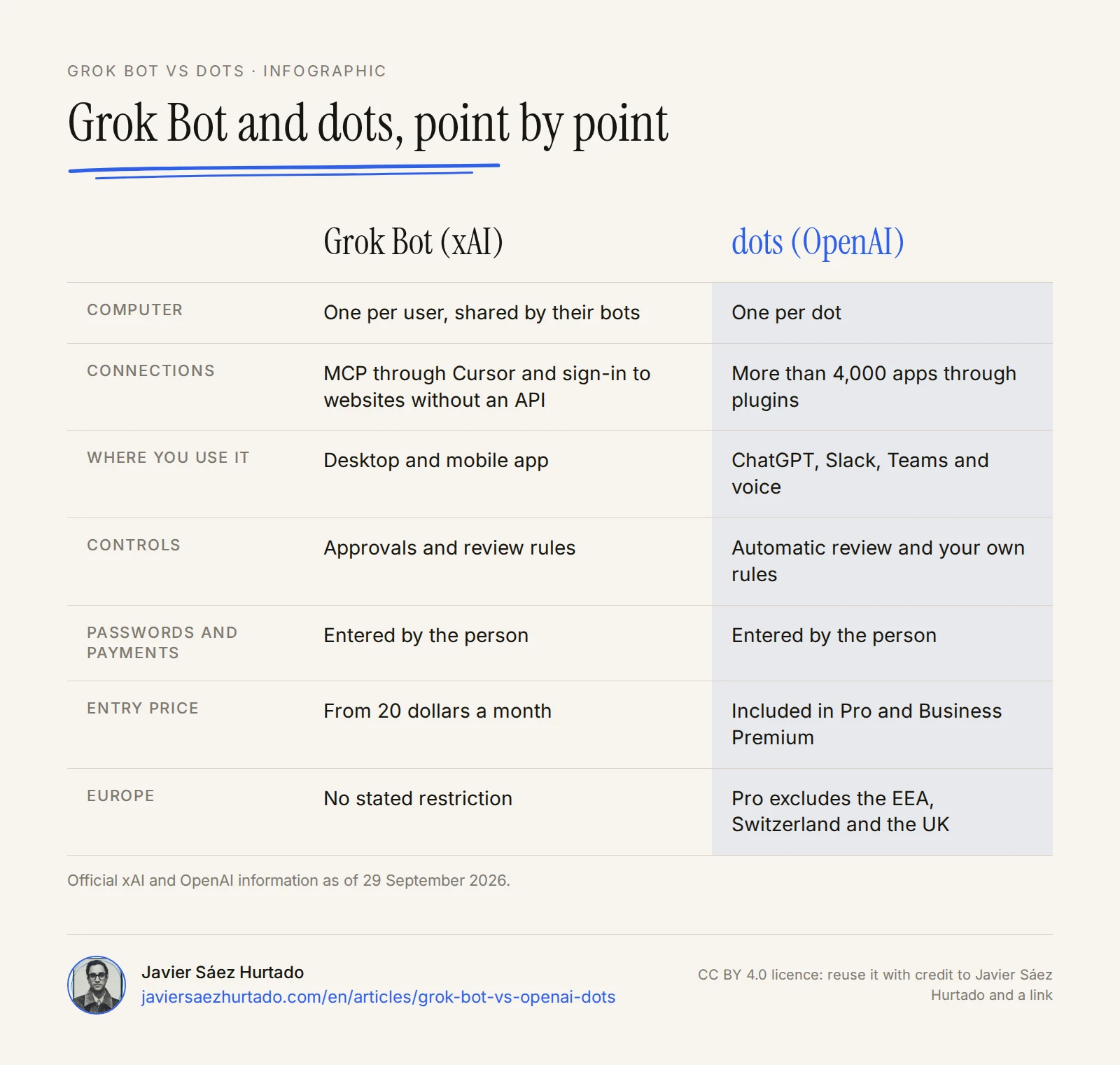
Grok Bot and dots, point by point
Official information as of 29 September 2026
| Grok Bot (xAI) | dots (OpenAI) | |
|---|---|---|
| Launch | 11 Aug 2026 | 29 Sep 2026 |
| Model | Not clearly stated | GPT-6 Astra |
| Computer | One per user, shared by all their bots | One per dot |
| Connections | MCP through Cursor and sign-in to websites without an API | More than 4,000 apps through plugins |
| Where you use it | Desktop and mobile app | ChatGPT, Slack, Teams and voice |
| Several agents | Yes, with group chats | One at launch; more later |
| Controls | Approvals and review rules | Automatic review and your own rules |
| Own identity | No: it acts with your permissions | Specialist dots with their own identity in the company |
| Entry price | From 20 dollars a month | Included in Pro and Business Premium |
| Europe | No stated restriction; computers run in the US | Pro excludes the EEA, Switzerland and the UK |
Which is safer? Controls and approvals
On the basics they agree more than it seems. Both ask for approval before sensitive actions, both leave passwords and payments to the person and neither shows your passwords to the model. It is the same line I hold in the essay on what you would let an agent do without looking (in Spanish): nothing that cannot be undone is handed over without a person in the loop.
The deeper difference is separation. In Grok Bot all your bots share the same computer, with its files, sessions and sign-ins, and the xAI documentation itself warns against using separate bots as a security boundary. In dots, each agent has its own computer, and OpenAI is preparing specialist dots with their own identity and credentials inside the company.
Having controls does not make them foolproof. OpenAI admits that dots can make mistakes, including when following rules, and so far there is no independent test that compares the two products on the same tasks.
Pricing and availability in Europe
According to the xAI page on 29 September, Grok Bot can be used with Cursor Pro (20 dollars a month), SuperGrok (30 dollars a month) or Cursor Teams (40 dollars per seat a month), with weekly usage included and extra usage billed as you go. xAI does not state any country restrictions, and its computers run in the United States.
dots come included, with a first dot at no extra cost, in ChatGPT Pro and Business Premium. On Pro, OpenAI offers it for now outside the European Economic Area, Switzerland and the UK, so it is not available there on that plan. On Business Premium it is available in every region where ChatGPT works.
What the first tests say
The first reactions are cautious. TechCrunch pointed out that much of what dots do was already possible with Codex and similar tools, and Engadget ran its piece with a “what could go wrong?” headline. The comparisons published so far compare features; none runs the same tasks on both products.
The most complete hands-on test I have found is by Peter Yang, who used dots for several days in his own business and compares it with Grok Bot:
The full OpenAI DevDay keynote is on its channel.
Which one should you choose?
- If your work already lives in ChatGPT, Slack or Teams, dots have the edge: they connect to more apps and each agent has its own computer.
- If you want to start on a small budget or work with websites without an API, Grok Bot is cheaper and can get in where there is no connector.
- If you are in the European Economic Area, Switzerland or the UK on a Pro plan, the question answers itself today: dots are not available on that plan.
- If you will use several agents with sensitive information, keep in mind that in Grok Bot they all share the same computer.
In every case, start with low-risk tasks, keep approval on for anything it writes and give it more autonomy only when you have proof that it works.
What I would not hand to either of them
An agent that never switches off is very useful and, for the same reason, very easy to overload. I would not give either of them anything that depends on talking to other people on my behalf, or anything that touches high-value accounts. It is not distrust of the technology: what takes a second to do can take much longer to undo.
Disclosure: Convexify, the firm I founded, is part of the OpenAI Select Partner program. This comparison is based on the public documentation of both products and on the linked sources.
Key takeaways
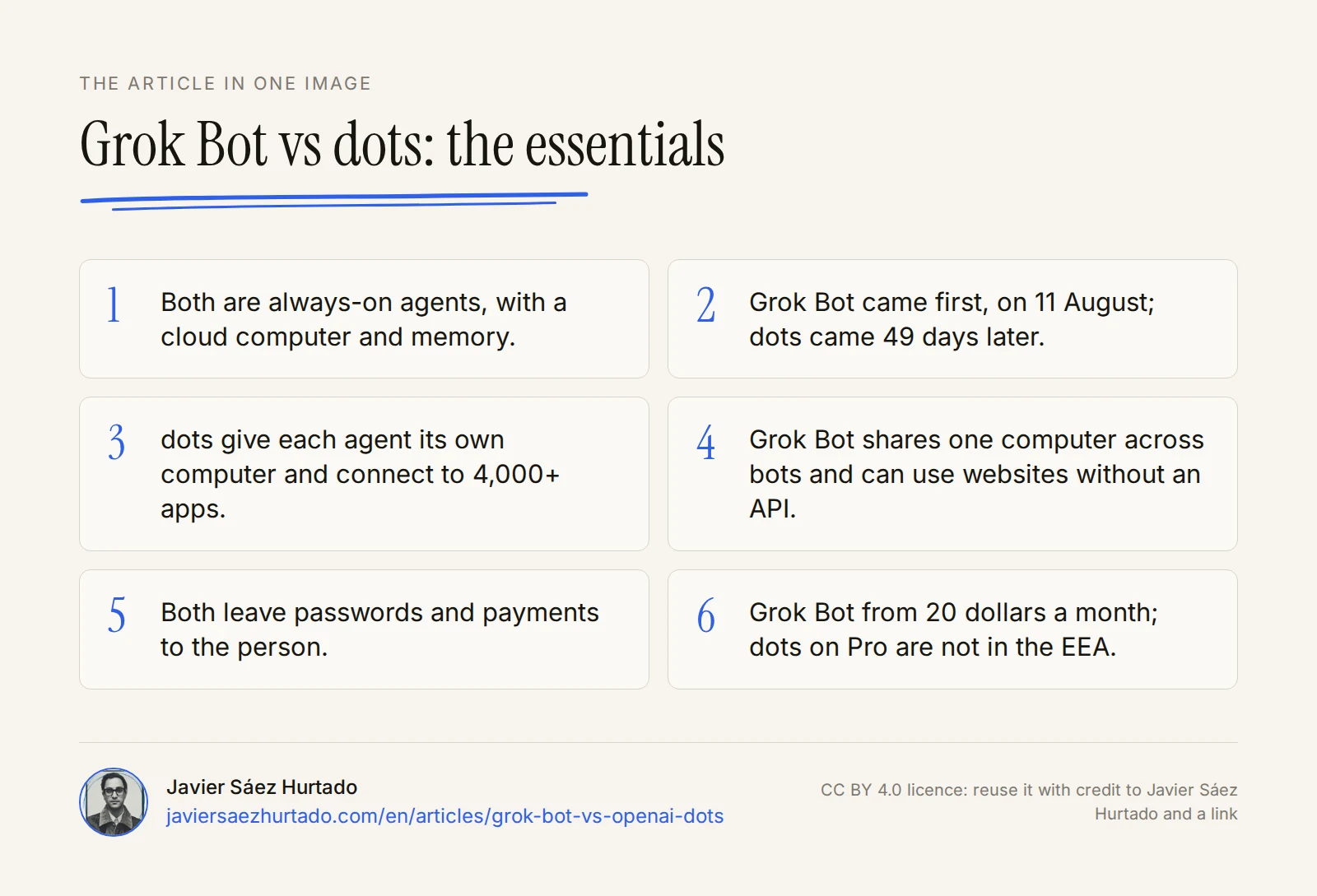
- Grok Bot and dots are always-on agents, with a cloud computer, memory and proactive work.
- Grok Bot came first, on 11 August 2026; dots came 49 days later.
- dots give each agent its own computer and more than 4,000 apps through plugins; Grok Bot shares one computer across bots and can use websites without an API.
- Both leave passwords and payments to the person.
- Grok Bot starts at 20 dollars a month; dots come with Pro and Business Premium, and on Pro they are not available in the EEA, Switzerland or the UK.
The article in one image
Frequently asked questions
What is Grok Bot?
It is the AI agent app from xAI, launched on 11 August 2026. Its bots work 24/7 on a persistent cloud computer with a browser, files and a terminal, remember your preferences and ask for approval before sending messages, posting, buying or deleting.
What are OpenAI dots?
They are always-on agents that OpenAI announced at DevDay on 29 September 2026. Each dot runs on GPT-6 Astra on its own cloud computer, connects to more than 4,000 apps through plugins and reviews anything that could affect your accounts before it acts.
What is the main difference between Grok Bot and dots?
How they are built and how they connect. Each dot has its own computer and works with ChatGPT plugins; in Grok Bot all of a user’s bots share one computer and can use websites without an API by signing in like a person. Grok Bot is also cheaper to start with.
Are OpenAI dots available in Europe?
Not on ChatGPT Pro: for now OpenAI excludes the European Economic Area, Switzerland and the UK. On Business Premium, dots are available in every region where ChatGPT works.
How much does Grok Bot cost?
According to the xAI page on 29 September 2026, you can use it with Cursor Pro (20 dollars a month), SuperGrok (30 dollars a month) or Cursor Teams (40 dollars per seat a month), with weekly usage included and extra usage billed as you go.
Is it safe to let an always-on agent use my accounts?
It depends on which accounts and for what. Both products leave passwords and payments to the person and ask for approval before sensitive actions, but neither is foolproof. The careful choice is not to hand over anything that speaks on your behalf or touches high-value accounts.
Sources
- OpenAI, Introducing dots (29 Sep 2026)
- OpenAI Help Center, getting started with your dot
- OpenAI Help Center, dots privacy, security and safety FAQs
- OpenAI, DevDay 2026 recap (29 Sep 2026)
- xAI, Introducing Grok Bot (11 Aug 2026)
- xAI, Grok Bot plans and pricing
- xAI Docs, Grok Bot
- xAI Docs, Grok Bot approvals, security and privacy
- TechCrunch, OpenAI launches Dots (29 Sep 2026)
- PYMNTS, Grok Bot gains early traction (Sep 2026)
- OfficeChai, dot.com redirects to Grok Bot (29 Sep 2026)