Meta Muse: what Meta’s personal AI agent is, how it works and where you can use it
Muse is the personal AI agent Meta launched on 8 September 2026. It works on its own virtual machine in the cloud, does tasks for you and asks before it sends an email or buys something. For now it is only available in the US and Canada, and Meta has given no date for Europe.
What is Meta Muse?
Muse is Meta’s personal AI agent. It launched on 8 September 2026 and, unlike a chatbot, it does not stop at answering. You give it a job, it works on its own computer in the cloud, and it checks with you before anything sensitive, like sending an email or paying for something.
- Muse
- Meta’s personal agent. You use it in its own iOS and Android app, on the web at muse.ai and inside WhatsApp.
- Muse Spark
- The model behind it, built by Meta Superintelligence Labs. Meta introduced it on 8 April 2026; the Muse safety paper names version 1.3.
- Sentinel
- A second agent, kept apart from Muse, that approves every request going out to the internet.
Muse is not the same as Meta AI, the assistant you already see in Instagram, WhatsApp and Facebook. Meta AI talks with you; Muse does tasks on your behalf. It is the third product this autumn built on the same idea, an always-on agent with its own computer, after the two I compared in Grok Bot vs OpenAI dots.
What can Meta Muse do?
Muse handles whole tasks that used to take several apps and a fair amount of time. In its launch post, Meta lists sending emails, booking travel, filling in forms in the browser, negotiating for you, selling a car, lowering a bill and adjusting a training plan when your week changes.
One example is very Meta: you save a recipe reel on Instagram and Muse turns it into a shopping list. It keeps working after you close the app, and when it is time to pay it can use Link by Stripe, which creates a single-use card.
Where you can use it today:
- The Muse app for iOS and Android, and the web at muse.ai.
- WhatsApp, right in the chat.
- Mac, with an app released on 17 September that, according to TechCrunch, lets it take actions on your computer.
- Meta’s AI glasses, “in the coming months”, as Meta announced at Connect.
How does Muse work?
Each person gets their own virtual machine in the cloud, which Meta calls Muse Secure VM, with its own browser. Muse lives there, and so do the data and credentials for the services you connect. On the same machine, but kept apart at the system level, runs Sentinel: nothing Muse does reaches the internet unless Sentinel approves it.
Meta adds that credentials go into secure storage, so Muse can use them without seeing them, including passwords you type into the browser yourself. Later this year it plans Muse Confidential VM, where the whole machine, with your data and conversations, is encrypted with a key only you hold.
The design will look familiar if you know OpenClaw, the open source agent I explained in what is OpenClaw (in Spanish). Meta is open about it: according to TechCrunch, Nat Friedman, head of product at Meta Superintelligence Labs, said Muse was inspired by OpenClaw as a product, although it was built from scratch.
Does Muse ask for permission before it acts?
Yes, for sensitive actions. In Meta’s words, Muse checks with the person before things like sending an email or making a purchase, and it shows a complete log of everything it has done and plans to do.
You also choose which apps it connects to and how much access each one gets. With email, for example, you can allow read only or also sending, and you can disconnect any service at any time. The safety paper adds that third-party connector actions, purchases and high-risk forms also need a person to approve them.
On memory and privacy, Meta says Muse remembers what matters, that you can tell it to “forget” specific things, that you can stop your conversations from being used to train models, and that Muse does not share your conversations or the data in your virtual machine with Meta’s ad systems.
Two points appear in Meta’s safety paper but not in the launch post, as Search Engine Journal noted:
- Its browsing counts as yours. If Muse visits a store to buy you a shirt, that store can use the visit to show you an ad on Instagram.
- It is not immune to attack. Meta says prompt injection, when a web page or document tries to give the agent orders, is still an open problem and that Muse will sometimes make mistakes. Its bug bounty pays up to 300,000 dollars.
How much does Meta Muse cost?
Meta says Muse is free for most of what people need, with subscription plans for people who want to do more. The official post gives no figures. According to TechCrunch and Axios, there are two paid plans: Power at 20 dollars a month and Maximum at 100 dollars a month. I checked this on 30 September 2026 and could not confirm it on a Meta pricing page.
The business model goes beyond subscriptions. At Connect, Mark Zuckerberg said, as reported by TechCrunch, that Muse will be free for a large amount of use and that Meta expects to make money over time by taking a small fee from transactions. In other words, Meta earns when Muse buys.
Is Meta Muse available in Europe?
No. As of 30 September 2026, Muse is only available in the US and Canada. The 8 September post mentioned the US; the 29 September post already says “the US and Canada”. None of Meta’s posts mention Europe, Spain or Andorra, and Meta has not said why.
Some media point to European rules, such as the Digital Markets Act, the AI Act or the GDPR. These are reasonable guesses, but they are not statements from Meta, so I do not treat them as facts.
For a company in Spain or elsewhere in Europe, this means three things:
- You cannot test it officially today. Using it from Europe with region workarounds is outside what Meta supports, and your data may end up where you have no control over it.
- You have time to decide calmly. Before it arrives, it is worth deciding which accounts you would connect, with which permissions, and who checks its work.
- The channel matters. Muse lives inside WhatsApp and Instagram, which many European businesses already use to talk with customers. That is exactly where an agent that writes on your behalf needs the most care.
What did Meta announce at Connect, and what is Muse for Small Business?
At Connect, on 23 September, Meta said Muse will come to its AI glasses in the coming months: you will be able to say its name and have it act on what you are looking at, such as a product on a shelf or a flyer. Meta also showed a voice mode in which Muse keeps working while you talk.
New connectors arrived too: stores such as Walmart, Best Buy, Sephora and Wayfair, payments through Shop Pay and PayPal, Instacart for groceries, Expedia soon for travel, and Notion, Granola, GitHub and Box for work. Muse will get its own email address, and Meta showed Muse Charm, a small pocket device for talking with the agent, with more details promised later this year.
On 29 September came Muse for Small Business. It connects to Asana, Box, Canva, Dropbox, Figma, Intuit QuickBooks, Klaviyo, Notion, Shopify, Slack, Stripe and Zoom, plus Facebook and Instagram business accounts and Meta ad accounts. Meta suggests using it to draft a growth plan, sort email and calendar, review ads or check the books, and sums it up with a clear rule: nothing publishes, sends or spends without your approval.
Muse vs Grok Bot vs dots: how are they different?
All three are agents with their own cloud computer, memory and the ability to work while you are away. They differ in how they contain risk, what they connect to and where you can use them.
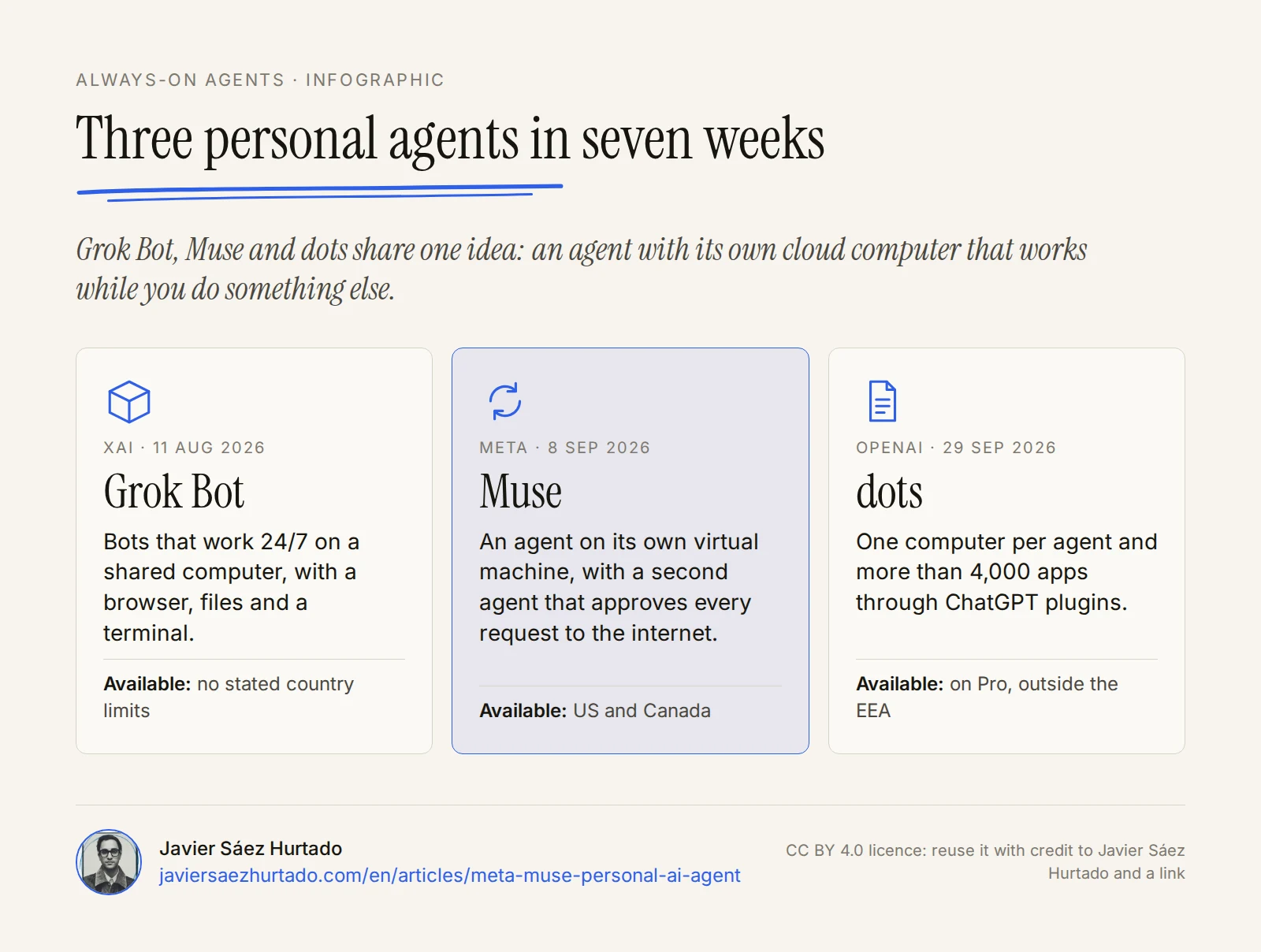
Muse, Grok Bot and dots, point by point
Official information as of 30 September 2026
| Muse (Meta) | Grok Bot (xAI) | dots (OpenAI) | |
|---|---|---|---|
| Launch | 8 Sep 2026 | 11 Aug 2026 | 29 Sep 2026 |
| Model | Muse Spark | Not clearly stated | GPT-6 Astra |
| Computer | Own virtual machine per person | One per user, shared by their bots | One per dot |
| Outbound control | Sentinel approves every request to the internet | Approvals and review rules | Automatic review and your own rules |
| Where you use it | App, muse.ai, WhatsApp and Mac | Desktop and mobile app | ChatGPT, Slack, Teams and voice |
| Entry price | Free for most use | From 20 dollars a month | Included in Pro and Business Premium |
| Europe | Not available | No stated restriction | Not on Pro; yes on Business Premium |
The most visible difference in Muse is the split between the agent that acts and the one that lets things out: one works, the other checks every request to the internet. The most important difference for Europe is simpler: of the three, Muse is the only one you cannot use officially in Europe at all.
What do early reviews and critics say?
Uptake in the US has been fast. Apptopia data reported by TechCrunch put Muse at 1.8 million iOS downloads in the US and Canada in its first 12 days. These are third-party estimates, not Meta figures.
The criticism is mostly about trust. TechCrunch framed its launch story around whether consumers will trust Muse and went through Meta’s privacy record, from the 2011 FTC settlement to Cambridge Analytica. Search Engine Journal pointed out that the attack risks appear in the safety paper and not in the post for the public.
Reuters published a clear explainer on how it works and the questions it leaves open:
What would I let Muse do when it reaches Europe?
On the technical side, Muse is well thought out: it separates the agent from the gatekeeper, asks before sending or buying and keeps a log of everything. That is what I ask of any agent before I let it work, as I wrote in the essay on what you would let an agent do without looking (in Spanish).
Even so, I would start with low-risk work: making lists, searching and comparing, organising information, preparing drafts. I would not let it talk to other people on my behalf, by email or on WhatsApp, and I would not connect high-value accounts. This is not distrust of the technology. What an agent sends or pays in a second can take a long time to undo, and Meta itself says Muse will sometimes get things wrong.
One detail is worth keeping in mind: Muse’s business model includes taking a fee when it buys. An agent that helps you shop, made by a company that earns from each purchase, deserves a careful human check. Approval before paying is not a formality; it is the most important part of the design.
Transparency: Convexify, the firm I founded, is part of the OpenAI Select Partner programme. This article compares Muse with OpenAI dots and is based on public documentation from Meta, xAI and OpenAI and on the linked sources.
Key takeaways
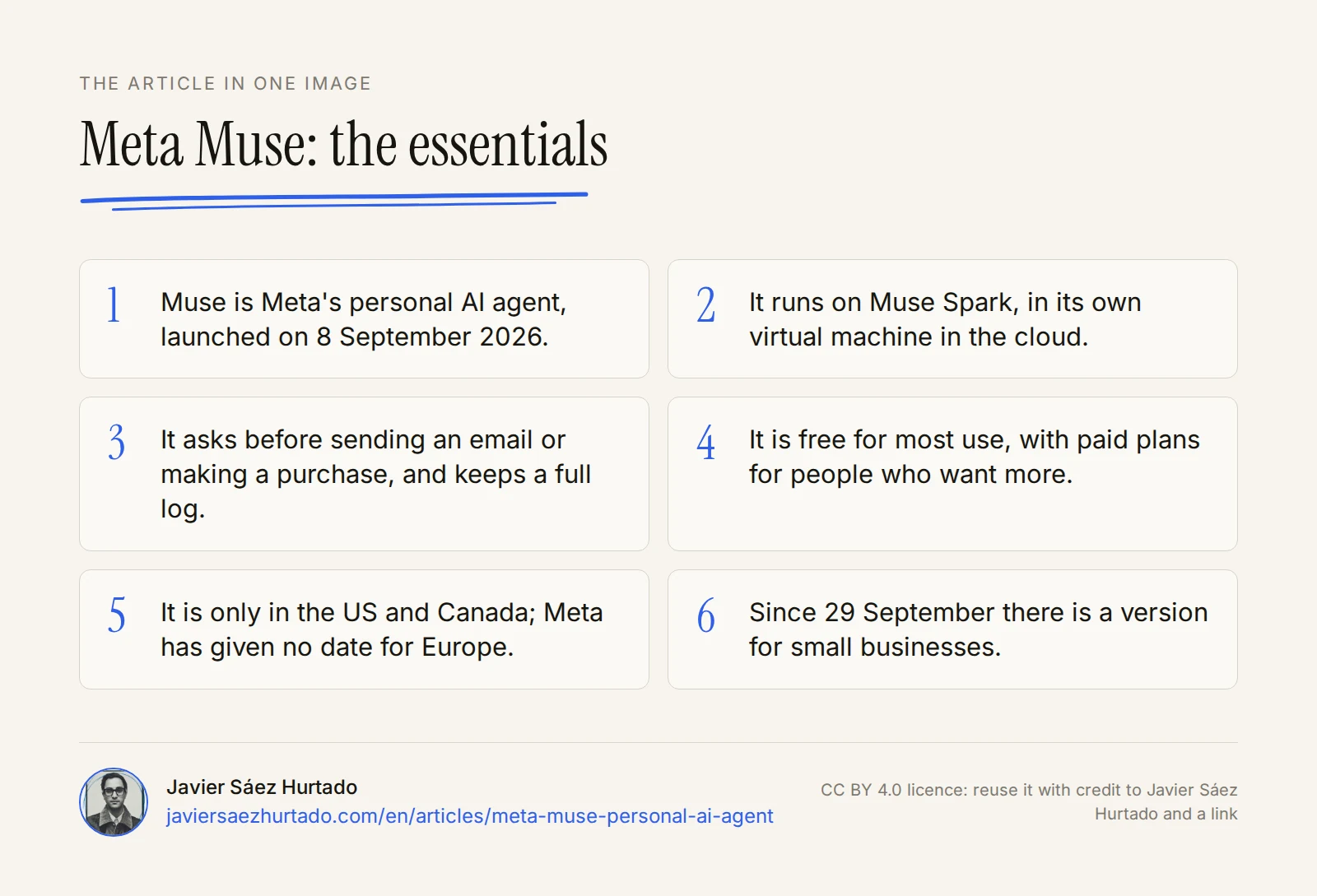
- Muse is Meta’s personal AI agent, launched on 8 September 2026 and powered by Muse Spark.
- It works on its own virtual machine, with a second agent that approves every request to the internet.
- It asks before sending an email or buying, and keeps a log of everything it does.
- It is free for most use; according to TechCrunch, the paid plans cost 20 and 100 dollars a month.
- It is only in the US and Canada; Meta has given no date for Europe.
The article in one image
Frequently asked questions
What is Meta Muse?
Muse is Meta’s personal AI agent, launched on 8 September 2026. It runs on the Muse Spark model on its own virtual machine in the cloud and can do tasks for you, like sending emails, booking travel, filling in forms or shopping, and it asks before sensitive actions.
What can Meta Muse do?
Meta’s examples include sending emails, booking travel, filling in web forms, negotiating for you, lowering a bill and turning a saved Instagram recipe reel into a shopping list. It keeps working when you close the app and connects to stores, payments and work tools such as Notion and GitHub.
Is Meta Muse free?
Meta says Muse is free for most of what people need, with subscription plans for people who want to do more. According to TechCrunch, the paid plans are Power at 20 dollars a month and Maximum at 100 dollars a month (checked on 30 September 2026).
Is Meta Muse available in Europe?
No. As of 30 September 2026, Muse is only available in the US and Canada. Meta has not announced a date for Europe, including Spain and Andorra, and has not said why.
Does Muse ask for permission before it acts?
Yes, for sensitive actions. Meta says Muse checks with you before things like sending an email or making a purchase, that you choose which apps it connects to and how much access it gets, and that it shows a full log of what it has done and plans to do.
How is Muse different from Grok Bot and OpenAI dots?
All three are agents with their own cloud computer. Muse adds a second agent, Sentinel, that approves every request to the internet, and it lives inside Meta’s apps, such as WhatsApp and Instagram. Grok Bot shares one computer across all your bots, and dots give each agent its own computer and connect to more than 4,000 apps.
Sources
- Meta, Introducing Muse, personal AI agent (8 Sep 2026)
- Meta AI, How We Built Safety Into Muse (8 Sep 2026)
- Meta, The Biggest News From Connect 2026 (24 Sep 2026)
- Meta, Introducing Muse for Small Business (29 Sep 2026)
- Meta, Introducing Muse Spark (8 Apr 2026)
- Meta AI, Muse page
- TechCrunch, Meta debuts its Muse AI agent. Will consumers trust it? (8 Sep 2026)
- TechCrunch, Meta’s Muse hits Mac (18 Sep 2026)
- TechCrunch, Meta admits Muse’s likeness to OpenClaw isn’t a coincidence (22 Sep 2026)
- TechCrunch, Everything new coming to Meta’s AI agent Muse (23 Sep 2026)
- Axios, Meta debuts Muse, its long-planned personal AI agent (8 Sep 2026)
- Search Engine Journal, Meta published 2 documents about Muse and only one mentions attacks (15 Sep 2026)