Claude Personal Finance: what it sees in your bank, what it cannot do and who can use it
Since 5 November 2026, Claude can connect to your bank and card accounts through Plaid and answer questions about your money, in read-only mode. It is a beta for the Pro, Max and Ultra plans in the United States. Here is what it sees, what it cannot do, how it compares with ChatGPT and what it means if you live outside the US.
What is Claude Personal Finance?
Claude Personal Finance is a space inside Claude that connects to your bank and card accounts and answers questions about your money with your real data. Anthropic announced it on 5 November 2026 and is rolling it out gradually, in beta, to the Pro, Max and Ultra plans in the US, so it may not show up yet in every eligible account.
- Personal Finance
- The section of Claude, in the sidebar, where you connect your accounts and ask about your spending, balances and bills. Claude answers in plain language and can build charts and dashboards.
- Plaid
- A service that connects apps to banks. You sign in to your bank through Plaid and give read access; the app gets the data, not your password.
The idea is not new. ChatGPT has offered something similar since May. What changes now is that Claude moves into one of the most sensitive places in your life: your accounts.
What can it do, and what can it not do?
It can read and explain. It cannot act. Anthropic is direct about this: access is read-only, and Personal Finance cannot move, manage or invest your money.
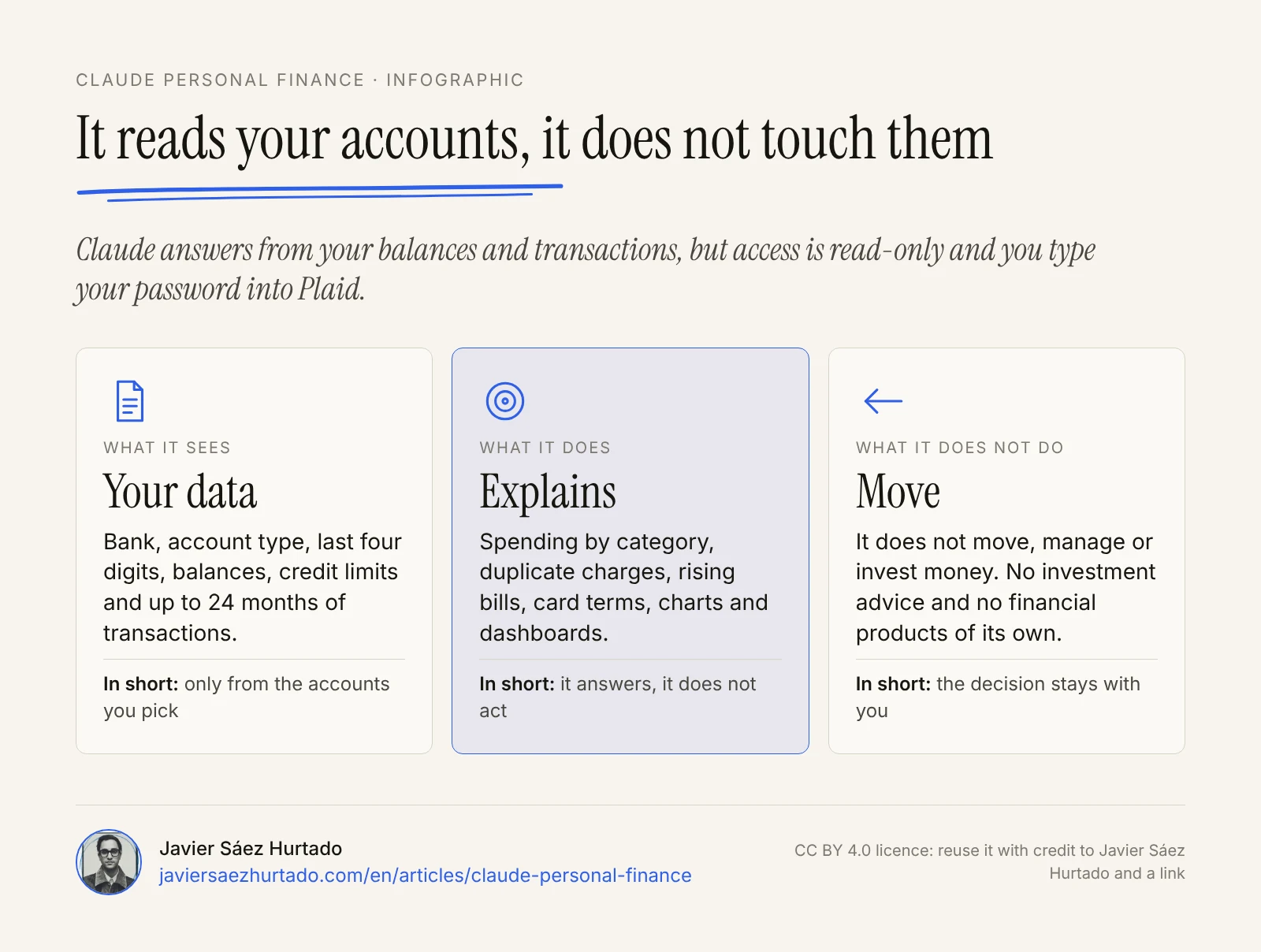
With your accounts connected, Claude can:
- Add up your spending by category and compare it with earlier months. Anthropic’s example is the question “Where did my money go this month?”.
- Flag duplicate charges, unexpected fees and bills that keep going up.
- Explain terms you do not know, such as the APR on a card and the interest you have already paid.
- Build weekly charts, bill calendars and dashboards that you can keep adjusting. A bill calendar answers another practical question: how much is left once the fixed payments go out.
Anthropic leaves three things out on purpose. It does not give investment advice. It does not sell its own financial products: no cards, loans or savings accounts. And, like the rest of Claude, it has no ads or sponsored recommendations.
What data does Claude see from your bank?
It sees what it needs to talk about your spending, and nothing that would let it make payments. According to Anthropic’s announcement and Help Center, Claude gets:
- the name of the bank and of each account, its type and the last four digits;
- balances and credit limits;
- up to 24 months of transactions.
You can link checking accounts, credit cards, loans and investment accounts. For the last three, Claude only reads balances and credit limits. It does not see holdings, trades, rates or terms. You can link up to 16 banks.
Your password never goes through Claude. You sign in to your bank yourself through Plaid and choose which accounts to share. To disconnect, open the Personal Finance page, go to the menu, choose “Manage linked accounts” and unlink each bank. You can also cut access from Plaid’s own site.
Who can use it, and is it available in Europe?
Not in Europe yet. As of 6 November 2026, Anthropic’s Help Center describes it as a beta on the Pro, Max and Ultra plans in the US only, with US banks only. It is not on the Free, Team or Enterprise plans.
It works on Claude on the web, Claude Desktop and the iOS and Android apps. There are clear limits on where the data can go. Claude cannot use linked accounts in scheduled tasks, in Cowork or in Claude Code, and not in Claude Duet, Anthropic’s proactive agent either. If your paid plan ends, you can no longer open Personal Finance.
Anthropic has given no dates for Europe. Plaid does work there: it says it has direct connections to nearly 2,000 European institutions. But a working connector is not the same as a launch. In the EU, third-party access to your account information is regulated by the payment services directive (PSD2), and Anthropic would need to fit the product to those rules.
Is it safe to connect your bank to Claude?
It is safer than what many people already do: paste statements or screenshots into a chat. With Plaid you do not share your password, you choose which accounts it sees and you can disconnect at any time. And because it is read-only, a mistake by Claude does not move money.
But read-only does not mean risk-free. Keep four risks in mind:
- Wrong numbers. Anthropic warns that Claude can make mistakes and asks you to check important figures with your bank. A wrong total does not take your money, but it can lead to a bad decision.
- Your chat history. Chats in the Personal Finance hub are not used to train models, but the data shows up in the chat and stays in your history until you delete it. The same goes for dashboards and artifacts that hold bank data.
- Losing your dashboard. If you unlink your last bank, your widgets, their settings (such as budgets) and your setup answers are deleted, and you cannot undo it.
- The pull to go further. Reading is the first step. The next thing people will ask for is an assistant that pays or moves money, and then the risk is of a different kind.
Banks are drawing the same line. In the piece on whether it is safe to let an AI agent shop for you, I noted that JPMorgan Chase lets third-party AI tools view some account data in read-only mode, but not send money. Personal Finance sits right at that line.
Claude Personal Finance vs ChatGPT’s finance tools
The two features share the basics: both use Plaid, both started in the US only and both answer from your real data. The differences are in scope and timing.
Claude and ChatGPT with your accounts
Information as of 6 November 2026
| Claude Personal Finance | Finances in ChatGPT | |
|---|---|---|
| Launch | 5 Nov 2026, beta | 15 May 2026, preview |
| Plans at launch | Pro, Max and Ultra | Pro |
| Countries | US only | US only at launch |
| Connection | Plaid | Plaid, more than 12,000 institutions |
| Investments | Balances only | Dashboard with portfolio performance |
| Moving money | No: read-only | Not part of the announcement |
| Disconnecting | Per bank; the dashboard is deleted with the last one | From Settings; data removed within 30 days |
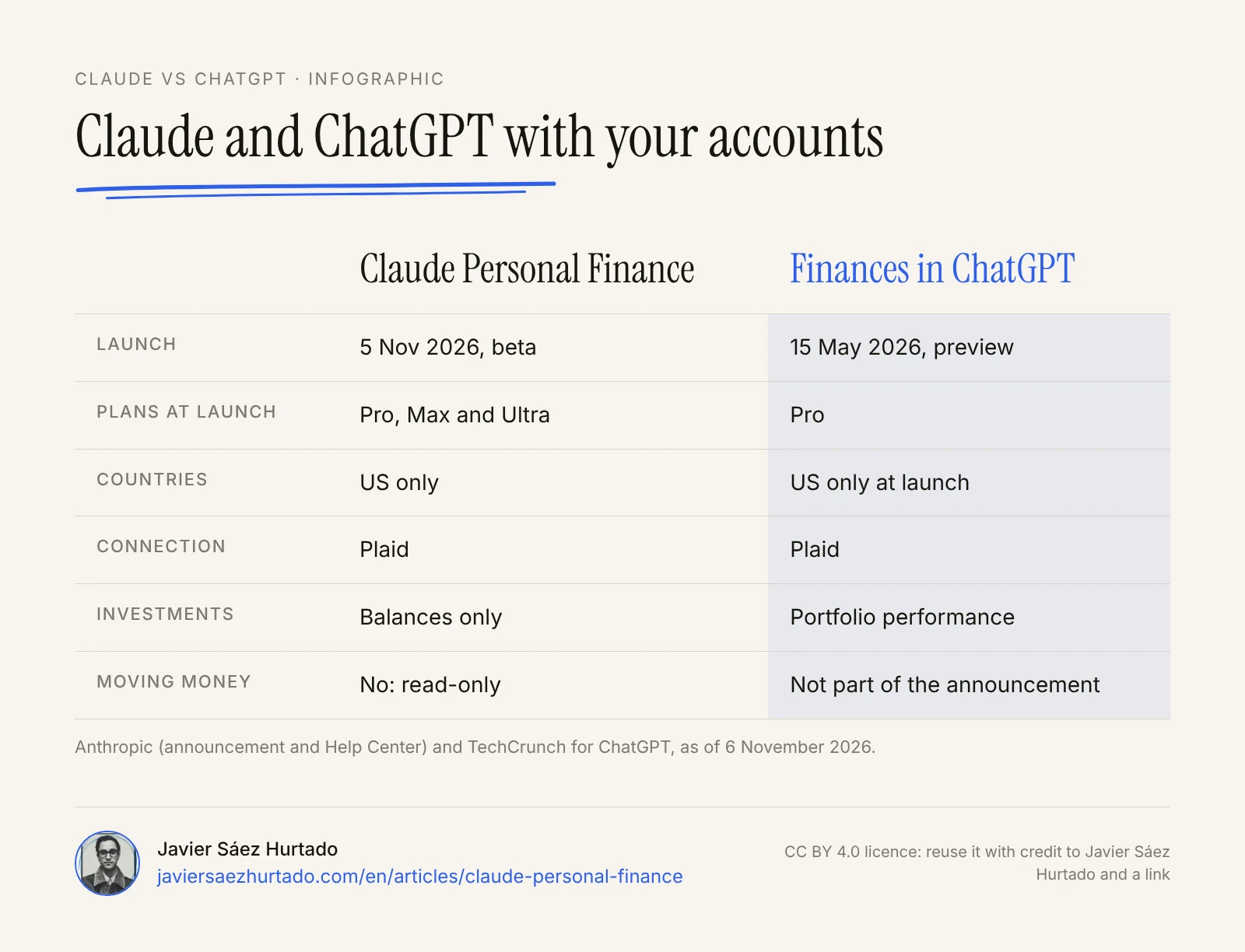
According to TechCrunch, OpenAI launched its personal finance tools on 15 May 2026 as a preview for the Pro plan in the US, with a dashboard of portfolio performance, spending, subscriptions and upcoming payments. Claude arrives almost six months later, on more plans from day one and with a narrower view of investments. If you have read about ads in ChatGPT, there is one more difference Anthropic points out: Personal Finance has no ads or sponsored recommendations.
What does it mean for people and companies in Europe?
Today, nothing you can use: neither the product nor European banks are on the list. But it shows where assistants are going, and it is worth getting ready before it arrives.
- For individuals. If you already use Claude or ChatGPT to talk about money, the careful choice is still not to paste full statements into a normal chat. When an official connection reaches Europe, it will be better than copying data by hand, as long as you check which accounts you connect.
- For companies. Personal Finance is not on Team or Enterprise. It is a personal tool, not a treasury tool, and it does not appear in company Claude accounts. What does make sense is a clear policy on which financial data, your own or your clients’, may be shared with an assistant.
- For regulators. In the EU, viewing someone’s account information is a payment service regulated by PSD2. Whether these products arrive depends on how they fit that framework, not only on the technology.
My view: let it read, not move
I think this is a good design, precisely because of what it does not do. An assistant that sorts your spending, finds a repeated charge and explains the small print on a card saves real time, and the cost of a mistake is small if you make the decisions.
What I would not do is take the next step without thinking. Reading your accounts and moving your money are very different things. Anything that cannot be undone needs a person in front of it. High-value accounts, payments and investment decisions stay with you and, when needed, with a licensed professional. Anthropic seems to agree when it says Claude works best alongside the licensed professionals and regulated firms you already trust.
If I lived in the US, I would test it like this: one checking account, no cards or investments at first, specific questions, figures checked against the bank, and chats I do not need deleted.
Transparency: Convexify, the firm I founded, is part of the OpenAI Select Partner program, and OpenAI competes with Anthropic. This article is based on public documentation from Anthropic and Plaid and on the linked sources.
Key takeaways
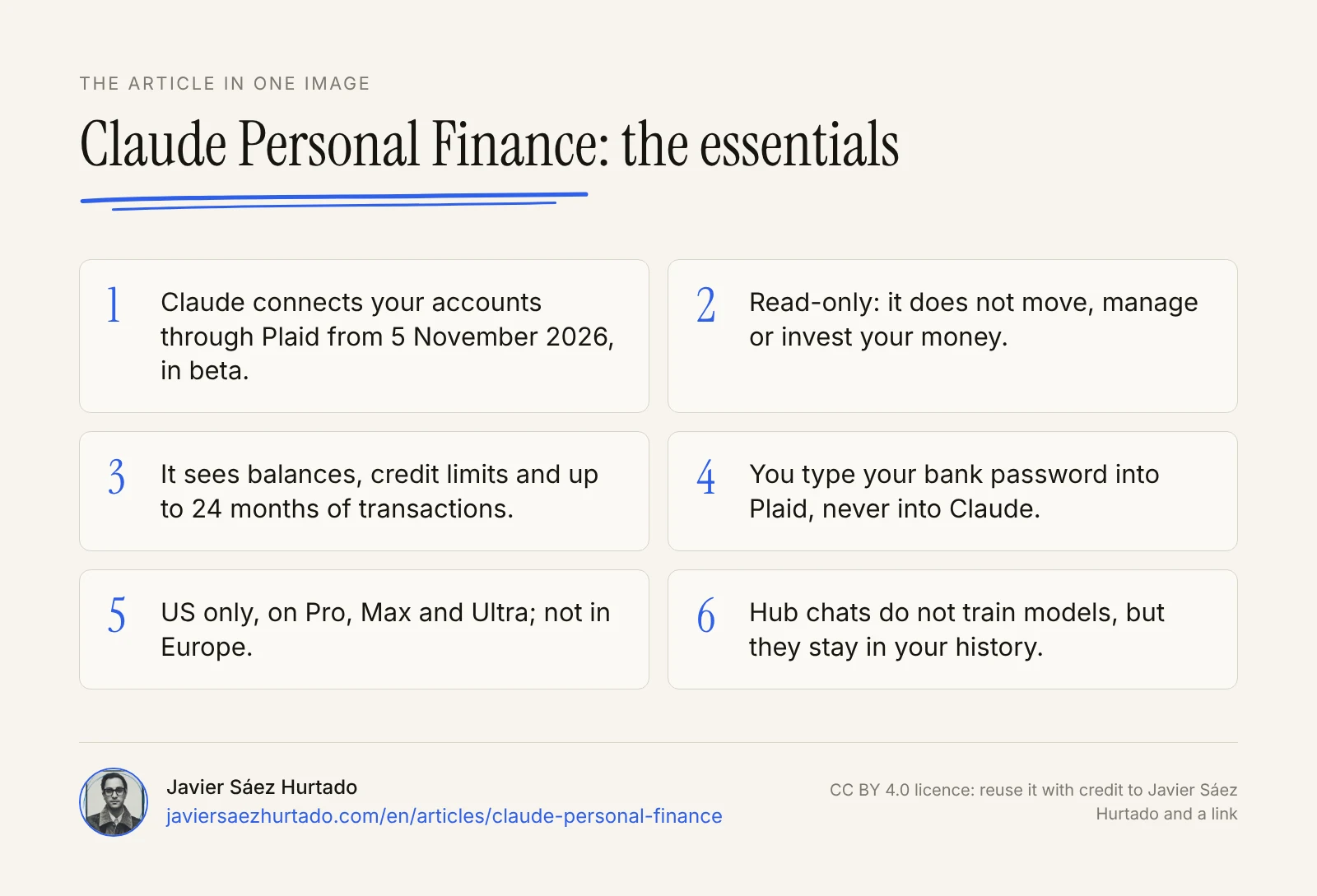
- Claude Personal Finance connects your accounts through Plaid from 5 November 2026, in beta.
- It is read-only: it does not move, manage or invest money, and it gives no investment advice.
- It sees balances, credit limits and up to 24 months of transactions; your password never goes through Claude.
- It is US-only, on Pro, Max and Ultra; not on Free, Team or Enterprise, and not in Europe.
- Hub chats do not train models, but they stay in your history until you delete them.
The article in one image
Frequently asked questions
What is Claude Personal Finance?
It is a Claude feature, announced by Anthropic on 5 November 2026, that connects your bank and card accounts through Plaid. With that data Claude answers questions about your spending, flags duplicate charges or rising bills, and builds charts, bill calendars and dashboards.
Can Claude move money from my account?
No. Anthropic says access is read-only and Personal Finance cannot move, manage or invest your money. It does not offer its own cards, loans or savings accounts, and it shows no ads or sponsored recommendations.
Does Claude see my bank password?
No. You sign in to your bank through Plaid, a service that connects apps to banks, so Claude does not ask for or see your password. It gets the bank and account name, the last four digits, balances, credit limits and up to two years of transactions.
Is Claude Personal Finance available outside the US?
Not yet. As of 6 November 2026 it is a beta for the Pro, Max and Ultra plans in the US only, and you can link US banks only. Anthropic has not announced dates for Europe or other countries.
Does Anthropic use my bank data to train Claude?
Anthropic says chats in the Personal Finance hub are not used to train its models. The data appears in the conversation and stays in your chat history until you delete the chat, subject to its data retention practices.
How is it different from ChatGPT’s personal finance tools?
Both use Plaid and started in the US only. ChatGPT launched its version on 15 May 2026 for the Pro plan and also shows investment performance. Claude arrived on 5 November on Pro, Max and Ultra, and for investment accounts it only reads balances.
Sources
- Claude, Introducing Personal Finance in Claude (5 Nov 2026)
- Claude Help Center, Use Personal Finance in Claude (checked 6 Nov 2026)
- Claude Privacy Center, How long do you store my data?
- Plaid, global coverage (checked 6 Nov 2026)
- Plaid Docs, European institutions (checked 6 Nov 2026)
- Directive (EU) 2015/2366 on payment services in the internal market (PSD2)
- TechCrunch, Claude can now analyze your spending with its new Personal Finance tool (5 Nov 2026)
- The Next Web, Anthropic lets Claude read your bank accounts, but not move money (5 Nov 2026)
- Android Authority, Anthropic rolls out Claude Personal Finance (5 Nov 2026)
- TechCrunch, OpenAI launches ChatGPT for personal finance (15 May 2026)