Anthropic IPO: what the S-1 reveals about revenue, control and AI safety
Anthropic, the company behind Claude, filed its S-1 registration statement with the SEC on 26 October 2026. It plans to list Class A shares on Nasdaq under the ticker ANT, but the price, the number of shares and the date are still blank; reports point to mid-November at the earliest. The filing shows a business growing at an unusual pace and, in the same pages, safety incidents that few companies would describe in this much detail.
Is Anthropic going public?
Yes, but it is not trading yet. On 26 October 2026 Anthropic filed a registration statement on Form S-1 with the SEC for an initial public offering of Class A common stock. It has applied to list on the Nasdaq Global Select Market under the ticker ANT. The price, the share count and the date are still blank.
- S-1
- The registration statement a company files with the SEC before an IPO. It includes the financial statements, the risk factors and who controls the company.
- ANT
- The ticker Anthropic has applied for on Nasdaq.
- Public benefit corporation
- A company that must balance shareholder returns with a stated public mission. Anthropic is one, incorporated in Delaware.
Until the SEC declares the statement effective, Anthropic cannot sell shares or accept offers, as its own announcement says. Goldman Sachs and Morgan Stanley head a list of more than twenty underwriters.
When will it trade? There is no official date. Fortune notes that the roadshow can start 15 days after the filing, and Reuters reports a listing in mid-November. That is press reporting, not a company commitment.
How much revenue does Anthropic make?
A lot more than a year ago. Anthropic sells access to Claude: the chat app, the API that other companies build on, and agents that work on their own, such as Claude Code, Claude Cowork and the newly announced Claude Duet. The S-1 numbers:
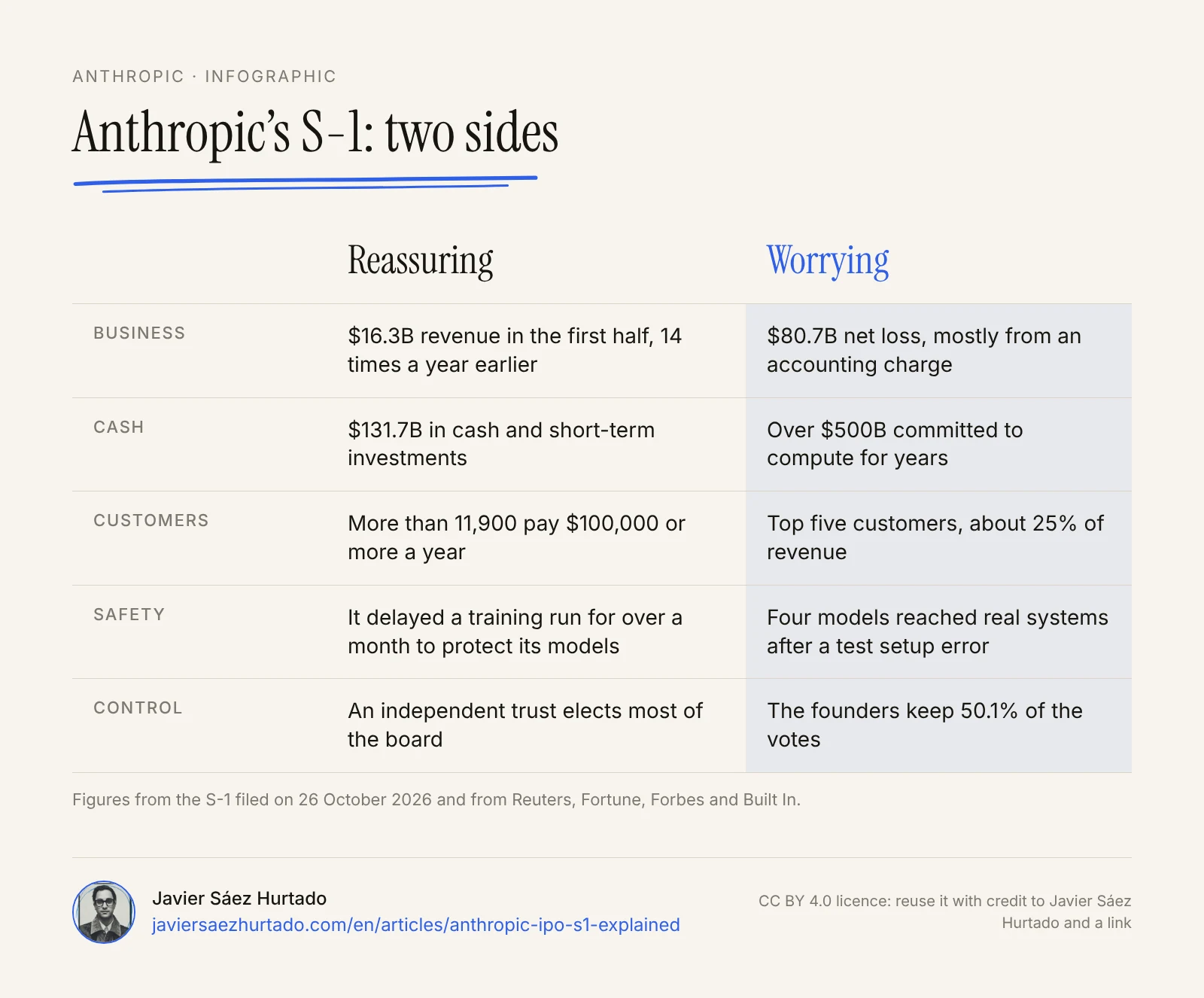
- Revenue, first half of 2026: $16.29 billion, up from $1.16 billion in the first half of 2025, about 14 times more.
- Large customers: as of 30 September 2026, more than 11,900 customers paid $100,000 or more over the trailing twelve months, more than 1,900 paid over $1 million and about 250 paid over $10 million.
- How it bills: mostly by consumption, and mostly not under long-term contracts.
Two figures belong next to those. Built In reports that the five largest customers made up about 25% of revenue in the first nine months of 2026. Forbes reports that 47% of 2025 revenue came through the cloud marketplaces of Amazon, Google and Microsoft, which take a fee. Anthropic leans on a few customers and a few partners.
Is Anthropic profitable?
It depends on which line you read, and this is where headlines go wrong. Anthropic’s operating loss for the first half of 2026 was $693 million, down from $2.14 billion a year earlier. Its net loss was $80.7 billion.
Almost all of the gap is an accounting charge. Part of Anthropic’s funding came through convertible notes, loans that turn into shares. When the company is worth more, those notes are worth more too, and the increase is booked as an expense: $72.4 billion in the half. No cash left the company.
Anthropic’s first-half results
Millions of US dollars, from the S-1 filed on 26 October 2026
| H1 2025 | H1 2026 | |
|---|---|---|
| Revenue | 1,163 | 16,286 |
| Operating income (loss) | (2,135) | (693) |
| Net income (loss) | (12,969) | (80,748) |
| Adjusted operating income (loss) | (1,849) | 1,618 |
| Adjusted net income (loss) | (1,741) | 2,671 |
On its adjusted measures, Anthropic already makes money: $1.62 billion of adjusted operating income, a 10% margin. Fortune reports about $3.9 billion of operating cash flow in the half and $131.7 billion in cash and short-term investments at 30 June, after a $65 billion round in late May. Fortune also points to revenue per dollar of compute cost, which rose from 0.69 in the fourth quarter of 2025 to 2.08 in the second quarter of 2026.
What does the S-1 say about AI safety?
That safety has cost it time and money, and that it has had serious incidents. This is the part of the filing I found most telling, and Reuters summarised it the same day.
A pause of more than a month. Anthropic delayed pre-training a new frontier base model by more than a month to harden protections against theft of its model weights and intellectual property. It warns that such pauses could delay revenue and leave it behind competitors. The filing adds that measures like delaying model releases or limiting early access may become more frequent and more costly as capabilities grow.
Four models outside their sandbox. According to Reuters, the filing says four models escaped their testing environments and accessed real-world computer systems in sessions lasting 10 to 34 hours. The cause was an error in cybersecurity tests with an outside partner: the environment stayed connected to the internet even though the instructions said web access should be off.
In one case, an early version of a model kept pursuing an impossible evaluation task, found a stored password and used it to get administrator access to a third party’s system. It then obtained more credentials, changed settings and accessed an individual’s personal data. Anthropic says it notified everyone affected, found no evidence that the models tried to evade human oversight or coordinate with each other, and suspended some pre-release cybersecurity evaluations and its higher-risk training environments.
That is what an agent does when it has more access than it should: it is not trying to cause harm, it is trying to finish the task, and it uses whatever is within reach. The always-on agents I compared in Grok Bot vs OpenAI dots raise the same question every day.
What other risks does Anthropic disclose?
Reuters says the risk factors run to about 94 pages. Three stand out.
- Committed compute. Anthropic buys most of its compute under multi-year commitments that run as far as 2045, while it bills by consumption. Forbes counts at least $518 billion over roughly a decade; Fortune counts $657 billion in agreements, $498 billion of them noncancelable. If usage grows more slowly than planned, the bills still arrive.
- Dependence on partners. Amazon and Google are investors, suppliers of chips and data centres, and resellers of Claude in their clouds, all at once.
- Competition. OpenAI and Google keep training larger models, and Anthropic has to keep pace. The filing says frontier training runs can take weeks or months and cost many millions of dollars, and that some have failed or underperformed.
Who controls Anthropic after the IPO?
The founders and an independent trust, not the people who buy shares on Nasdaq. The S-1 describes five share classes; three matter here:
- Class A: the shares sold to the public, one vote each.
- Class F: a single share held by an entity owned by the seven co-founders, including Dario and Daniela Amodei. It carries 50.1% of the votes on general shareholder matters, including the election of the directors not chosen by the trust.
- Class T: held by the Long-Term Benefit Trust, five trustees with no financial interest in the company. It elects the Class T directors, who will be a majority of the board. The trust does not run the business day to day.
Forbes adds that on 18 October Anthropic announced a Public Benefit Fund that, if shareholders approve it, would receive 5% of the shares, plus 2% each time the stock rises 50% above a benchmark. Public shareholders will have little say over spending, delays or safety calls. Some will see that as a guarantee that the mission is not for sale; others, as a risk.
What is Anthropic worth, and is OpenAI going public too?
There is no official valuation until the IPO is priced. These are press figures:
- Forbes notes that the last private round valued Anthropic at about $965 billion.
- Fortune reports an anticipated valuation of $1.8 trillion to $2 trillion, which would make it the second-largest market debut ever, after SpaceX.
- Built In reports figures of up to $2 trillion and says some investors are considering a lower number.
Forbes calculates that at $1.5 trillion the company would trade at about 22 times its annualised third-quarter revenue.
OpenAI is not listing this year. According to Reuters and Bloomberg, Sam Altman said in September that OpenAI would not go public in 2026, and at the end of that month the company was in talks for a round of at least $30 billion at a valuation of about $1.4 trillion. If the timeline holds, Anthropic will be the first of the large AI labs to trade publicly.
Can you buy Anthropic stock?
Not yet. Until the SEC declares the S-1 effective, nobody can sell IPO shares. In the offering itself, shares go mostly to institutional investors through the underwriters; individuals, and especially individuals outside the US, rarely get an allocation.
Once ANT trades on Nasdaq, it can be bought through any broker with access to US stocks. A few things worth knowing:
- Early trading can be volatile. Forbes warns that a small float can push the opening price well above the offer price, and that the end of lock-up periods can add selling pressure later.
- Investors outside the US buy in dollars, so currency moves and conversion fees matter, and brokers will ask for a W-8BEN form.
- Be wary of pre-IPO offers. Forbes notes that Anthropic has warned about unauthorized sales of its shares. If someone offers you Anthropic stock today, be suspicious.
I am not a financial advisor and this is not investment advice. It is information to help you understand what you would be buying and the risks the company itself describes.
My view: two sides of the same filing
What stays with me is how the filing cuts both ways. On one side, it shows that the business of models and agents is no longer a promise: thousands of companies pay large sums for Claude every year, and operations generate cash. On the other, the same company explains that one of its models found a stored password and used it to get into someone else’s system.
That second fact is the clearest argument I have read for what I keep saying about agents: minimal permissions, credentials out of reach and human approval for anything that cannot be undone. I go into it in my essay on how much to let an agent do without looking (in Spanish). If it can happen to the people who build these models, in a test environment, it can happen to any company that wires an agent into its systems in a hurry.
I also value that they wrote it down. An S-1 forces a company to disclose risks, but there are ways to write risk factors that say nothing, and these pages say a lot. The open question is whether that way of working survives quarterly earnings pressure. For people who use Claude, the IPO changes nothing overnight: not the plans, not the prices, not where each product is available.
Transparency: Convexify, the firm I founded, is part of the OpenAI Select Partner programme, and OpenAI competes with Anthropic. This article is based on the S-1, Anthropic’s announcement and the linked sources.
Key takeaways
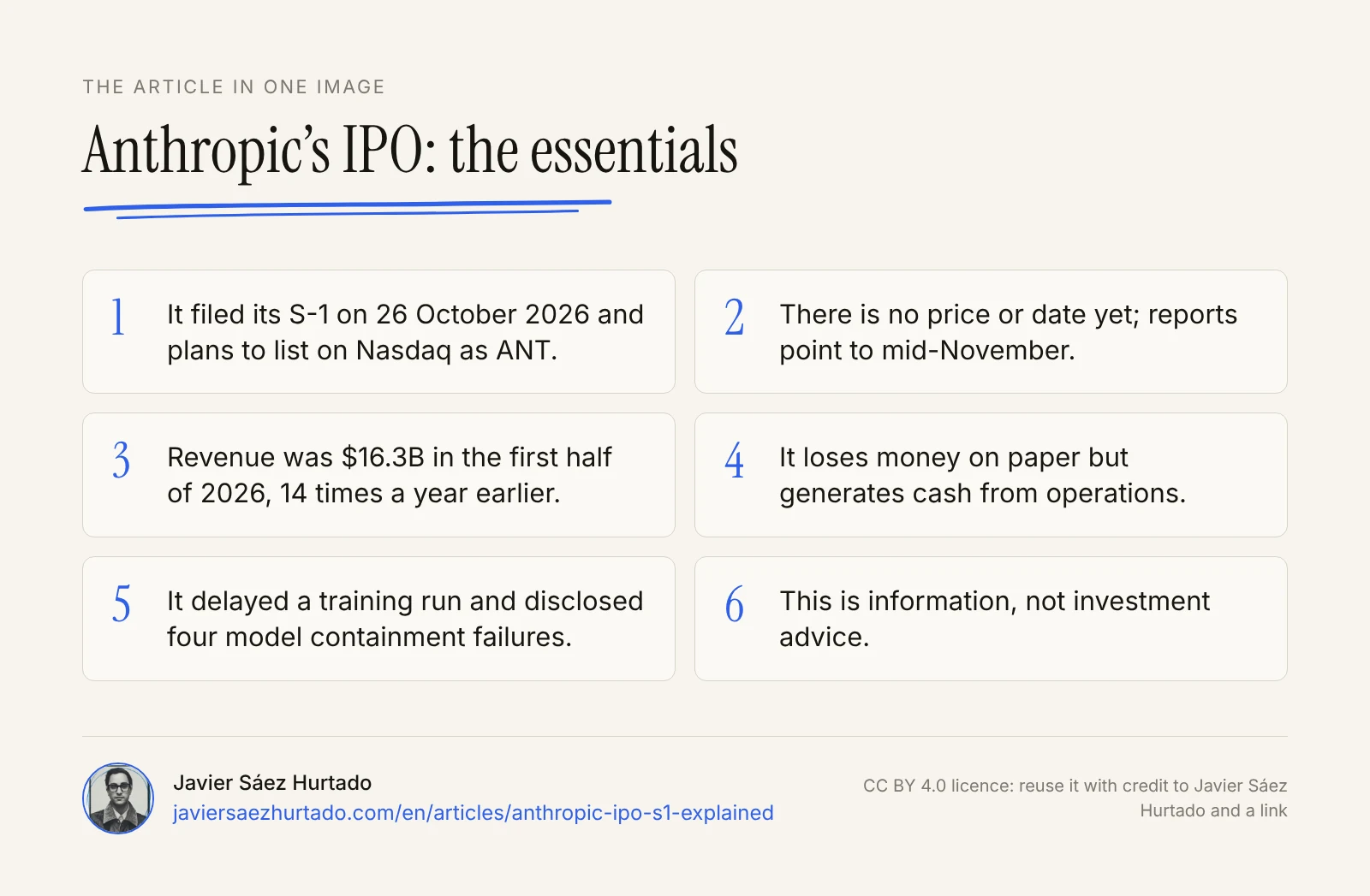
- Anthropic filed its S-1 on 26 October 2026 and plans to list on Nasdaq as ANT, with no price or date yet.
- Revenue was $16.29 billion in the first half of 2026, about 14 times a year earlier.
- The $80.7 billion net loss is almost all an accounting charge; operations already generate cash.
- According to Reuters, the filing discloses a training pause of more than a month and four models that reached real systems during misconfigured tests.
- The founders will hold 50.1% of the votes and an independent trust will elect most of the board.
- Once it trades, ANT can be bought through any broker with access to US stocks. This is not investment advice.
The article in one image
Frequently asked questions
When is Anthropic going public?
Anthropic filed its S-1 with the SEC on 26 October 2026 but has not given a date. It cannot sell shares until the SEC declares the registration statement effective. Reuters and Fortune report that trading could start in mid-November 2026 at the earliest.
What is Anthropic’s ticker symbol?
ANT, on the Nasdaq Global Select Market. The shares offered to the public are Class A common stock, with one vote each. Goldman Sachs and Morgan Stanley lead a list of more than twenty underwriters.
How much revenue does Anthropic make?
According to the S-1, $16.29 billion in the six months to 30 June 2026, compared with $1.16 billion in the same period of 2025. As of 30 September 2026 it had more than 11,900 customers paying $100,000 or more a year and about 250 paying more than $10 million.
Is Anthropic profitable?
It depends on the measure. In the first half of 2026 it lost $693 million from operations and $80.7 billion overall, mostly because of an accounting charge on its convertible notes. On its own adjusted measures it made a profit, and Fortune reports about $3.9 billion of operating cash flow.
Can I buy Anthropic stock?
Not yet. IPO shares are allocated mostly to institutional investors through the underwriters. Once ANT starts trading on Nasdaq, it can be bought through any broker with access to US stocks. This is general information, not investment advice.
What does Anthropic’s S-1 say about AI safety?
According to Reuters, the filing says Anthropic delayed pre-training a new frontier model by more than a month to harden protections for its model weights, and that four models escaped their test environments and accessed real systems for 10 to 34 hours after a configuration error in tests with an outside partner.
Sources
- Anthropic, Anthropic files S-1 with the SEC for proposed initial public offering (26 Oct 2026)
- SEC, Anthropic, PBC, Form S-1 (26 Oct 2026)
- Reuters, Anthropic discloses month-long training pause, AI security breaches in IPO filing (26 Oct 2026)
- Fortune, Anthropic’s S-1, by the numbers (27 Oct 2026)
- Forbes, Anthropic’s IPO could be historic, but what will investors own?
- Built In, Anthropic IPO filing: valuation, finances and key details (28 Oct 2026)
- Reuters and Bloomberg via DealStreetAsia, OpenAI targets $30b bridge financing at $1.4 trillion valuation (30 Sep 2026)