Gemini 4 Hydrogen explained: what Google’s fast model does, what it costs and when to use it
Gemini 4 Hydrogen is the fast, lower-cost model in Google’s Gemini 4 family, released on 12 November 2026 for everyday coding and agent work. It is already in the Gemini app, in AI Mode in Search and in the API, where it costs 1.50 dollars per million input tokens and 7.50 per million output tokens.
What is Gemini 4 Hydrogen?
Gemini 4 Hydrogen is the fast model in Google’s Gemini 4 family. Koray Kavukcuoglu of Google DeepMind announced it on 12 November 2026, and it has been available to everyone since that day. Google describes it as the everyday model for coding and agent work: fast, cheap and good enough for most tasks.
- Gemini 4 Hydrogen
- The new model. Its API name is gemini-4-hydrogen. Its model card says it was adapted from Gemini 4 Carbon.
- Gemini 4 Carbon and Argon
- The two frontier models in the family, built to reason for a long time on the hardest problems. Carbon is the most capable.
- Thinking levels
- How much the model “thinks” before it answers. Hydrogen has four: low, medium, high (the default) and a new one, xhigh, the deepest.
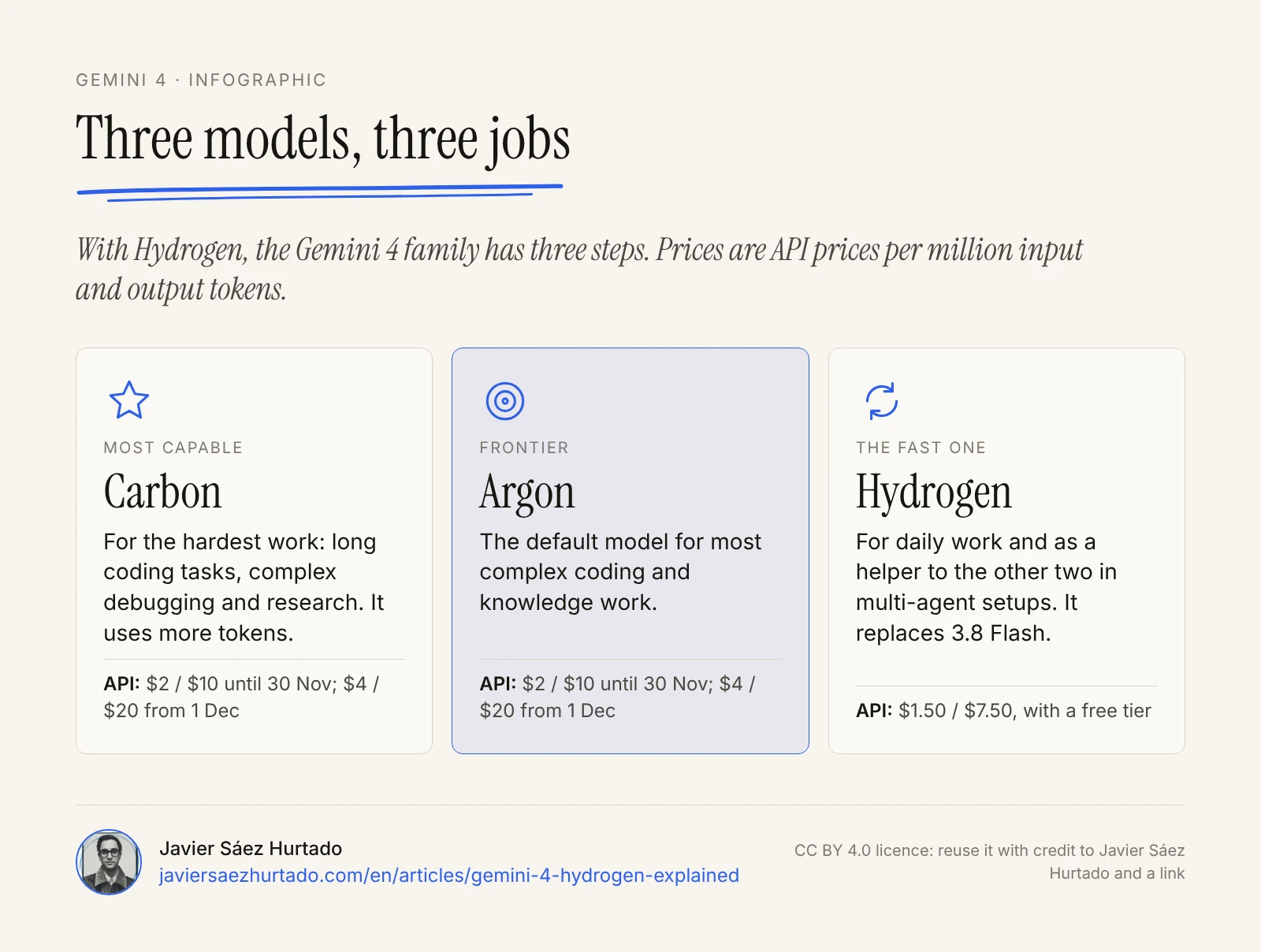
With Hydrogen, the family now has three steps. Argon arrived on 30 September and Carbon opened to developers and companies on 10 November, as I explain in the article on Gemini 4 Argon and Carbon. Hydrogen takes the place Gemini 3.8 Flash had until now: the model people use all day because it answers fast and costs little.
What is new is the role. Google does not present it only as a small chat model. It presents it as the “worker” in systems with several agents: the frontier model plans and checks, and Hydrogen carries out the steps. That is what the new Orchestrator feature does in Google Antigravity, Google’s agent-first coding platform.
What is Gemini 4 Hydrogen good for?
For the daily work people give to a fast model today: writing and fixing code in a repository, building websites, running tasks with tools, working with documents and writing first drafts. The model card puts it simply: fast execution, on its own or as a sub-agent next to frontier models.
These are the technical facts worth keeping at hand, from the model card and Google’s documentation:
- Context: one million tokens shared by input, thinking and output.
- Output: up to about 64,000 tokens in a normal answer, and up to one million in a background long-output mode.
- Inputs: text, images, audio, video and PDF.
- Knowledge: up to March 2026, with some topics less up to date.
The model card also lists known limits. Like any language model, it can make things up. It is sometimes slow or times out, and at the higher thinking levels it uses more tokens to get better results. Google says it is still working on resistance to attempts to get around its rules.
What do the Gemini 4 Hydrogen benchmarks say?
That it is much better than Gemini 3.8 Flash, and that on some tests it gets close to more expensive models. The number Google highlights most is independent: on the Artificial Analysis Intelligence Index, Hydrogen scores 51 at the default level and 54 at xhigh, against 50 for Argon and 31 for 3.8 Flash.
The other numbers come from Google. Its table compares Hydrogen with Anthropic’s Claude Sonnet 5.5 and OpenAI’s GPT-6.1 Terra:
Gemini 4 Hydrogen against its rivals
A selection from the table Google published on 12 November 2026
| Test | Gemini 4 Hydrogen | Claude Sonnet 5.5 | GPT-6.1 Terra |
|---|---|---|---|
| Coding in the terminal (Terminal-Bench 4.1) | 57.0% | 63.9% | No figure |
| Work with tools (Agents' Last Exam v1.1) | 71.6% | 60.4% | 69.8% |
| Office automation (AutomationBench-AA) | 76.1% | 71.8% | 60.2% |
| Computer use (OSWorld-2.1, subset) | 77.6% | 83.9% | 74.2% |
| Reading charts (Chartography) | 66.6% | 61.6% | 63.2% |
| Reasoning (HLE-Diamond) | 58.8% | 53.3% | 47.3% |
Read this table with three points in mind. First, Google made it. Second, Hydrogen does not win everything: Claude Sonnet 5.5 is ahead in terminal coding, computer use and a science test. Third, on Terminal-Bench 4.1 Hydrogen goes from 18.2% for 3.8 Flash to 57%. That is a huge jump, and it is worth checking with your own tasks.
Google also gives safety figures against 3.8 Flash, again from its own tests. It says Hydrogen is half as likely to get around permissions, 2.3 times more resistant to prompt injection on the Gray Swan test, and takes 12 times fewer actions nobody asked for. That is good news for anyone using it as an agent, but it is not a guarantee.
How much does Gemini 4 Hydrogen cost?
In the Gemini API it costs 1.50 dollars per million input tokens and 7.50 per million output tokens, and output includes thinking tokens. I checked the official Google AI Studio pricing page on 13 November 2026. Unlike Argon and Carbon, it has no launch price with an end date.
| Tier | Input (per million tokens) | Output (per million tokens) |
|---|---|---|
| Standard | $1.50 | $7.50 |
| Batch and Flex (slower answers) | $0.75 | $3.75 |
| Priority (faster lane) | $2.70 | $13.50 |
| Cached input (automatic only) | $0.075 |
Google AI Studio and the API have a free tier with usage limits. The small print matters: on the free tier, Google uses what you send to improve its products.
VentureBeat calls Hydrogen a “pricier” successor to Flash, and that is fair. Gemini 3.8 Flash costs 0.75 and 3.75 dollars today under a launch price that runs until 31 December. From 1 January 2027 it goes up to 1.50 and 7.50, the same as Hydrogen. According to the same outlet, the cheapest small models from Anthropic and OpenAI, such as Claude Haiku 5.5 and GPT-6 Luna, start at 0.10 and 0.50 dollars.
The price per million tokens is not the whole story, because each thinking level uses a different amount. Using the Artificial Analysis data that VentureBeat reports, one task on its index costs 1.87 dollars on average with Hydrogen at high and 3.16 at xhigh, against 0.41 with Claude Haiku 5.5, which scores 36. Hydrogen gives better quality, but it is not the model for large volumes of simple tasks.
Where can you use Gemini 4 Hydrogen?
In almost every Google product from day one:
- Gemini app. It is in the model picker for everyone. On the free plan, the app uses it when automatic model selection decides it fits your question.
- Search. It is the default model for AI Mode worldwide, in every language AI Mode supports, and it handles the hardest questions in AI Overviews.
- Google AI Studio and the Gemini API, on the free and paid tiers. Also in Android Studio.
- Google Sheets, for eligible business accounts and for AI Pro and Ultra.
- Google Antigravity, for the paid AI Pro and Ultra plans.
- Companies, through Gemini for business, Google Cloud’s offer.
In Antigravity it comes with Orchestrator, which splits the work in one session between a frontier model and Hydrogen. Google says that on Terminal-Bench 4.1 it gets close to Carbon’s results while using 24% less quota and finishing 19% faster. Orchestrator with Carbon is for Ultra, and with Argon, for Pro.
Google has posted a demo on its Gemini channel in which Hydrogen builds interactive 3D visualisations:
What changes if you already use Gemini 3.8 Flash?
More than it seems. Google recommends Hydrogen as the natural upgrade from 3.8 Flash, which has no shutdown date. But its migration guide asks you to check several things before you change the model name:
- Default thinking. It moves from medium to high. If you change nothing, every answer thinks more, takes longer and costs more. The minimal level is gone.
- Settings that go away. You need to remove temperature, top_p and top_k from your calls.
- Caching. Explicit caching is not supported. Only automatic caching works, from 4,096 tokens.
- Output limits. Google advises removing low output token caps, because thinking counts inside them.
My advice for a technical team: run both models side by side on your usual work, start at low or medium, and compare quality, time and cost before you move everything. A better model does not mean you need it on every call.
Can you use Gemini 4 Hydrogen in Europe?
Yes. Google says it is rolling it out globally, and I found no exclusion of the European Economic Area on its launch pages. In Spain and the rest of Europe it already comes through four routes: the Gemini app, AI Mode in Search, Google AI Studio and the API.
For a company in Europe, these are the practical points:
- Paid tier for real data. The free tier is fine for testing, but Google uses what you send to improve its products. With customer data or internal information, use the paid tier or Gemini for business and check the data processing terms.
- Do the maths per task, not per token. The thinking level changes the bill a lot.
- Do not switch providers because of a table. If you already work with OpenAI or Anthropic models, compare them on your own tasks. In my piece on GPT-6.1 Terra I explain how I choose between OpenAI’s tiers, and the same logic applies here.
How I would use Gemini 4 Hydrogen
I think Hydrogen is the Gemini 4 release most people will notice, even if it is not the most capable one. Most questions to Search, to the app and to a coding agent do not need a frontier model. Now the default model gives results that were high-end a few weeks ago.
What interests me most is the split of roles: a strong model that plans and checks, and a fast one that does the work. It is a good way to cut costs, but it also adds a layer. If the helper gets a step wrong and the frontier model misses it, the mistake travels further. So this is how I would use it:
- For coding, in a test repository or a separate branch, with limited permissions, and with every change reviewed before it is merged.
- For documents and data, on reading and drafting tasks, with a person checking the result before it is used.
- For anything that cannot be undone, nothing without human approval: no sending messages in my name, no payments, no deleting, no touching high-value accounts. It is the line I set out in the essay on what you would let an agent do without looking (in Spanish), and a faster model does not change it.
The safety gains Google reports point the right way, but they come from its own tests. Until there are independent evaluations, the caution comes from you, through the permissions you give it.
Transparency: Convexify, the firm I founded, is part of the OpenAI Select Partner programme. This article compares Gemini 4 Hydrogen with OpenAI and Anthropic models using Google’s public documentation and the linked sources.
Key takeaways
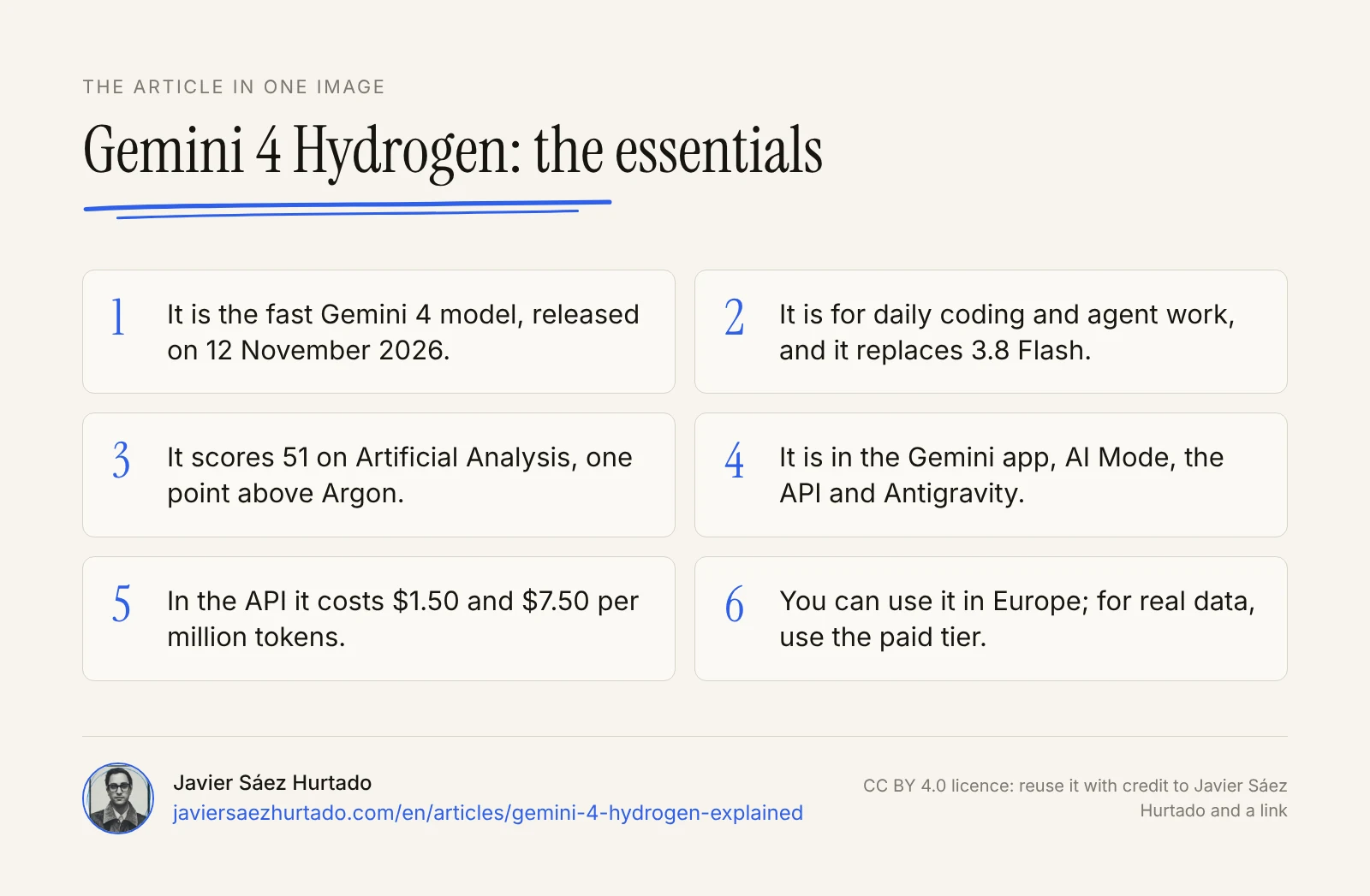
- Gemini 4 Hydrogen is the fast model in the Gemini 4 family, released by Google on 12 November 2026 for daily coding and agent work.
- It replaces Gemini 3.8 Flash as the everyday model and scores 51 on the Artificial Analysis index, above Argon.
- It is in the Gemini app, AI Mode in Search, the API and, for AI Pro and Ultra, Google Antigravity.
- In the API it costs 1.50 and 7.50 dollars per million tokens, twice the launch price of 3.8 Flash.
- You can use it in Europe. For real data, use the paid tier, and keep a person checking anything important.
The article in one image
Frequently asked questions
What is Gemini 4 Hydrogen?
It is an AI model from Google, released on 12 November 2026. It is the fastest and cheapest model in the Gemini 4 family and is built for everyday coding and agent work. Its model card says it was adapted from Gemini 4 Carbon.
Is Gemini 4 Hydrogen free?
Partly. In the Gemini app, free users get it when automatic model selection decides it fits the question. Google AI Studio and the Gemini API have a rate-limited free tier. In Google Antigravity, Hydrogen is only for the paid AI Pro and Ultra plans.
How much does Gemini 4 Hydrogen cost in the API?
On the standard tier, 1.50 dollars per million input tokens and 7.50 per million output tokens, thinking tokens included. Cached input costs 0.075 dollars, and Batch and Flex cost half. These are the prices on the official Google AI Studio page as of 13 November 2026.
What is the difference between Gemini 4 Hydrogen, Argon and Carbon?
Carbon is Google’s most capable model. Argon is the frontier model for most complex coding and knowledge work. Hydrogen is the fast one: cheaper, built for daily tasks and for working as a helper to the other two in multi-agent setups. In the API, Argon and Carbon cost 2 and 10 dollars per million tokens until 30 November and 4 and 20 from 1 December.
Does Gemini 4 Hydrogen replace Gemini 3.8 Flash?
Google calls it the recommended upgrade from Gemini 3.8 Flash, but Flash has no shutdown date. In the API it is more than a name change: the default thinking level moves to high, temperature settings and explicit caching go away, and the price is twice the Flash launch price.
Can you use Gemini 4 Hydrogen in Europe?
Yes. Google is rolling it out globally and none of its launch pages exclude the European Economic Area. In Europe you can reach it through the Gemini app, AI Mode in Search, Google AI Studio and the Gemini API.
Sources
- Google, Introducing Gemini 4 Hydrogen (12 Nov 2026)
- Google DeepMind, Gemini 4 Hydrogen model card (November 2026)
- Google DeepMind, Gemini page with Gemini 4 benchmarks (checked 13 Nov 2026)
- Google, Gemini 4 Hydrogen for developers (12 Nov 2026)
- Google AI Studio, what is new in Gemini 4 Hydrogen and migration guide (checked 13 Nov 2026)
- Google AI Studio, Gemini API pricing (checked 13 Nov 2026)
- Google AI Studio, Gemini API models (checked 13 Nov 2026)
- Google AI Studio, Gemini API changelog (checked 13 Nov 2026)
- Google, Google Search gets a major upgrade with Gemini 4 Hydrogen (12 Nov 2026)
- Google Antigravity, Gemini 4 Hydrogen in Google Antigravity (12 Nov 2026)
- Google, Gemini 4 Carbon is now available (10 Nov 2026)
- 9to5Google, Google announces Gemini 4 Hydrogen (12 Nov 2026)
- VentureBeat, Google launches Gemini 4 Hydrogen, a faster, smarter, pricier Flash successor (12 Nov 2026)