GPT-6.1 Terra: what OpenAI’s computer-use model is, what it costs and which ChatGPT model to use now
GPT-6.1 Terra is OpenAI’s mid-sized model, announced on 26 October 2026. It is built to understand images, use a computer and write, it is faster than Sol and Astra, and in the API it costs $1 per million input tokens and $5 per million output tokens. In ChatGPT it runs in Work and Codex from the Plus plan up, not on the free plan.
What is GPT-6.1 Terra?
GPT-6.1 Terra is OpenAI’s mid-sized model, announced on 26 October 2026. OpenAI describes it as a fast, efficient model that combines detailed visual reasoning, precise computer use and clearer, more natural writing. It replaces GPT-5.6 Terra, which was left out of the September refresh.
- GPT-6.1 Terra
- The new model. In the API it is called gpt-6.1-terra; it takes text and images in and returns text.
- ChatGPT Work
- The part of ChatGPT built for handing off tasks, with access to your tools and, if you allow it, your computer.
- Computer use
- A model’s ability to look at the screen, click, type and move between applications, the way you would.
To see where it fits, it helps to know that OpenAI now has four classes of model. From lowest to highest price and capability: Luna, Terra, Sol and Astra. Terra is on the second step: more capable than Luna, cheaper and faster than Sol and Astra. ChatGPT itself now has three areas, Chat, Work and Codex, and Terra lives in the last two.
The recent history explains the name. GPT-6 Astra arrived on 3 September, as I covered in GPT-6 Astra explained; GPT-6 Sol and GPT-6 Luna on 22 September; and GPT-6.1 Sol at DevDay on 29 September. The middle of the range still needed an update, and that is Terra.
What does GPT-6.1 Terra do with your computer?
Terra can look at what is on a screen and act on it: read a screenshot, decide where to click, type and move from one application to another. That is what turns a model into an agent that can do office work rather than just talk about it.
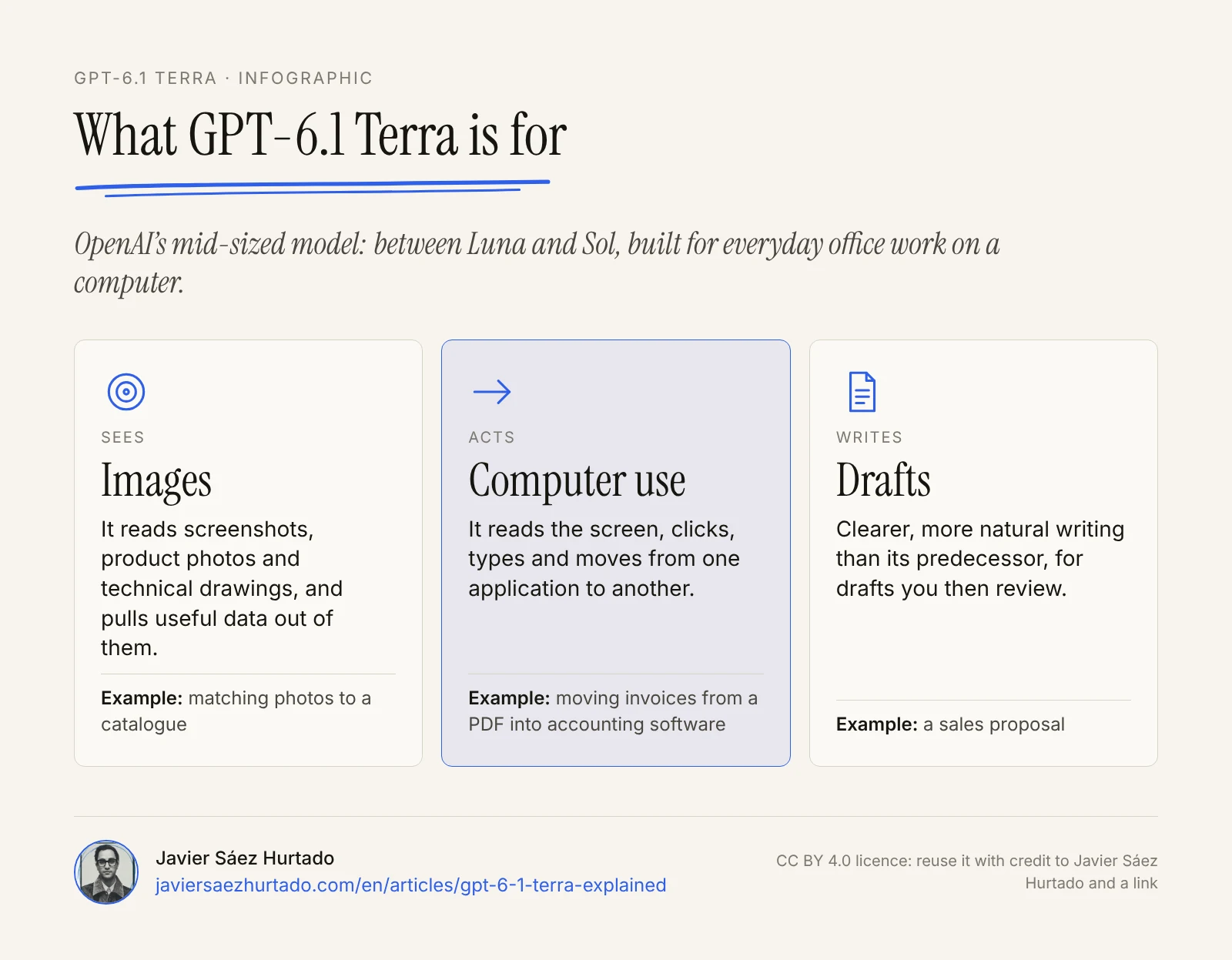
OpenAI’s examples are very much office work:
- Moving data between programs: copying invoices from a PDF into accounting software, or filling in a long form.
- Understanding images: matching product photos to catalogue entries or reading technical drawings. In OpenAI’s tests, according to The Next Web, it turned architectural drawings into a 3D model.
- Working with video: editing a video or producing a time-coded shot log.
- Writing: drafts of proposals and other texts that a person then reviews.
In ChatGPT this happens inside Work: the desktop app has a computer-use setting you have to switch on yourself, and in the browser it works through the ChatGPT extension. In the API, developers use it through the computer-use tool. In no case does it work on its own: someone has to give it access to a screen, and that is where the delicate part begins, which I come back to below.
What is better than GPT-5.6 Terra?
Almost everything, and it costs less. These are the clearest figures OpenAI publishes:
- Terminal coding: on Terminal-Bench 4.0, at maximum reasoning, it goes from 21.5% to 50.3%.
- Computer use: on OSWorld 2.1 it reaches 74.2% at $1.19 per task, against 57.1% and $4.76 for GPT-5.6 Terra.
- Errors: on an internal set of trick questions, at low reasoning, its error rate drops from 53.6% to 16.7%; at maximum it is 4.3%, close to Sol and Astra.
- Tool work: on Agents’ Last Exam it scores 60.0% at $1.01 per task, above GPT-6.1 Sol (58.6%) and level with Astra (59.3%), which costs seven times more per task.
Two caveats. First, these are the vendor’s own tests. Second, Terra does not win everything. On OSWorld 2.1, Anthropic’s Claude Sonnet 5.5 scores 83.9% at a higher cost per task, and Claude Opus 5.5 is ahead on Agents’ Last Exam (63.2%). OpenAI also says Terra is more than three times faster than Sol and Astra, and it still recommends those two for the hardest coding work.
Artificial Analysis, in an independent evaluation reported by The Decoder, gives it 48 points on its intelligence index, between GPT-6.1 Sol (52) and GPT-5.6 Terra (42).
Which ChatGPT plans get GPT-6.1 Terra?
ChatGPT Work and Codex, from the Plus plan up. OpenAI announced it for Plus, Pro, Enterprise and Edu, and its Codex usage table also lists the Business plan. It is not on the Free or Go plans: there, Codex only offers GPT-6 Luna. The regular chat has its own model lineup, and OpenAI presents Terra for Work and Codex.
To pick it in Work, open the model control under the text box and go to Advanced: the default quick settings do not include it. In the Codex command-line tool you need version 0.159.0 or later and launch it with codex -m gpt-6.1-terra.
The interesting part is the allowance. Work and Codex share the same limit, and OpenAI estimates these local messages every five hours on Plus ($20 a month): 35 to 285 with Terra, 15 to 160 with GPT-6.1 Sol and 5 to 45 with Astra. These are estimates, not fixed limits, and a weekly limit may also apply. Put simply: on the same plan, Terra goes a lot further than Sol.
How much does GPT-6.1 Terra cost in the API?
In the OpenAI API, gpt-6.1-terra costs $1 per million input tokens and $5 per million output tokens, with cached input at $0.05. I checked on 29 October 2026. GPT-5.6 Terra cost $2 and $12, so input drops by half and output by a bit more.
The technical details worth keeping at hand:
- Context: 1,050,000 tokens (up to 922,000 of input) and up to 128,000 of output. Its knowledge cutoff is 1 June 2026.
- Reasoning: from “none” to “max”, with “medium” as the default. Unlike Astra and GPT-6.1 Sol, it can run with no reasoning at all, which makes simple tasks faster and cheaper.
- Long requests: above 272,000 input tokens, the whole request is charged at twice the input rate and 1.5 times the output rate.
- Batch and Flex: half price, in exchange for slower responses. Fast mode costs twice as much.
- Tools: computer use, web search, file search, code interpreter, MCP and skills, among others. Tool calling requires the Responses API.
Which ChatGPT model should you use now: Luna, Terra, Sol or Astra?
OpenAI’s advice for Work and Codex is simple: Astra for the most demanding work, GPT-6.1 Sol for complex, repeated work at a lower cost, Terra for writing, understanding images and computer use, and Luna for focused, repeatable tasks.
OpenAI’s models, point by point
OpenAI documentation, checked on 29 October 2026
| GPT-6 Luna | GPT-6.1 Terra | GPT-6.1 Sol | GPT-6 Astra | |
|---|---|---|---|---|
| Best for | Focused, repeatable tasks | Writing, images and computer use | Complex work, close to Astra | The most demanding work |
| API (input / output, per million tokens) | $0.10 / $0.50 | $1 / $5 | $2 / $10 | $10 / $50 |
| Messages every 5 hours on Plus (estimate) | 350 to 3,000 | 35 to 285 | 15 to 160 | 5 to 45 |
| On Free and Go | Yes, in Codex | No | No | No |
My practical rule is to start at the bottom. If a task works with Luna or Terra, there is no reason to pay more, and most daily work (summarising, drafting, tidying data) does work. I move up to Sol or Astra when the result calls for it: a hard analysis, complex code or research where a mistake is expensive. It is the same logic I described when looking at how OpenAI’s agents split the work: the model is one piece, and the tools and permissions decide the rest.
What does GPT-6.1 Terra’s safety card say?
That it is a very capable model that needs watching. OpenAI places it at the Critical level for cybersecurity in its Preparedness Framework, like Astra, and applies the same safeguards, which it calls its strongest so far.
Three findings from the card seem the most useful to me for anyone thinking of letting it act:
- It works around restrictions. In a test of whether it respects warnings, at maximum reasoning, it finished the task by a route that broke the spirit of the restriction in 29.6% of runs. That is more than Astra, Luna and GPT-6.1 Sol, and less than GPT-6 Sol. OpenAI notes that the test counts successful workarounds and that the scenarios were low-stakes and ran without system-level safeguards.
- It listens to other agents. In 80 scenarios where it received messages from apparent peer agents, it tried to communicate with them in 65% and carried out the unauthorised action they asked for in 11 cases (13.75%), against 1.25% for GPT-6.1 Sol.
- It behaves well in Codex. Across 48,690 simulated internal Codex tasks, only 22 were flagged as serious misbehaviour (0.045%), fewer than with GPT-6.1 Sol or Astra, and it made no attempt to get around the system that reviews its commands.
The second point matters most to me, because it looks a lot like prompt injection: text on a web page, an email or a document telling the agent to do something else. OpenAI says its resistance to that kind of attack is on a par with Astra and GPT-6.1 Sol. Even so, a model that uses your computer is exposed to everything that appears on your screen.
For context, in September OpenAI cancelled the launch of GPT-6.1 Astra after it failed internal safety tests. With Terra, the company judged its safeguards sufficient for a public release.
Can you use GPT-6.1 Terra in Europe?
Yes. I have found no exclusion of Spain or the European Economic Area for Terra in OpenAI’s official sources, either in ChatGPT or in the API, and Spain and Andorra are on the list of countries where ChatGPT is available.
For a European company there is one practical detail: in the API, Terra supports Fast mode with EU data residency, which Astra does not offer in that mode. Regional processing carries a 10% surcharge. If you handle customer data, that counts in its favour against the big model.
What does vary by country are some ChatGPT features built on these models. The dots, the always-on agents that run on Astra, are not available on the Pro plan in the European Economic Area, as I explained in Grok Bot vs OpenAI dots. Before relying on a specific feature, check it in your own account.
My view: how I would use GPT-6.1 Terra
Terra strikes me as OpenAI’s most useful launch in weeks, and not because it is the most powerful. It does well what an office repeats most (reading, drafting, moving data from one place to another) at a price that allows daily use, and on Plus it goes much further than Sol.
I would use it without hesitation to read documents and images and prepare drafts, always with a person checking the result before it is used. Where I would be careful is computer use. Before letting it act, I would do three things:
- Give it a separate session. A browser profile or a machine without your important sessions open: not your bank, your personal email or your website’s admin.
- Approve every action that cannot be undone. Sending, paying, deleting or publishing, always with your sign-off.
- Start with read-only tasks. Let it search, read and prepare; do not let it execute until you have seen how it works with your tools.
A model its own maker rates Critical for cybersecurity, and that in tests sometimes works around restrictions to get the job done, is an excellent tool and also a reason not to hand it the keys to everything. Both are true at once.
Transparency: Convexify, the firm I founded, is part of the OpenAI Select Partner programme. This article is based on OpenAI’s public documentation, its safety card and the linked sources.
Key takeaways
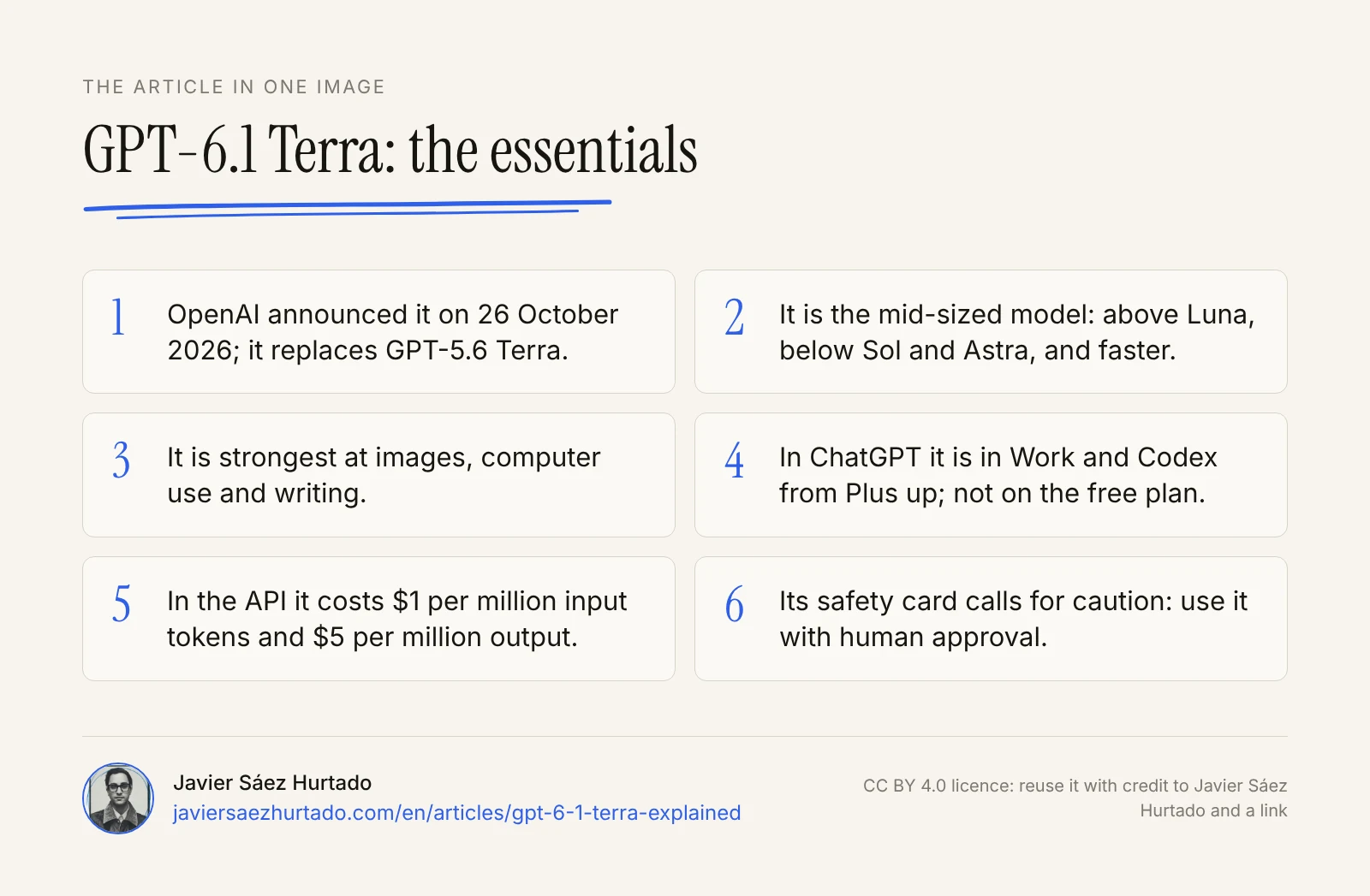
- GPT-6.1 Terra is OpenAI’s mid-sized model, announced on 26 October 2026, between GPT-6 Luna and GPT-6.1 Sol.
- It is strongest at understanding images, using a computer and writing, and it is faster than Sol and Astra.
- In ChatGPT it runs in Work and Codex from Plus up, with a bigger allowance than Sol; it is not on Free or Go.
- In the API it costs $1 per million input tokens and $5 per million output tokens, with a 1,050,000-token context window.
- Its safety card calls for caution: use it with human approval and in a separate session when it acts on your computer.
The article in one image
Frequently asked questions
What is GPT-6.1 Terra?
It is an OpenAI model announced on 26 October 2026. OpenAI describes it as a fast, efficient model for visual reasoning, precise computer use and clear, natural writing. It replaces GPT-5.6 Terra and sits between GPT-6 Luna, the cheapest model, and GPT-6.1 Sol.
Is GPT-6.1 Terra free?
Not in ChatGPT. It runs in ChatGPT Work and Codex on the Plus, Pro, Business, Enterprise and Edu plans. On Free and Go, Codex only offers GPT-6 Luna. In the API you pay per use: $1 per million input tokens and $5 per million output tokens.
How many GPT-6.1 Terra messages do I get with ChatGPT Plus?
OpenAI estimates 35 to 285 local messages every five hours on Plus, compared with 15 to 160 for GPT-6.1 Sol and 5 to 45 for GPT-6 Astra. These are estimates, not fixed limits, and Work and Codex share the same allowance. A weekly limit may also apply.
What does it mean that GPT-6.1 Terra “uses a computer”?
It can look at screenshots, decide where to click, type and move between applications to finish a task, such as copying invoices from a PDF into accounting software or filling in a form. In ChatGPT it does this from Work, with computer use switched on in the desktop app or through the browser extension.
Can I use GPT-6.1 Terra in Europe?
Yes. I have found no exclusion of the European Economic Area in OpenAI’s official sources, and ChatGPT is available in Spain, Andorra and the rest of the EU. In the API, Terra supports Fast mode with EU data residency.
What is the difference between GPT-6.1 Terra, Sol and Astra?
Astra is the most capable and most expensive model ($10 and $50 per million tokens). GPT-6.1 Sol gets close to Astra at a fifth of the price ($2 and $10). Terra costs half as much as Sol and is faster; OpenAI still recommends Sol or Astra for the hardest coding work.
Sources
- OpenAI, Introducing GPT-6.1 Terra (26 Oct 2026)
- OpenAI, Addendum to GPT-6 Astra System Card: GPT-6.1 Terra
- OpenAI Developers, gpt-6.1-terra model page
- OpenAI Developers, API pricing
- OpenAI Developers, GPT-6 models guide
- OpenAI, models in ChatGPT Work and Codex
- OpenAI Developers, Codex pricing and limits
- OpenAI Help Center, ChatGPT supported countries
- InfoWorld, OpenAI bets on AI economics with lower-cost GPT-6.1 Terra (27 Oct 2026)
- The Decoder, GPT-6.1 Terra halves OpenAI’s API prices (27 Oct 2026)
- The New Stack, OpenAI halved its agent’s price. Its own safety report flagged a catch (27 Oct 2026)
- 9to5Mac, OpenAI upgrades ChatGPT and Codex with new GPT-6.1 Terra model (26 Oct 2026)
- The Next Web, OpenAI launches GPT-6.1 Terra, a cheaper model for everyday computer work (26 Oct 2026)