Gemini 4 Argon: what it is, what it costs and when you can use it
Gemini 4 Argon is Google’s new frontier model, announced on 30 September 2026 and built for coding, professional work and cyber defence. Today only cyber defenders picked by Google can use it; paid API customers and Google AI Ultra subscribers come next, at $2 per million input tokens and $10 per million output, with no dates or countries confirmed.

What is Gemini 4 Argon?
Gemini 4 Argon is Google’s new frontier AI model. Koray Kavukcuoglu, senior vice president at Google DeepMind and Google’s chief AI architect, announced it on 30 September 2026 as a model that can keep reasoning through long, complex tasks.
Google aims it mainly at three kinds of work: real software engineering, professional work such as legal and finance, and cyber defence. It also points to its creative writing. This is not a model for better small talk. It is a model for working on the same problem for hours.
- Gemini 4 Argon
- The first model in the Gemini 4 generation. Google only uses this name and has not announced a “Gemini 4 Pro”.
- Fairwind programme
- Google’s limited access programme for governments and trusted security partners. It started on 2 September 2026 and has more than 650 members.
- Output limit
- The most the model can write in one response. Argon raises it to one million tokens, from 64,000.
That output limit is the technical change Google stresses most. With one million tokens, the model can think and write hundreds of thousands of tokens in one go, which helps when you need to move a whole codebase or write a long report in a single pass. Google has not published the size of its context window. Media reports give different numbers and none is confirmed.
What is Gemini 4 Argon good for?
Google says Argon is built for work that takes many steps and a lot of time. It backs this up with how the company already uses it inside Google, where thousands of employees work with it. These are Google’s own examples, not independent tests:
- Saving memory. A team of Argon agents studied usage data from Google’s data centres and made changes that free up more than 300 TiB of memory.
- Moving code. Argon agents are porting C and C++ code to Rust, from libraries with tens of thousands of lines up to the Fuchsia Zircon kernel, with more than 800,000.
- Defending systems. Google says Argon can find, check and fix critical software flaws on its own. Wiz already uses it in a programme that protects public infrastructure.
For a business, the type of task is what matters. Argon is aimed at jobs where today’s agents fall short because the work is too long: reviewing a long contract, going through a set of financial documents or updating an old application. I covered the basics in my guide to OpenAI agents: an agent does not answer, it works. The longer the job, the more it matters that the model does not lose track.
What do the benchmarks say? Gemini 4 Argon vs GPT-6 Astra and Claude
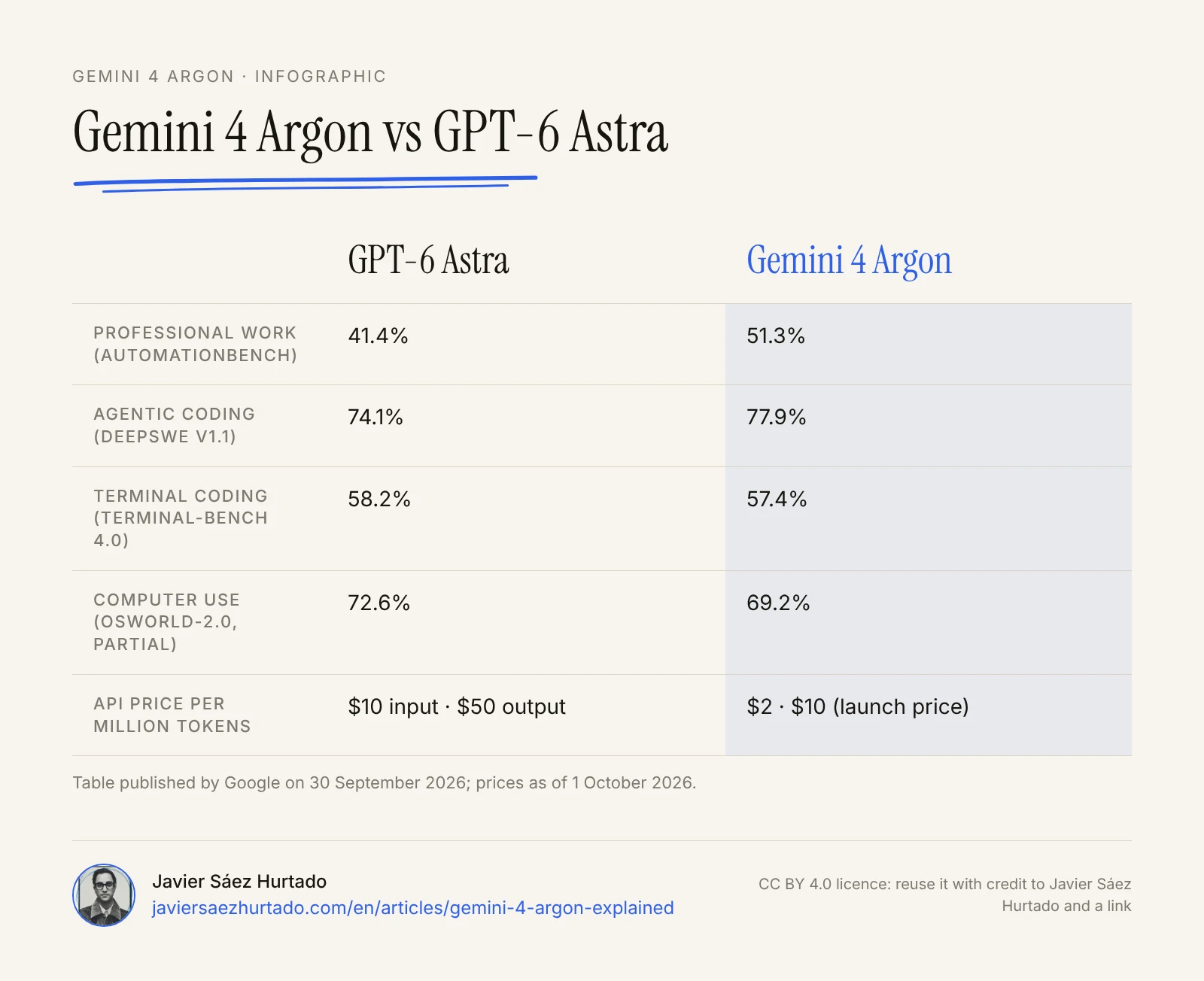
In the table Google published, Argon comes first or ties in 14 of 19 tests against OpenAI’s GPT-6 Astra and Anthropic’s Claude Fable 5.1 and Claude Opus 5.5. The biggest gaps are in professional work. On AutomationBench it scores 51.3%, against 42.5% for Opus 5.5 and 41.4% for GPT-6 Astra.
Read that table with care, for three reasons. First, Google made it. Second, its methodology notes that many rival scores are the ones each company reports, and Argon was tested at its highest reasoning setting. Third, some figures do not quite match the other companies’ numbers: Google gives GPT-6 Astra 58.2% on Terminal-bench 4.0, while OpenAI reported 57.9%.
Gemini 4 Argon against its rivals
Selection from the table Google published on 30 September 2026
| Test | Gemini 4 Argon | GPT-6 Astra | Claude Opus 5.5 |
|---|---|---|---|
| Professional work (AutomationBench) | 51.3% | 41.4% | 42.5% |
| Finance agent (Vals Finance Agent v2) | 65.4% | 53.5% | 58.6% |
| Legal agent (Harvey) | 19.6% | 5.4% | 3.8% |
| Agentic coding (DeepSWE v1.1) | 77.9% | 74.1% | 74.2% |
| Terminal coding (Terminal-bench 4.0) | 57.4% | 58.2% | 66.4% |
| Computer use (OSWorld-2.0, partial) | 69.2% | 72.6% | No score |
| Long video (LVBench) | 91.7% | 87.5% | 83.7% |
| Cybersecurity (CWE-bench v1) | 68.0% | 68.0% | 67.0% |
Where Argon does not win is just as useful. In terminal coding and in PostTrainBench, a machine learning engineering test, it trails Claude Opus 5.5, which scores 66.4% and 49.3%. In computer use, FrontierSWE v2 and Terminal-Bench Science it trails GPT-6 Astra. No model wins everything. It depends on the job.
For background on the OpenAI model, see GPT-6 Astra: what it is and who can use it.
How much does Gemini 4 Argon cost?
Gemini 4 Argon will launch in the API at $2 per million input tokens and $10 per million output tokens, with cached input 95% cheaper, so $0.10. When that launch period ends, on a date Google has not given, the price goes up to $4 and $20.
These are announced prices. You cannot pay them yet. As of 1 October 2026, Argon does not appear in the Gemini API model list or on its pricing page, which still show the 3.x models.
API price per million tokens
Official figures checked on 1 October 2026
| Model | Input | Output | Cached input |
|---|---|---|---|
| Gemini 4 Argon (launch price) | $2 | $10 | $0.10 |
| Gemini 4 Argon (later) | $4 | $20 | Not stated |
| GPT-6.1 Sol (OpenAI) | $2 | $10 | $0.10 |
| Claude Opus 5.5 (Anthropic) | $4 | $20 | $0.20 (read) |
| GPT-6 Astra (OpenAI) | $10 | $50 | $1 |
The pattern is simple. Argon’s launch price matches GPT-6.1 Sol, which OpenAI announced at DevDay on 29 September, and its later price matches Claude Opus 5.5. Against GPT-6 Astra, OpenAI’s most expensive model, Argon costs a fifth during the launch period.
Who can use Gemini 4 Argon, and when?
Today only members of the Fairwind programme can use it: cyber defenders and testers picked by Google. Next come paying Gemini API customers and Google AI Ultra subscribers, and later developers, businesses and consumers in general. Google has not given a date for any of these stages.
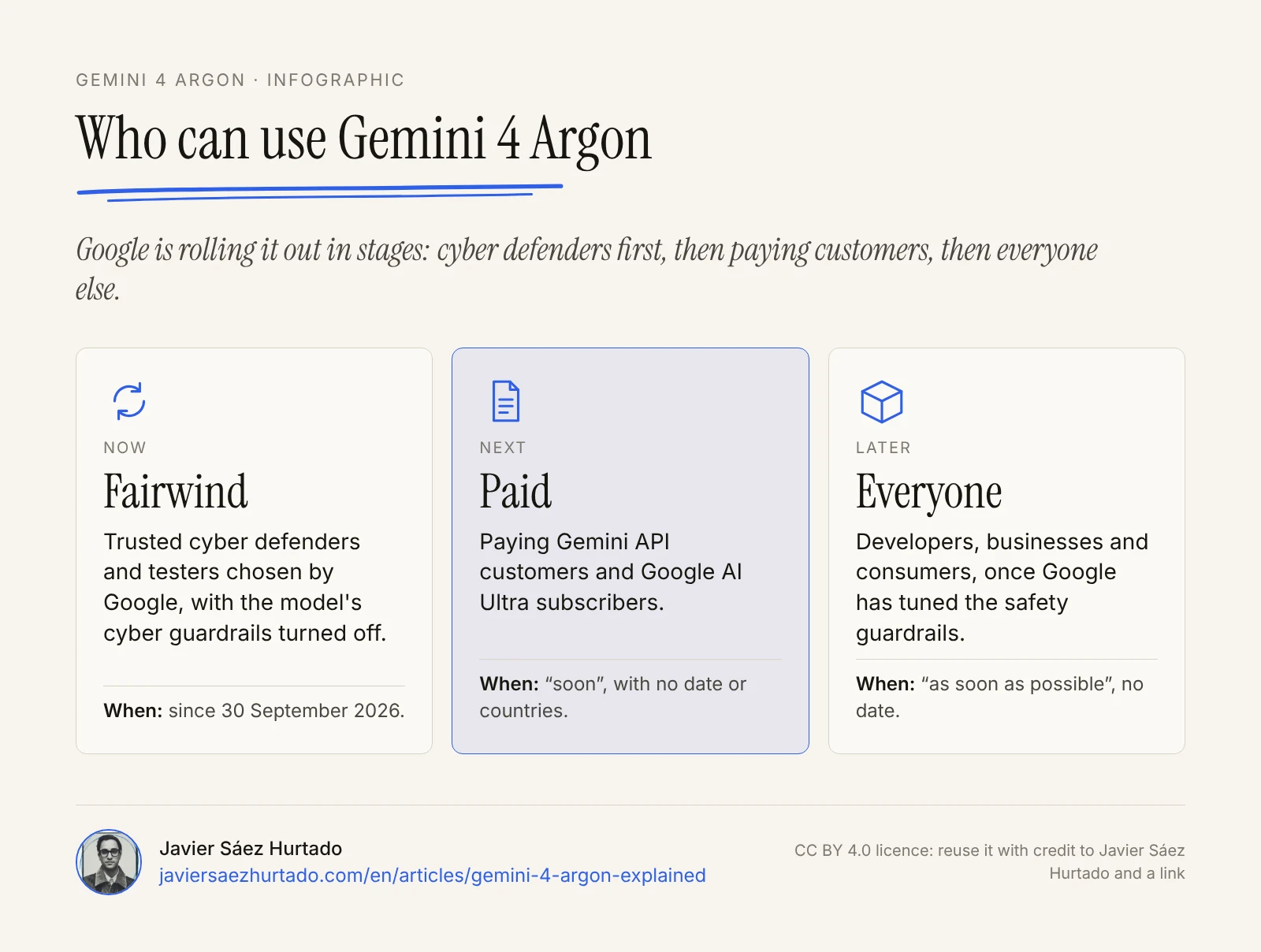
Fairwind is not open to everyone. Google set it up for governments and trusted partners, and members must limit access to their internal security, incident response or penetration testing teams, with measures such as multi-factor sign-in. Google gives these members Argon without the cyber guardrails the general version will have, so they can use its full defensive power.
There is also nothing yet about the Gemini app, Google AI Pro, AI Studio or Vertex AI by name. Google only mentions paid API customers and Google AI Ultra.
Why is Google releasing it in stages?
Google says so in its post: releasing a model this capable safely needs a phased approach. It adds that it is taking part in the US government’s voluntary process for early model access and will keep gathering feedback from early testers while it tunes the guardrails.
The underlying reason is security. A model that can find and fix software flaws could also help someone exploit them, so Google gives it first, without limits, to the people who defend systems. For everyone else, the post lists four layers of protection:
- Misuse: safeguards against cyber attacks and chemical, biological, radiological and nuclear threats, under its Frontier Safety Framework.
- Prompt injection: Google says Argon is its most resistant model to harmful instructions hidden in documents or web pages, and leads the Gray Swan test.
- Misalignment: monitoring of the model’s reasoning and actions, which can stop a task if it goes beyond what the user wanted.
- Sandboxes: high-risk training and testing in isolated, sealed environments.
The timing helps explain it. The same week, according to The Wall Street Journal as reported by Al Jazeera, OpenAI cancelled the release of GPT-6.1 Astra because it did not meet its internal safety standards. The big labs now have models capable enough that safety sets the release pace more and more.
Can you use Gemini 4 Argon in Europe?
Not yet, unless your organisation is in the Fairwind programme. Google has said nothing about the EU, the UK or other regions, and there is no API or Vertex AI model name that would let you check where it runs. Any date for Europe you read today is a guess.
If you run a business in Europe, here is what I would do now:
- Do not switch providers because of a table. The figures come from Google and you cannot test the model yet.
- Get your tests ready. Pick three or four real tasks from your business, with data that is not sensitive, so you can compare models once Argon is available.
- Check where your data goes. When Google publishes the documentation, look at regions and data processing terms, and check they fit your EU obligations.
- Watch the launch price. If you start on the launch price, also do the numbers at the later price, which is double.
What early reviews say
Since almost nobody can use it, early reactions are about the table and the rollout, not hands-on tests. VentureBeat says Google is back in first place in many tests, but with a limited release, and TechCrunch stresses its focus on defensive security work.
Sam Witteveen’s video is a calm walkthrough of what Google changed, without claiming more than the launch post shows:
If you want to go through the numbers one by one, AICodeKing reviews Google’s table test by test:
How I would use Gemini 4 Argon
What interests me most about Argon is not the table. It is the one million output tokens and the focus on long tasks. If independent tests confirm it, that is good news for work that today has to be split up by hand, such as going through a large case file or updating an old application.
That said, I would test it like any new model: real tasks, data that is not sensitive and a person checking the result. A model that can work for hours in a row can also be wrong for hours in a row, and the longer the job, the more it costs to find the mistake at the end.
I would also keep the line I set out in the essay on what you would let an agent do without looking (in Spanish). I would not let any model talk to other people on my behalf or touch high-value accounts, and anything that cannot be undone would need a human to approve it. Google releasing Argon in stages, with layers of safeguards, points the same way.
Transparency: Convexify, the firm I founded, is part of the OpenAI Select Partner programme. This article compares Gemini 4 Argon with OpenAI and Anthropic models using the three companies’ public documentation and the linked sources.
Key takeaways
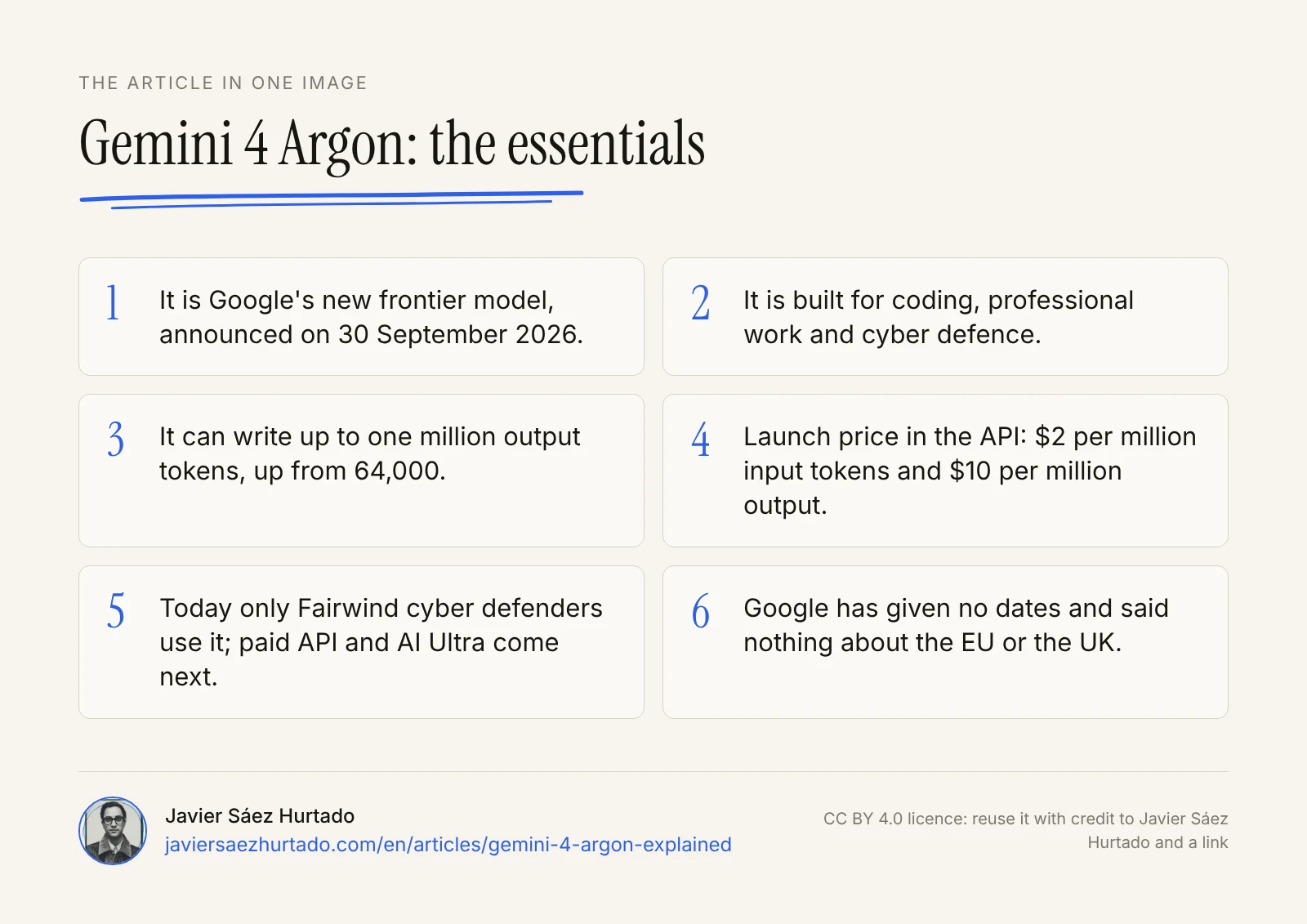
- Gemini 4 Argon is Google’s new frontier model, announced on 30 September 2026.
- It is built for long coding jobs, professional work and cyber defence, with up to one million output tokens.
- In Google’s table it comes first or ties in 14 of 19 tests, but the figures are Google’s own and it does not win everything.
- Its launch price in the API is $2 per million input tokens and $10 per million output; later, $4 and $20.
- Today only the Fairwind programme can use it. Paid API customers and Google AI Ultra come next, with no dates and nothing yet on Europe.
The article in one image
Frequently asked questions
What is Gemini 4 Argon?
It is Google’s most advanced AI model, announced on 30 September 2026. Google describes it as a model for long, complex workflows: real software engineering, professional work such as legal and finance, and cyber defence.
When is Gemini 4 coming out?
Gemini 4 Argon was announced on 30 September 2026, but for now only cyber defenders in the Fairwind programme and testers chosen by Google can use it. It will reach paid API customers and Google AI Ultra “soon”, and everyone else later, with no confirmed date.
Is Gemini 4 Argon free?
No free version has been announced. Google says it will go first to paid Gemini API customers and Google AI Ultra subscribers, its most expensive plan. It has not said whether it will come to the free Gemini app or to Google AI Pro.
How much does Gemini 4 Argon cost?
As of 1 October 2026, the launch price is $2 per million input tokens and $10 per million output tokens, with cached input 95% cheaper. When the launch period ends, on a date Google has not given, it will cost $4 and $20.
Is Gemini 4 Argon the same as Gemini 4 Pro?
Google only uses the name Gemini 4 Argon. “Gemini 4 Pro” is what leaks and some media called it before the launch, and 9to5Google notes that Argon brings a new naming scheme. Google has not announced a Gemini 4 Pro.
Is Gemini 4 Argon available in Europe?
Not yet, unless your organisation is in the Fairwind cyber defence programme. Google has said nothing about the EU, the UK or other regions, and has not published a model name for the API or Vertex AI. It is best to wait for the official documentation.
Sources
- Google, Gemini 4 Argon: our next era of frontier intelligence (30 Sep 2026)
- Google DeepMind, Gemini 4 Argon evaluation methodology
- Google, Fairwind cyber defence programme (2 Sep 2026)
- Google AI for Developers, Gemini API models (checked 1 Oct 2026)
- Google AI for Developers, Gemini API pricing (checked 1 Oct 2026)
- OpenAI, Introducing GPT-6.1 Sol (29 Sep 2026)
- Anthropic, Claude pricing (checked 1 Oct 2026)
- 9to5Google, Google announces Gemini 4 Argon (30 Sep 2026)
- TechCrunch, Google releases Gemini 4 Argon (30 Sep 2026)
- VentureBeat, Google unveils Gemini 4 Argon in limited release (30 Sep 2026)
- Al Jazeera, OpenAI scraps release of GPT-6.1 Astra (29 Sep 2026)