ChatGPT and Codex usage limits: what the shared allowance changes in December
From December 2026, ChatGPT Plus, Pro and Business will have one usage allowance, measured in tokens, for chat, Work and Codex; conversations with Instant models do not use it. At the same time, OpenAI will merge the Chat and Work tabs into one view, starting with a small test group.

What changes in ChatGPT usage limits in December?
From December 2026, ChatGPT and Codex will share one usage allowance on the Plus, Pro and Business plans. Until now, chat had its own limits, and Work and Codex shared another one. From December, everything comes out of the same balance, measured in tokens. The exception is conversations with Instant models, which do not use it.
OpenAI has told subscribers about the change and explains it in its Help Center. The Decoder reported it on 1 November and AIN on 2 November. On OpenAI’s developer forum, several users have already opened threads asking the company to keep the limits separate.
- ChatGPT Work
- The ChatGPT mode that works like an agent: it uses a computer, opens files and chains steps together. It also powers Work mode in the ChatGPT Chrome extension.
- Codex
- OpenAI’s coding agent, in the terminal, the editor or the app. When you sign in with ChatGPT, it uses the usage included in your plan.
- Shared allowance
- One usage balance, measured in tokens, for reasoning chats, Work and Codex. It resets after a set time.
The idea is simple. Asking ChatGPT a question and letting it do a task for you used to be counted in different ways. From December they come out of the same pot.
Who is affected and who is not?
Plus, Pro and Business. According to the reports on OpenAI’s notice, Free, Go, Enterprise and Edu are not part of this change.
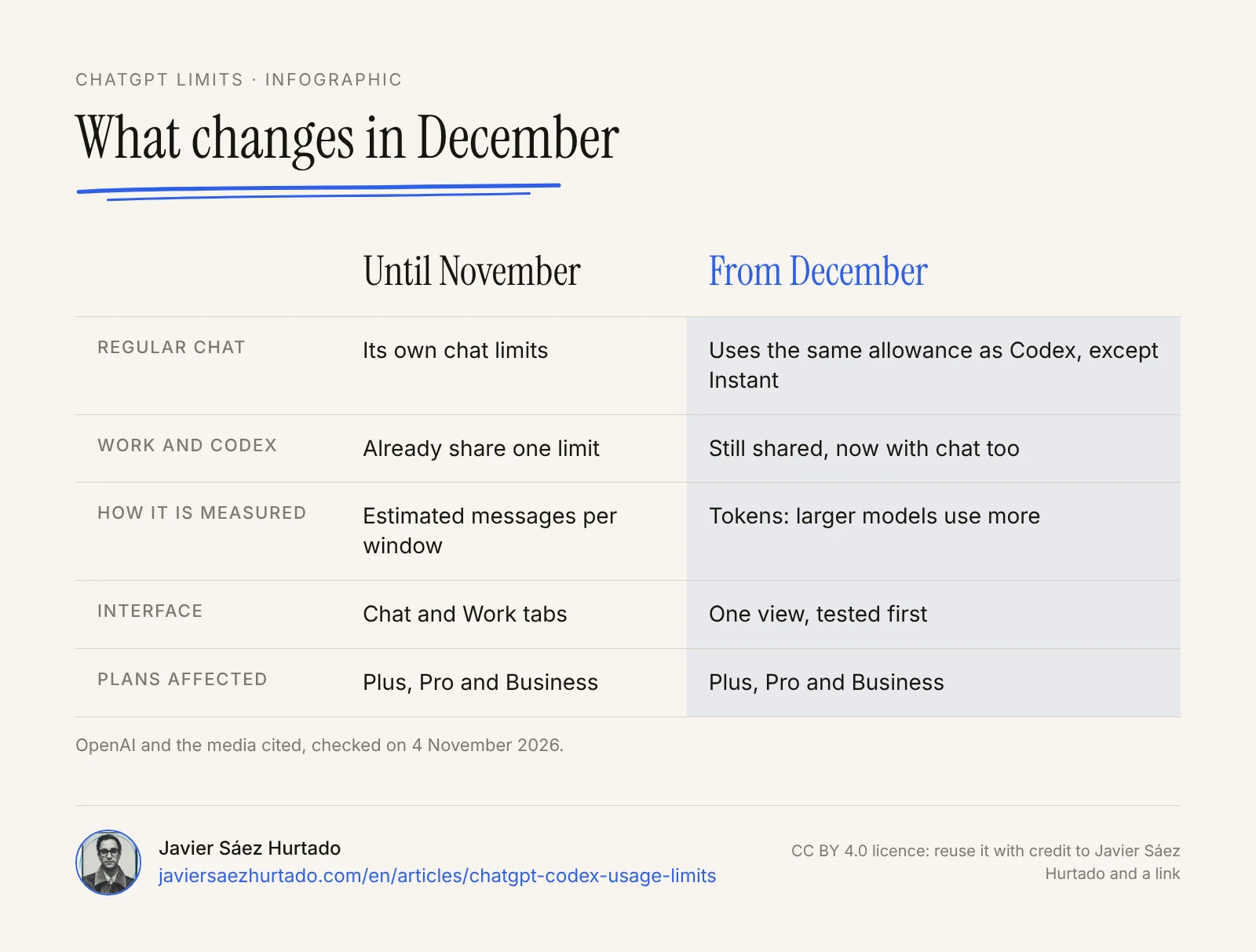
On the plans that are affected, how much you notice depends on how you use ChatGPT:
- If you mostly chat in Instant mode, you will notice little: those conversations do not count.
- If you use reasoning models a lot, they now compete for the same balance as your Work and Codex tasks.
- If you code with Codex every day, each long question you ask a large model in chat takes something away from your coding sessions.
AIN reports that OpenAI expects most users will not have to wait for a reset more often than they do now. That is the company’s own forecast, not a promise.
What uses the allowance and what does not?
Everything except conversations with Instant models: reasoning chats, Work tasks and Codex, local or in the cloud. And not everything costs the same.
OpenAI’s Codex documentation says usage depends on the model, the size of the task, the reasoning level and the tools used. A long cloud task uses far more than a short question. This was already true for Work and Codex. On Plus, OpenAI estimates very different allowances by model, as I explained in the article on GPT-6.1 Terra: on the same plan, Terra goes a lot further than Sol or Astra.
Some limits stay separate. File uploads, image generation and voice have their own caps in ChatGPT, according to OpenAI’s Help Center.
How is it measured: tokens, windows and weekly caps?
In tokens. A token is a piece of text, roughly three quarters of an English word, and each answer uses the tokens it reads and the tokens it writes. That is why a large model, which reasons more before it answers, uses more per answer.
Today, in Work and Codex, Plus has a five-hour window and may also have a weekly cap: you need room under both to keep going. The Pro tiers have no five-hour limit in Work and Codex. OpenAI has not yet said how those windows will work once chat joins the allowance in December, so check the real numbers in your account when the change arrives.
Your remaining balance and the reset time will show in ChatGPT Settings, under Usage. Starting a new chat does not reset the limit.
What happens to the Chat and Work tabs?
They merge. OpenAI will put Chat and Work into one view. It will test this with a small group of users in the coming weeks before rolling it out to everyone.
This fits the new limits. If chat and agent work use the same balance, two tabs with different rules make less sense. For people who use ChatGPT at work, the practical change is that the step from “ask it” to “do it for me” gets shorter. It is worth knowing which mode you are in.
What happens when the allowance runs out?
You have three options: wait for the reset, move to a higher plan or buy credits. Credits are available on Plus and Pro, according to the Codex pricing page. If you use Codex with an API key instead of your ChatGPT account, that usage is billed separately at API rates.
There is one useful detail for Codex. If you hit the limit in the middle of a task, the Help Center says it can finish the current turn, within fair-use rules.
Which plans and prices remain?
Prices do not change. On the Codex pricing page, checked on 4 November 2026, Go costs 8 dollars a month, Plus 20, and Pro has three tiers at 100, 200 and 500 dollars. What changes is how each plan’s included usage is shared.
Who is in the shared allowance
Based on OpenAI and the media cited, as of 4 November 2026
| Plan | Price per month | Shared allowance from December |
|---|---|---|
| Free | $0 | Not part of the change |
| Go | $8 | Not part of the change |
| Plus | $20 | Yes |
| Pro | $100, $200 or $500 | Yes |
| Business | Per user | Yes |
| Enterprise and Edu | Custom | Not part of the change |
Two other recent changes are worth knowing:
- More room on Pro. On 29 October, OpenAI doubled the Work and Codex allowance on Pro 100 and Pro 500, according to The Decoder. Nothing changed on Plus.
- Account limits per device and card. The Decoder reports that OpenAI now limits how many paid ChatGPT accounts can be used on one device or with one card, on Go, Plus and Pro. This affects people who opened several subscriptions to add up limits.
Together, the three moves point the same way: less “unlimited” use, more metered use, and more room for those who pay more.
What does it mean for companies in Europe?
Neither the notice nor the reports mention exceptions by country, so it makes sense to expect the same change in Spain, Andorra and the rest of Europe on the same plans.
For a company on ChatGPT Business, the practical steps are:
- Find out who uses Codex or Work every day. They are the first who will feel chat eating into their room.
- Check the Usage page before and after December. That tells you whether the change affects you in practice or only on paper.
- Split routine work from heavy work. Simple questions in Instant; long tasks with a large model, knowing what they cost.
- Budget for extra credits. If the team depends on Codex, it is better to plan for that margin than to find out on a deadline day.
If you rely on the agent features, my notes on OpenAI’s agents, skills and plugins explain how those pieces fit together, and they are exactly the parts that use the most allowance.
My view: measure before you delegate more
I think this is a reasonable change, and one that makes you think. One balance is easier to understand than three different limits, and leaving Instant chats out protects the most common use. What changes is the habit: there is no longer one pot for talking and another for working.
My advice is about agents. When an agent works on its own for a long time, it uses a lot, and now that comes out of the same place as your everyday questions. It is one more reason for what I have argued for a while: small, clear tasks, checked by a person, and nothing that cannot be undone without approval. An agent that runs in circles without supervision can make mistakes, and it can also leave you with no room for the work that matters.
What I would do in November is simple. For two weeks, write down which use of ChatGPT and Codex actually gives results and which is just habit. In December, with the balance in front of you, the decision will be easier.
Transparency: Convexify, the firm I founded, is part of the OpenAI Select Partner programme. This article is based on OpenAI’s public documentation and the linked sources.
Key takeaways
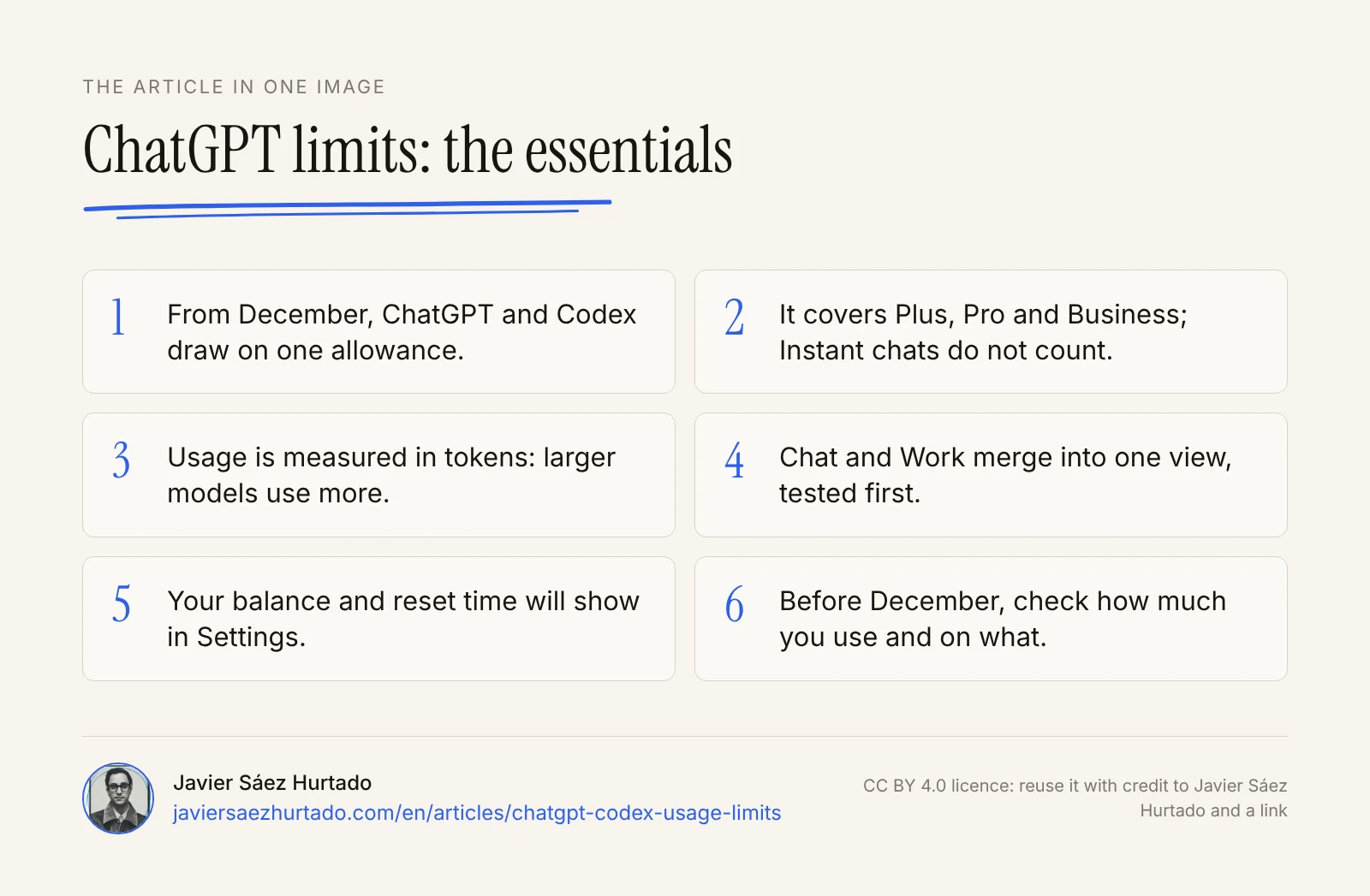
- From December 2026, ChatGPT and Codex draw on one allowance on Plus, Pro and Business.
- Conversations with Instant models do not use the allowance; reasoning, Work and Codex do.
- Usage is measured in tokens: larger models and longer tasks use more.
- Chat and Work will merge into one view, tested first.
- If it runs out, you can wait for the reset, upgrade or buy credits on Plus and Pro.
The article in one image
Frequently asked questions
What changes in ChatGPT usage limits in December?
Chat no longer has a separate limit. On Plus, Pro and Business, chat, Work and Codex will draw on one allowance measured in tokens. Conversations with Instant models are left out and do not use it.
Which ChatGPT plans are affected?
According to OpenAI’s notice as reported by the press, Plus, Pro and Business. The reports do not include Free, Go, Enterprise or Edu in the change.
Does using ChatGPT in Instant mode use my Codex allowance?
No. Regular conversations with Instant models do not use the shared allowance. Reasoning models, Work and Codex do, and larger models and longer tasks use more.
Where can I see how much I have left?
In ChatGPT Settings, under Usage, where OpenAI will show your remaining balance and when it resets. Starting a new chat does not reset your limit.
What happens when I run out of my ChatGPT and Codex allowance?
You can wait for it to reset, move to a higher plan or, on Plus and Pro, buy credits to keep going. If you use Codex with an API key, that usage is billed separately at API rates.
Does ChatGPT Plus cost the same after the change?
Yes. The notice does not change prices: Plus is still 20 dollars a month and Pro has tiers at 100, 200 and 500 dollars. What changes is how the included usage is shared, not what you pay.
Sources
- OpenAI (learn.chatgpt.com), Codex pricing: ChatGPT Work and Codex share usage (checked 4 Nov 2026)
- OpenAI Help Center, Understanding ChatGPT and Codex usage limits
- OpenAI Help Center, ChatGPT Work and Codex
- OpenAI Help Center, About ChatGPT Pro tiers
- The Decoder, OpenAI’s upcoming chat-and-work merger in ChatGPT signals the end of all-you-can-prompt pricing (1 Nov 2026)
- AIN, OpenAI will merge ChatGPT and Codex limits: what will change for users (2 Nov 2026)
- The Decoder, OpenAI doubles usage limits on Pro plans (29 Oct 2026)
- The Decoder, OpenAI is steering ChatGPT users toward more paid usage (1 Nov 2026)
- OpenAI Developer Community, Please keep ChatGPT and Codex usage limits separate in December 2026
- OpenAI (YouTube), How to Manage Your Workspace With ChatGPT Work (25 Aug 2026)