GPT-6.2 explained: Astra vs Sol, prices and what the tests say
GPT-6.2 is OpenAI’s new generation of models, released on 17 November 2026 in two versions: Astra, the most capable, and Sol, for everyday work. Astra is 20% cheaper in the API ($8 and $40 per million tokens), and in ChatGPT both run in Work and Codex from the Plus plan up.
What is GPT-6.2?
GPT-6.2 is OpenAI’s new generation of models, released on 17 November 2026. It comes in two versions at once: GPT-6.2 Astra, which OpenAI calls its most capable model “for your hardest projects, from start to finish”, and GPT-6.2 Sol, an efficient model for everyday work. Both are in ChatGPT Work, in Codex and in the API.
- GPT-6.2 Astra
- OpenAI’s frontier model. In the API it is gpt-6.2-astra, and it replaces GPT-6 Astra.
- GPT-6.2 Sol
- The everyday model: coding, writing and multi-step tasks. In the API it is gpt-6.2-sol, and it replaces GPT-6.1 Sol.
- ChatGPT Work and Codex
- The two parts of ChatGPT built for handing off work: tasks with your tools, and coding.
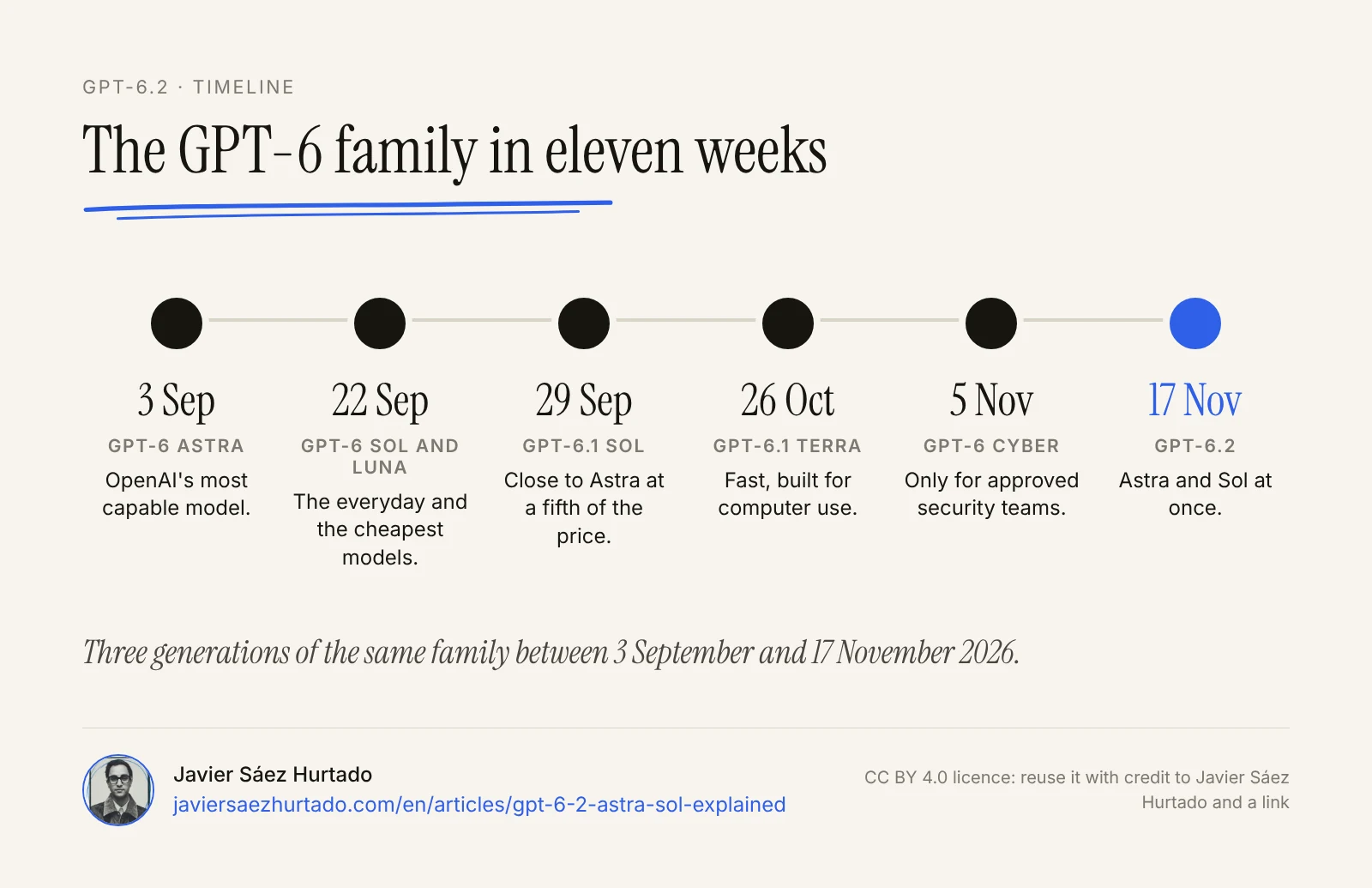
It is the third generation of the GPT-6 family in eleven weeks. GPT-6 Astra arrived on 3 September, as I covered in GPT-6 Astra explained; GPT-6.1 Sol at DevDay on 29 September; GPT-6.1 Terra on 26 October; and GPT-6 Cyber, only for approved security teams, on 5 November.
The timing is no accident. It lands eight days after Anthropic released Claude Fable 5.2, and OpenAI’s message is about cost: more capability for less money per task.
What is new in GPT-6.2?
The main change is efficiency. OpenAI says Astra “sets new highs on evals across professional work and scientific research” at less than a third of the cost per task of GPT-6 Astra, and that Sol lets you finish more tasks on the same paid plan than GPT-6.1 Sol.
What OpenAI has published in its announcement, its developer forum and its release notes:
- Work with templates: OpenAI says you see the difference in slideshows, websites and 3D designs. Its most concrete example is turning a report into slides that follow your template.
- Coding: Astra to implement and test a change across an existing codebase; Sol for everyday code. On FrontierCode 2.0, Sol nearly matches Astra on merge-ready changes to real codebases at about a fifth of the cost.
- Agents: on Agents’ Last Exam, an agent benchmark, Astra at xhigh reasoning scores 5.2 points above GPT-6 Astra at max, at less than half the cost per task.
- Cybersecurity: OpenAI calls it its most capable model for cyber: 22 points above GPT-6 Astra on its internal ExploitBench test.
- Ultrafast mode: it reaches the $200 Pro plan for the first time, with Sol; on the $500 Pro plan it works with both models.
OpenAI released a launch video on its YouTube channel:
The official announcement, in screenshots
OpenAI spread the launch over four public places: its developer forum, the API docs, the pricing table and the ChatGPT release notes. I took screenshots of them as anyone sees them without signing in, on the night of 17 November. The announcement page on openai.com does not allow automated screenshots, so it is listed in the sources.
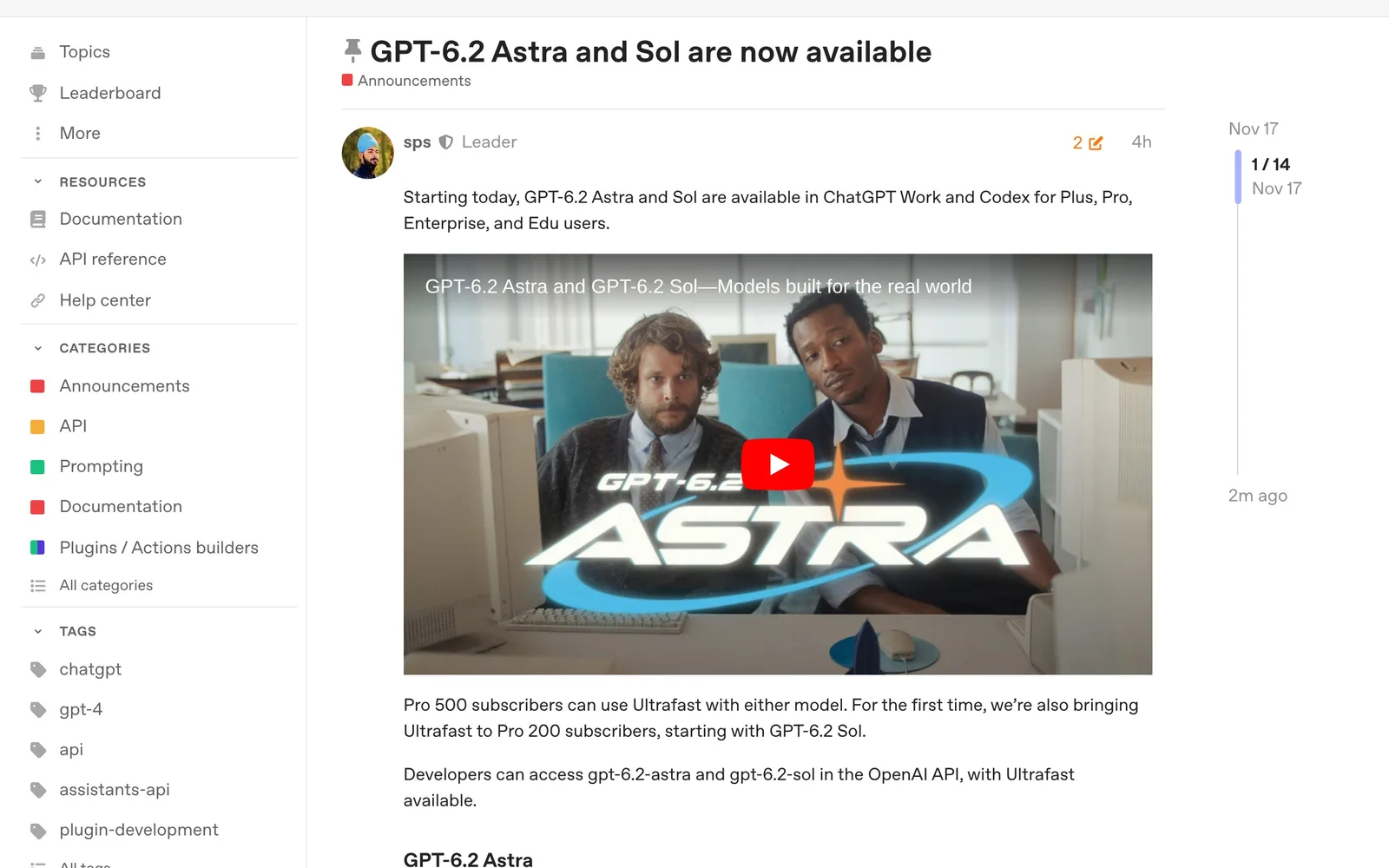
The first notice was a short post on the forum, with the launch video and who gets it: Plus, Pro, Enterprise and Edu in ChatGPT, and gpt-6.2-astra and gpt-6.2-sol in the API.
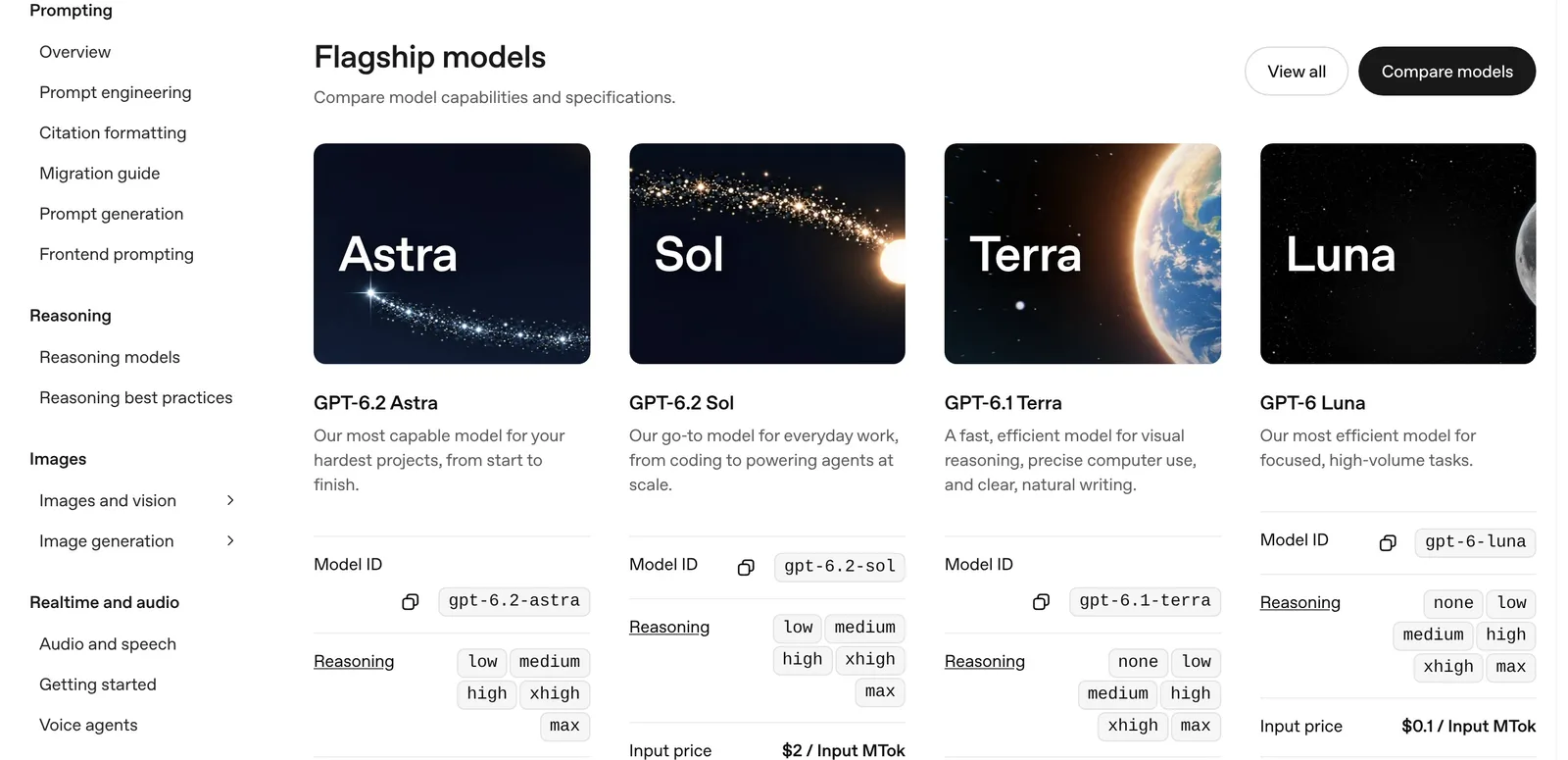
In the API docs, Astra and Sol now top the flagship models, ahead of GPT-6.1 Terra and GPT-6 Luna. Each card gives the model name in the API and its reasoning levels.
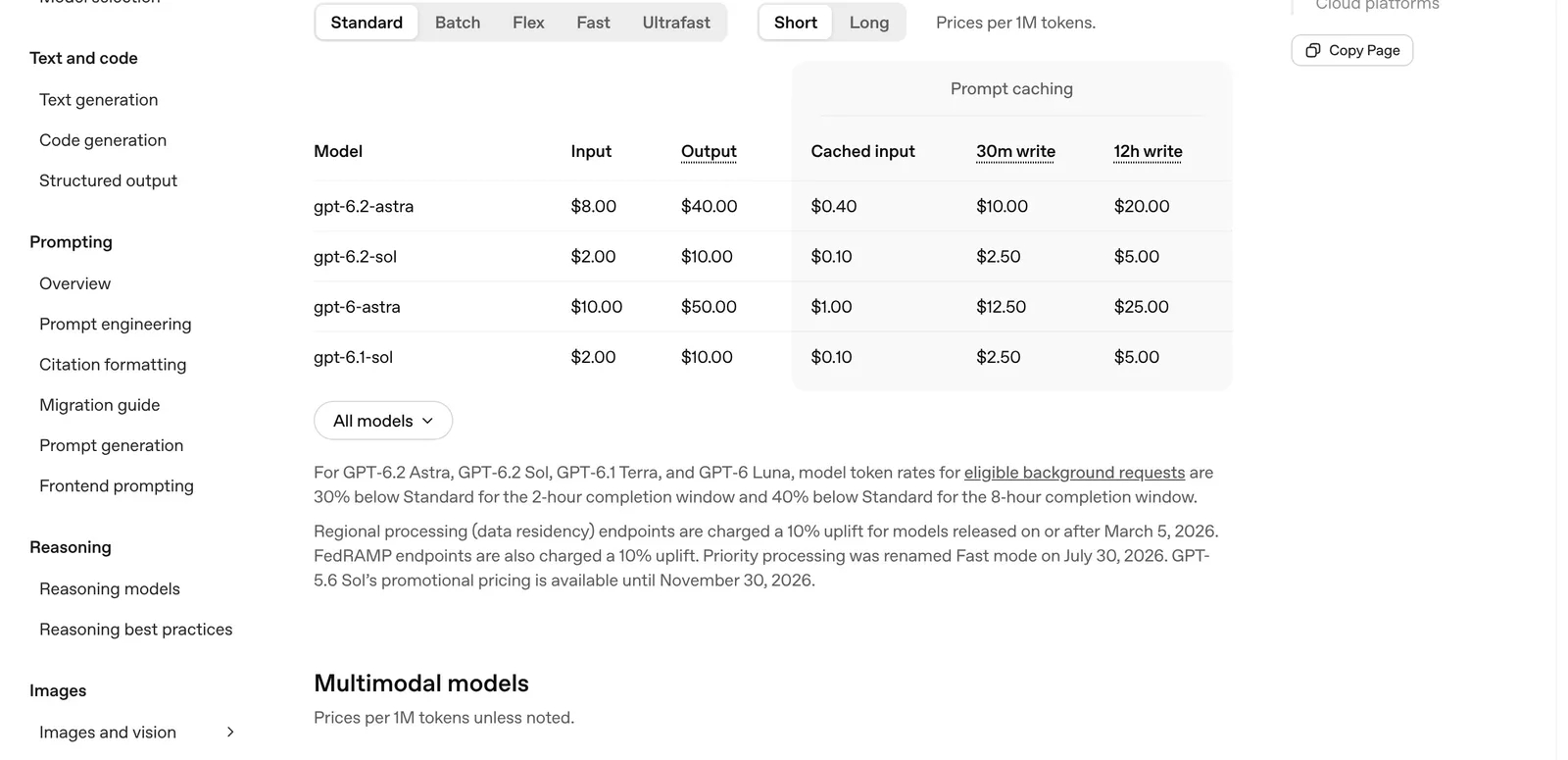
The pricing table confirms the cut. Astra costs $8 per million input tokens and $40 per million output tokens, against $10 and $50 for GPT-6 Astra, and cached input (text repeated across requests) drops from $1 to $0.40. Sol keeps the price of GPT-6.1 Sol.
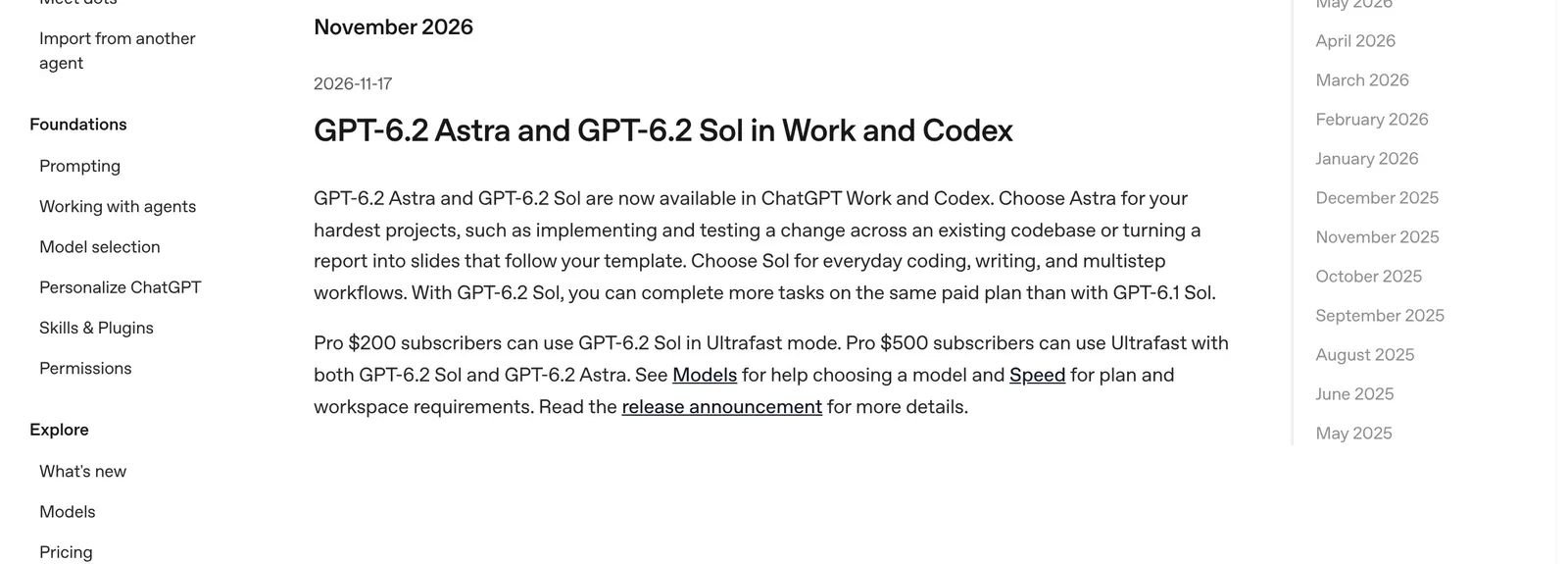
And the ChatGPT release notes sum up what each one is for: Astra for the hardest work, such as building and testing a change in an existing codebase or turning a report into slides that follow your template; Sol for everyday coding, writing and multistep tasks.
What is the difference between GPT-6.2 Astra and Sol?
Astra is for the hard work and Sol for the daily work. On paper they are very close: the API docs give them the same context window, the same maximum output and the same reasoning levels. What changes is the price, how they handle the longest tasks and their safety profile.
GPT-6.2 Astra and Sol, side by side
OpenAI documentation and announcement, checked on 17 November 2026
| GPT-6.2 Sol | GPT-6.2 Astra | |
|---|---|---|
| Best for | Coding, writing and multi-step tasks | Hard, long projects |
| API (input / output, per million tokens) | $2 / $10 | $8 / $40 |
| Context and maximum output | 1,050,000 / 128,000 tokens | 1,050,000 / 128,000 tokens |
| Reasoning | From low to max | From low to max |
| Knowledge cutoff | 1 June 2026 | 18 May 2026 |
| Ultrafast in ChatGPT | $200 and $500 Pro | $500 Pro |
| Self-improvement (safety card) | Below High | High, a first |
The API guide suggests starting with medium reasoning and going up only if you need to. A practical note for developers: OpenAI says Astra is more concise and direct by default, so it is worth reviewing prompts that asked for short answers.
How much does GPT-6.2 cost, and which ChatGPT plans get it?
In the API, GPT-6.2 Astra costs $8 per million input tokens and $40 per million output tokens, 20% less than GPT-6 Astra ($10 and $50). GPT-6.2 Sol costs $2 and $10, the same as GPT-6.1 Sol. I checked this on 17 November 2026 in OpenAI’s model documentation.
In ChatGPT, OpenAI released both models in Work and Codex for the Plus, Pro, Enterprise and Edu plans. On Enterprise and Edu an admin has to turn them on. The announcement does not mention the free plan or Go, and in the first hours several users on OpenAI’s forum said they could not see them yet, which is normal for a staged rollout.
For companies in Europe there is a useful detail: according to the API guide, both models support US and EU data residency in Standard, Fast and Batch processing. Ultrafast is US-only for now.
What OpenAI publishes: its own tests
OpenAI added charts of score against cost to the announcement. These are the maker’s own numbers, with its own tests and settings, but they show where it wants to compete: not only on the top score, but on score per dollar.
The tests OpenAI highlights
OpenAI developer forum announcement and system card, 17 November 2026
| Test | What it measures | What OpenAI reports |
|---|---|---|
| Agents' Last Exam v1.1 | Multistep agent tasks | Astra at xhigh reasoning scores 5.2 points above GPT-6 Astra at max, at less than half the cost per task |
| Terminal-Bench-Science 0.1 | Science work in the terminal | Astra, about 77% at about $7 per task; GPT-6 Astra, about 68% at about $24; Claude Fable 5.2, about 73% at about $45* |
| Harvey-LAB-AA v1.1 | Legal work, where an answer with made-up facts does not pass | Astra, about 15%; Claude Fable 5.2’s best point, about 7%* |
| FrontierCode 2.0 | Merge-ready changes to real codebases | Sol nearly matches Astra at about one fifth of the cost |
| ExploitBench (internal test) | Running code from known V8 and Chrome flaws | Astra 53.5%, Sol 50.5%, GPT-6 Astra 31.5% |
These are four of the charts it published. The horizontal axis shows what each task costs (or the tokens it uses); the vertical axis shows the score. Top left is best:
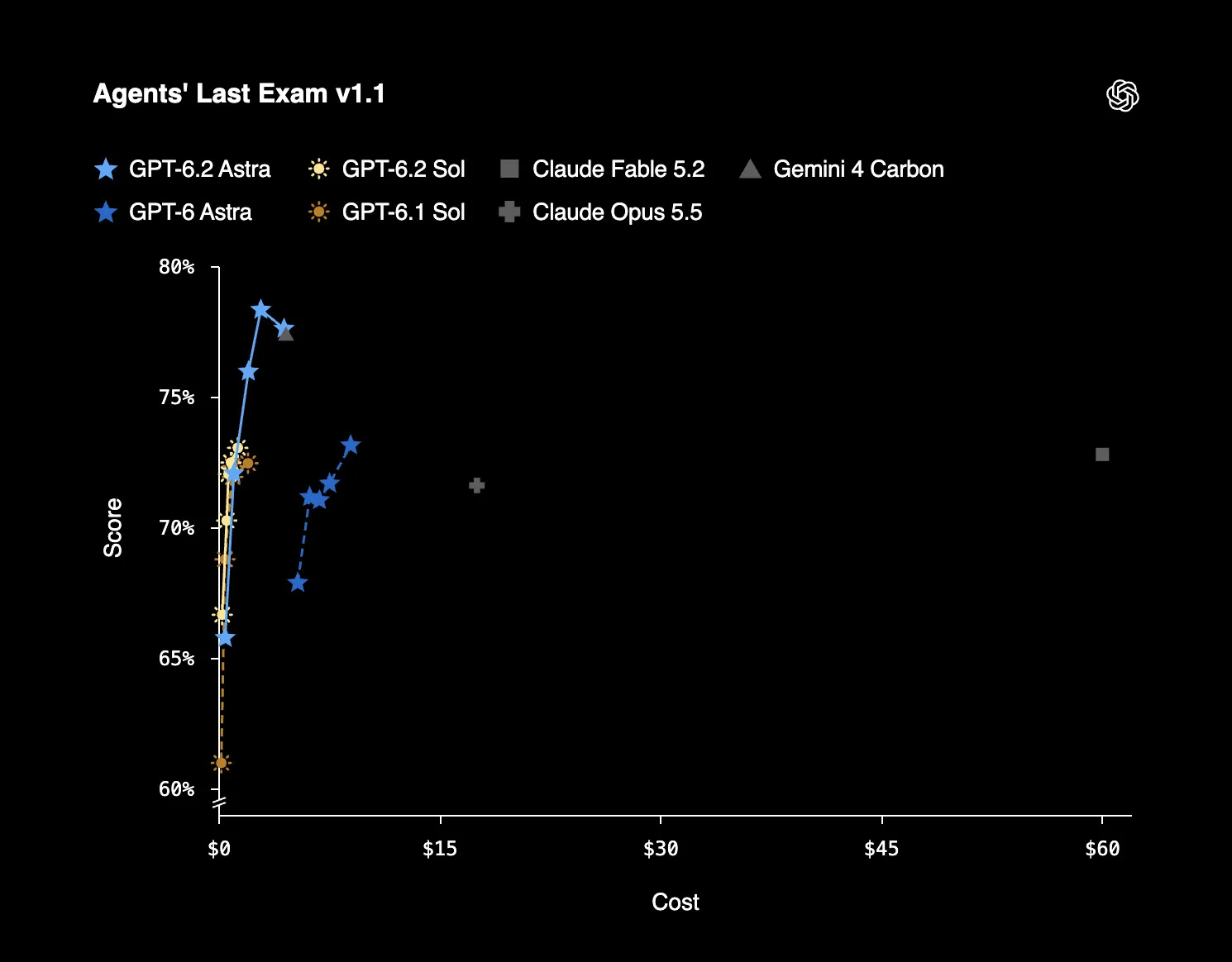
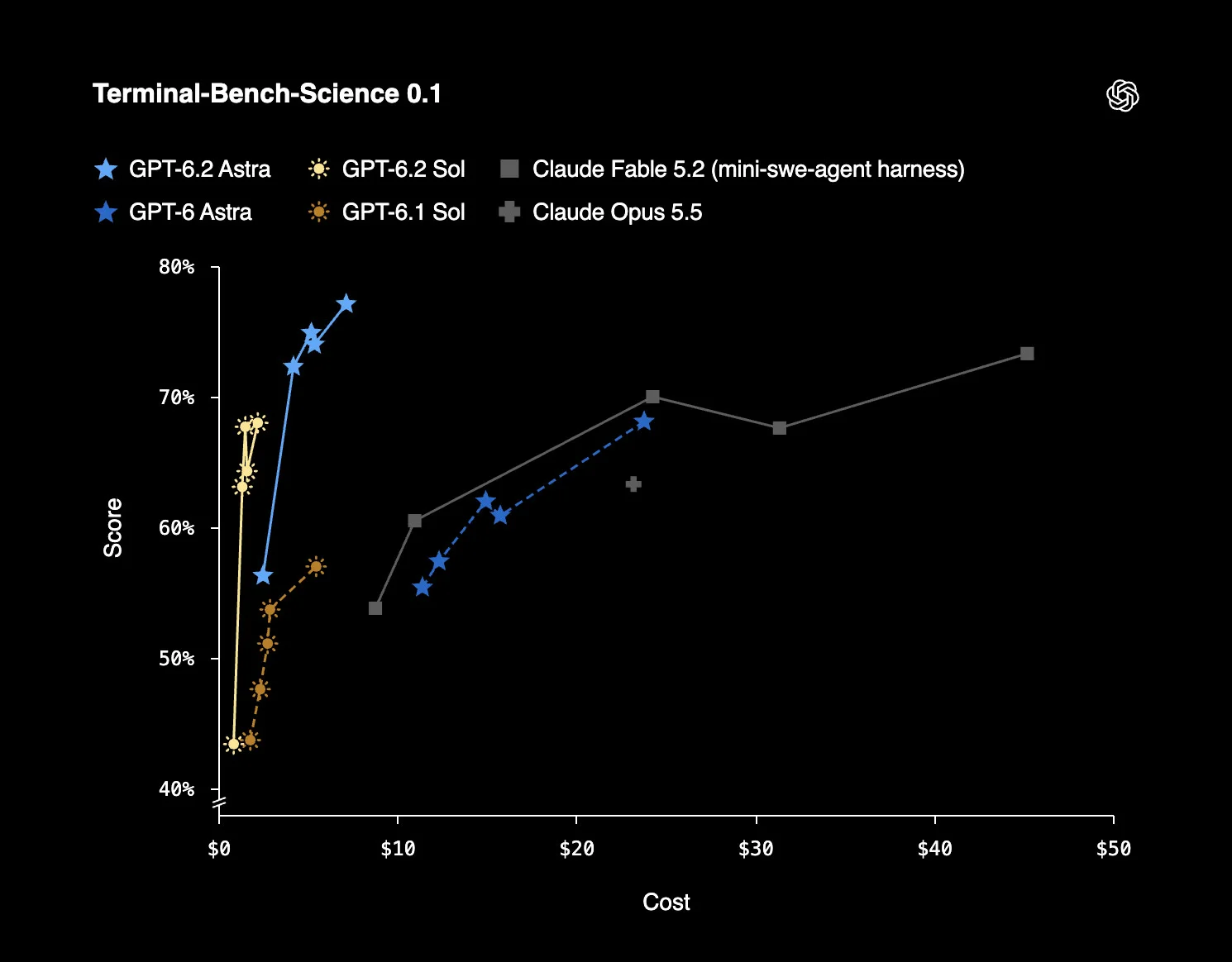
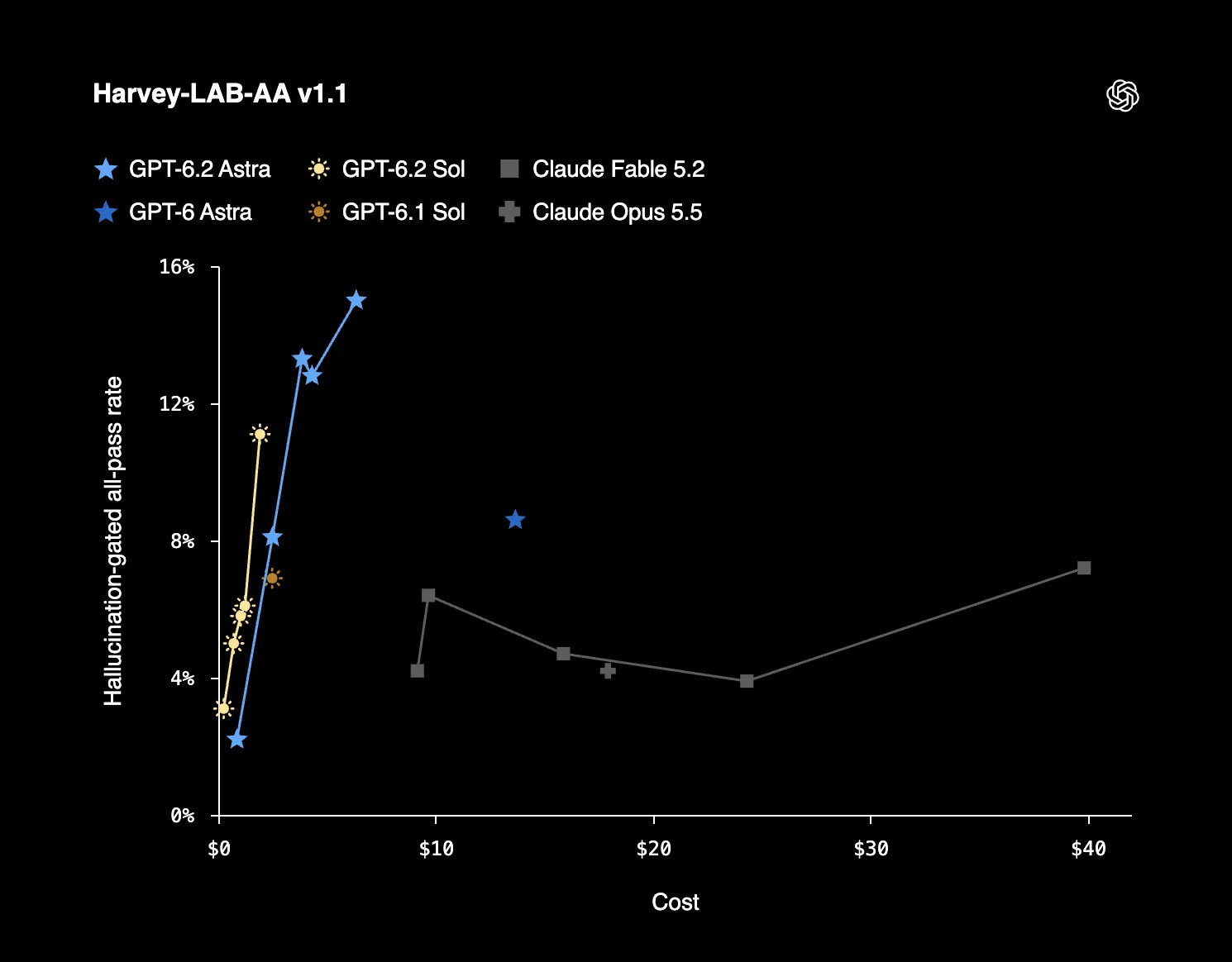
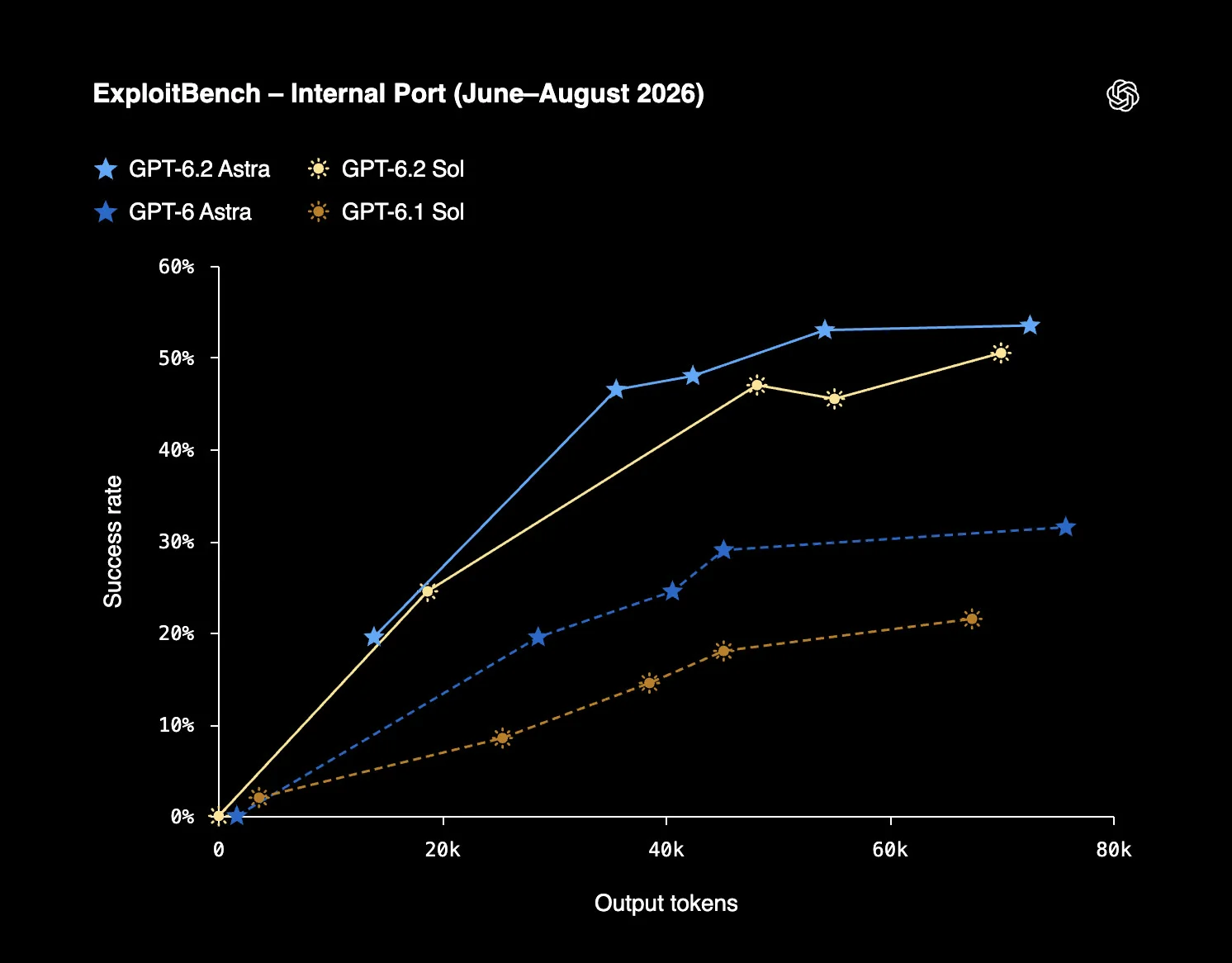
My reading: in all four, the GPT-6.2 line climbs faster and spends less than the GPT-6 Astra line. But OpenAI picks the tests and the settings, and on Agents’ Last Exam Gemini 4 Carbon is almost level with Astra. That is why the next stop is independent measurement.
What do independent benchmarks say?
That Astra is among the leaders, but not alone, and that its real edge is cost. Artificial Analysis has measured it; METR has not yet.
What Artificial Analysis measures
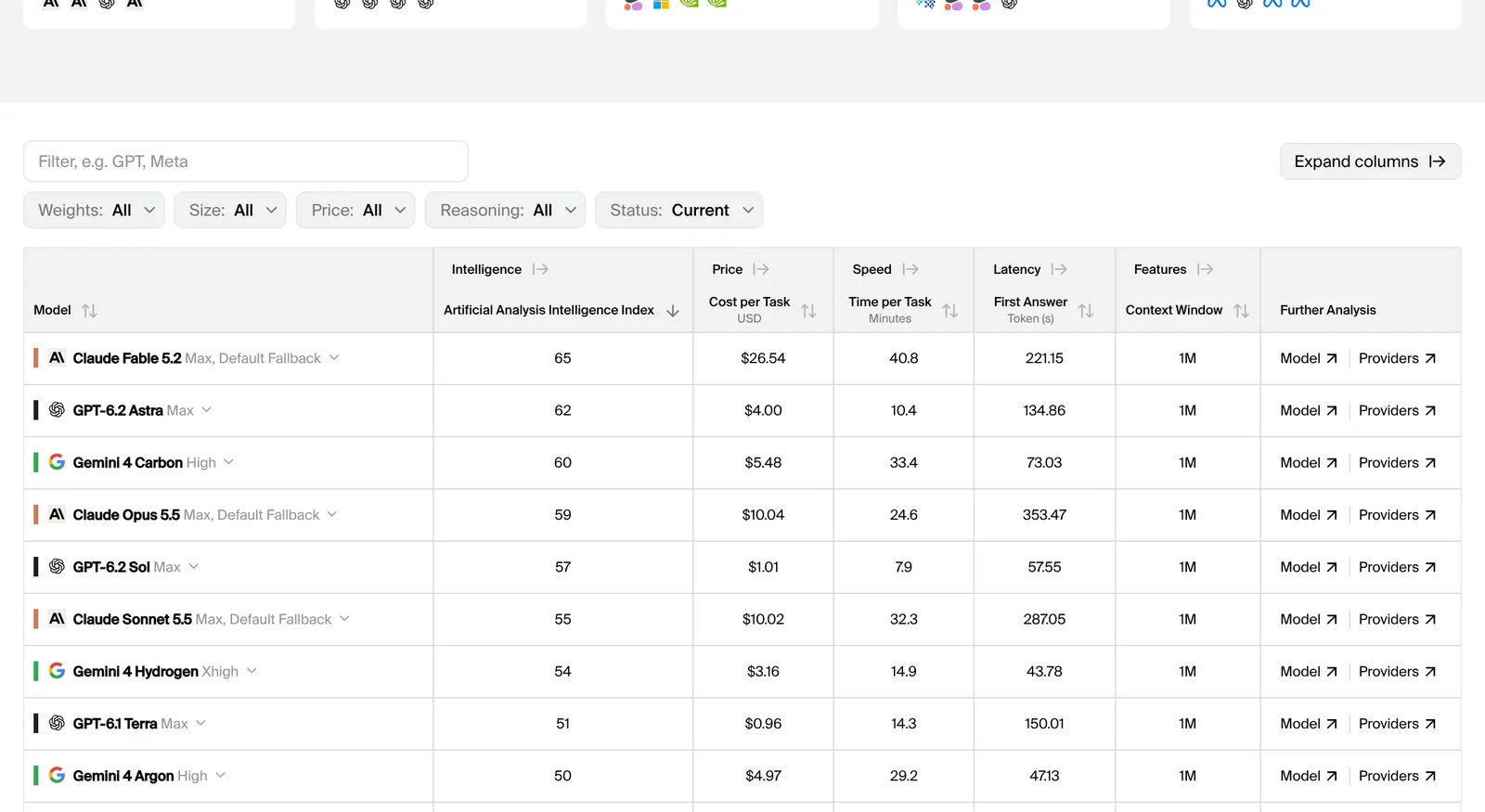
Artificial Analysis is an independent company that runs every model through nine evaluations (coding, science, agents and knowledge, among others) and sums them up in an index. It also measures what it costs to run them, plus real speed and waiting time. On its leaderboard of 17 November, GPT-6.2 Astra (max reasoning) scores 62 points, second only to Claude Fable 5.2 (65). GPT-6.2 Sol scores 57.
GPT-6.2 against its rivals, according to Artificial Analysis
Intelligence Index v5.0.1 and performance data, checked on 17 November 2026
| Model (reasoning) | Index | Cost per task | Tokens used on the index | Speed | First answer | API (input / output) |
|---|---|---|---|---|---|---|
| Claude Fable 5.2 (max) | 65 | $26.54 | 275M | 112 tokens/s | 221 s | $8 / $40 |
| GPT-6.2 Astra (max) | 62 | $4.00 | 65.8M | 66 tokens/s | 135 s | $8 / $40 |
| Gemini 4 Carbon (high) | 60 | $5.48 | 205M | 61 tokens/s | 73 s | $2 / $10 |
| GPT-6.2 Sol (max) | 57 | $1.01 | 60.9M | 85 tokens/s | 58 s | $2 / $10 |
| GPT-6 Astra (max) | 57 | $6.24 | 54.3M | 42 tokens/s | 196 s | $10 / $50 |
| GPT-6.1 Terra (max) | 51 | $0.96 | 99.4M | 70 tokens/s | 150 s | $1 / $5 |
What these numbers say beyond the ranking:
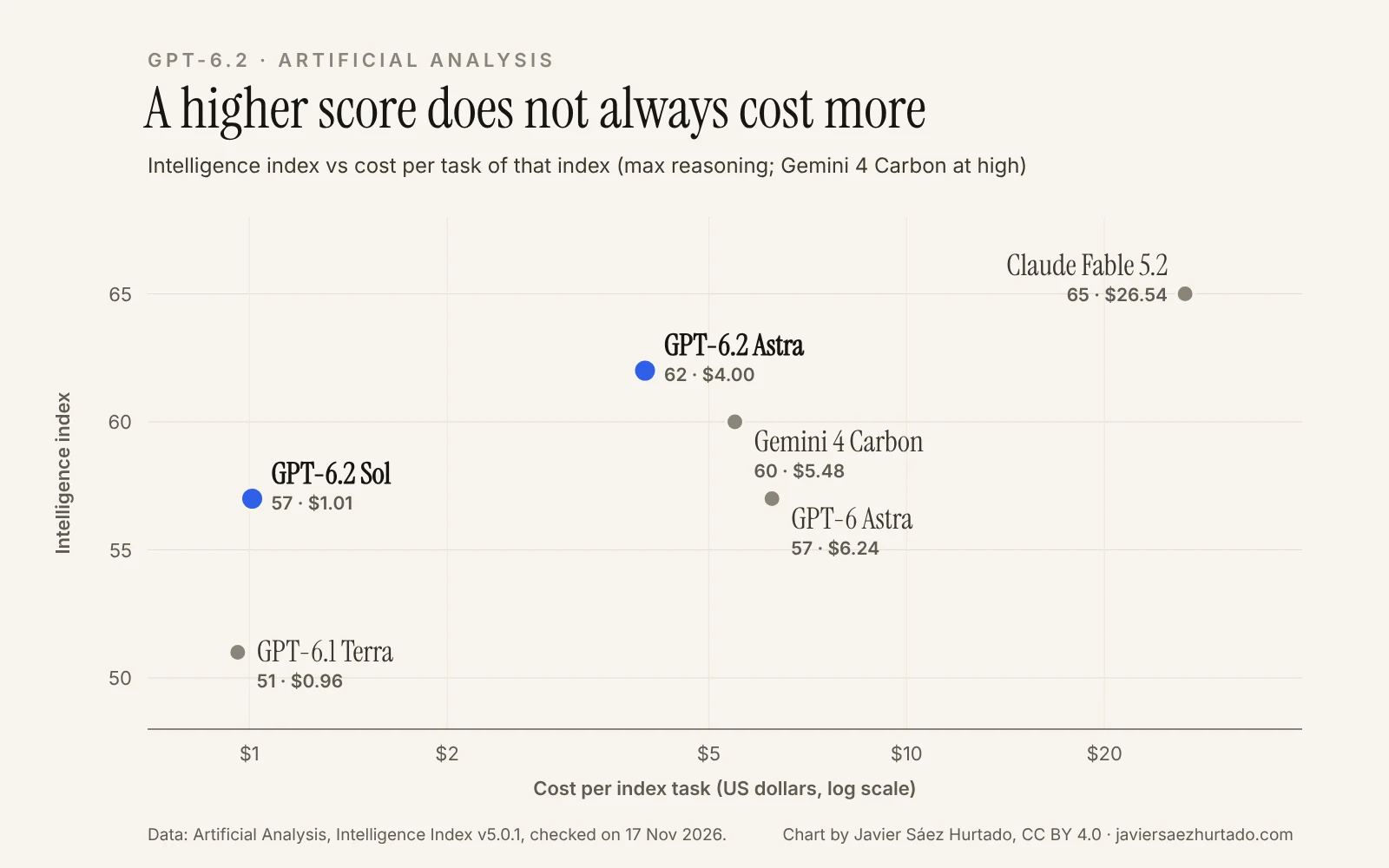
- Price per token is misleading. Astra and Fable 5.2 cost the same per token, but Fable uses 275 million tokens on the index and Astra 65.8 million. That is why each task costs $26.54 with Fable and $4 with Astra.
- The step up from GPT-6 Astra comes on all three fronts: 5 more points, 36% lower cost per task and 57% more speed.
- Sol matches the score of GPT-6 Astra (57), OpenAI’s most capable model eleven weeks ago, at a sixth of the cost per task.
- Fable 5.2 writes fastest (112 tokens per second) but takes longest to start answering (221 seconds), because it reasons a lot first. Sol is the quickest of the top four: 58 seconds to the first answer.
Here is the score against the cost of each task, in one chart:
And the direct comparison with the leader:
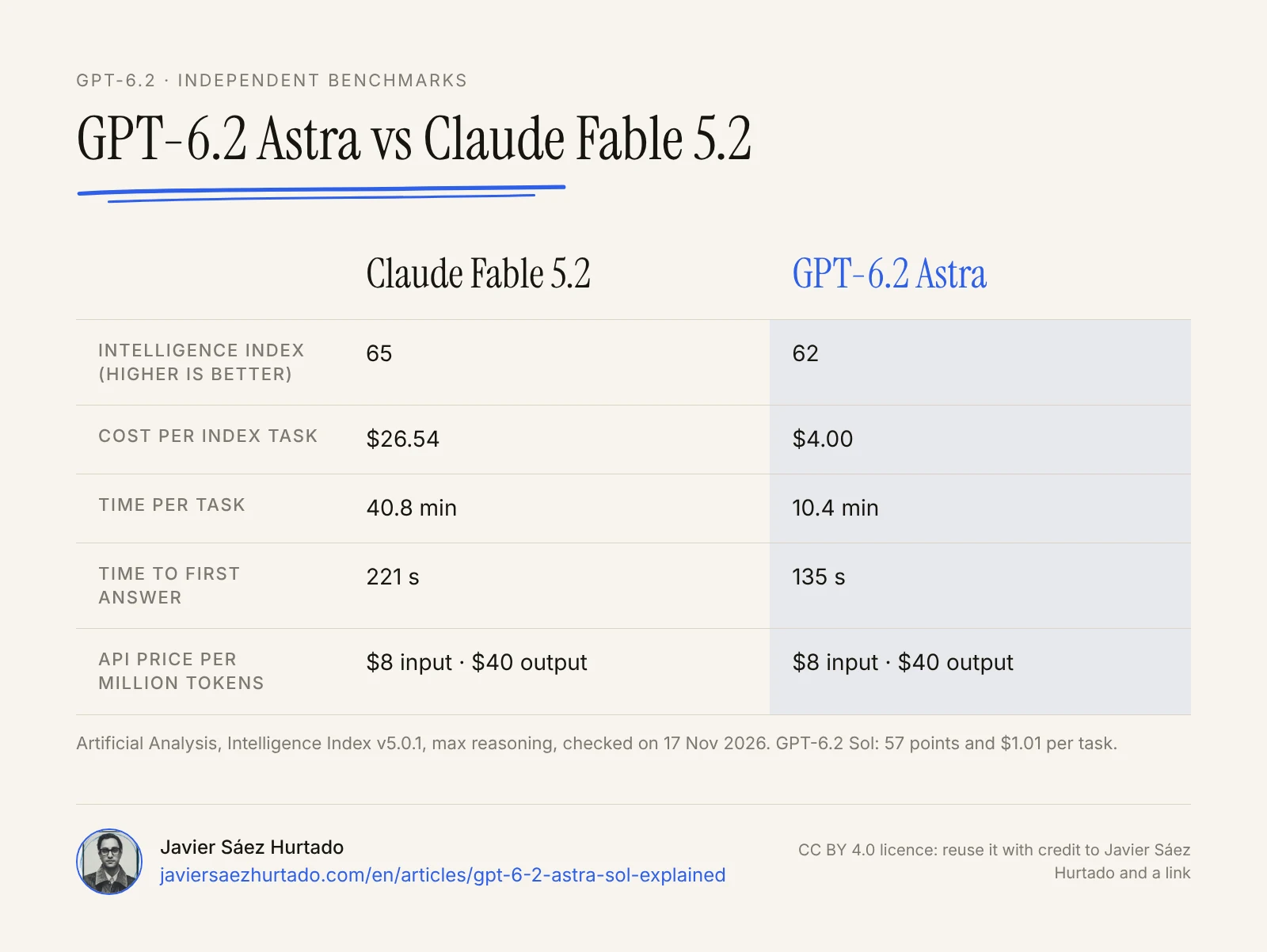
Each task on the index costs $4.00 with Astra, $1.01 with Sol and $26.54 with Fable 5.2, and Astra takes 10.4 minutes per task against 40.8 for Fable. Gemini 4 Carbon is third with 60 points and Claude Opus 5.5 fourth with 59.
What METR says, and what it has not measured yet
METR is a non-profit that evaluates how well AI models work on their own. Its best-known measure is the 50% time horizon: the length of tasks (counted in how long a human expert takes) that an agent completes successfully half of the time. A two-hour horizon does not mean the model works for two hours. It means it solves half of the tasks that would take a person two hours.
There is no number for GPT-6.2. METR’s time-horizons page stopped being updated on 8 September 2026, and the newest OpenAI model it lists is GPT-5.4, from March. No GPT-6 model appears in its data. What it has published still helps to see where this is going:
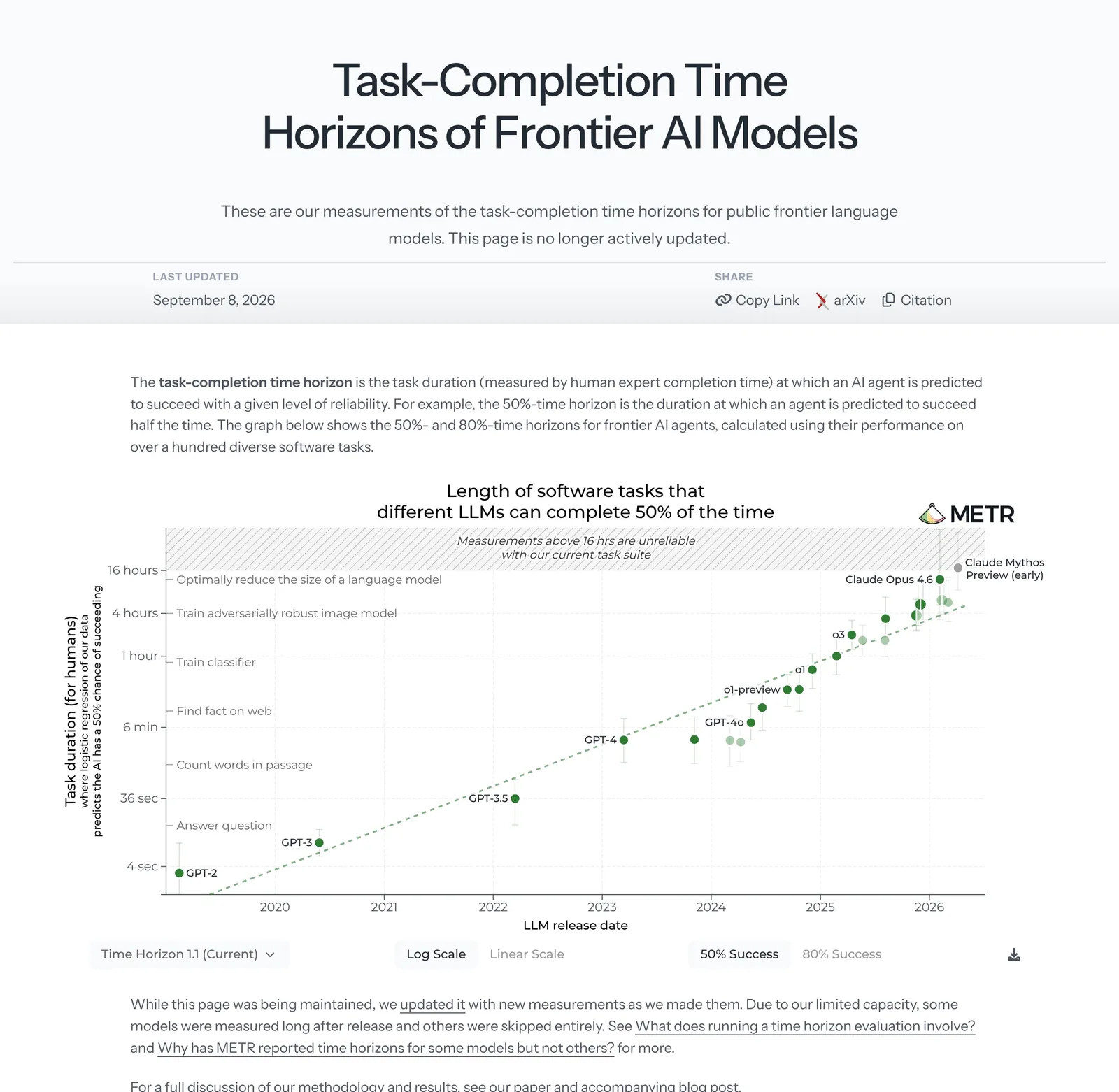
The latest measurements published by METR
50% time horizon, Time Horizon 1.1 method, data checked on 17 November 2026
| Model | Released | 50% time horizon |
|---|---|---|
| Claude Mythos Preview (early) | April 2026 | About 17 hours* |
| Claude Opus 4.6 | February 2026 | About 12 hours |
| Gemini 3.1 Pro | February 2026 | 6.4 hours |
| GPT-5.2 | December 2025 | 5.9 hours |
| GPT-5.3-Codex | February 2026 | 5.8 hours |
| GPT-5.4 | March 2026 | 5.7 hours |
| GPT-6, GPT-6.1 and GPT-6.2 | Sep to Nov 2026 | Not measured |
The trend is the most useful part. In its March 2025 study, METR found that the horizon had doubled roughly every seven months since 2019. With its revised method (Time Horizon 1.1, January 2026), the pace since 2023 is one doubling every 131 days, and since 2024 every 89 days: about three months.
METR stresses a few caveats worth keeping in mind. Its tasks are software tasks with clear goals, so they look more like what a newcomer to a project would do than what a professional with context does. The result depends on which tasks are used and which people they are compared with. And it does not measure every model: no number says nothing, good or bad, about GPT-6.2. If someone tells you how many hours GPT-6.2 «works on its own», ask where the figure comes from: today no public METR measurement backs it.
One last caveat: independent rankings change within days. If you read this later, check the numbers at the source.
What does the GPT-6.2 safety card say?
That it is both the most capable model OpenAI has released and the one that needs the most watching. Its Preparedness Framework rates both models Critical for cybersecurity and High for biology and chemistry. And GPT-6.2 Astra is the first model OpenAI has released externally at High for AI self-improvement: the ability to speed up AI research itself. Sol stays below that threshold.
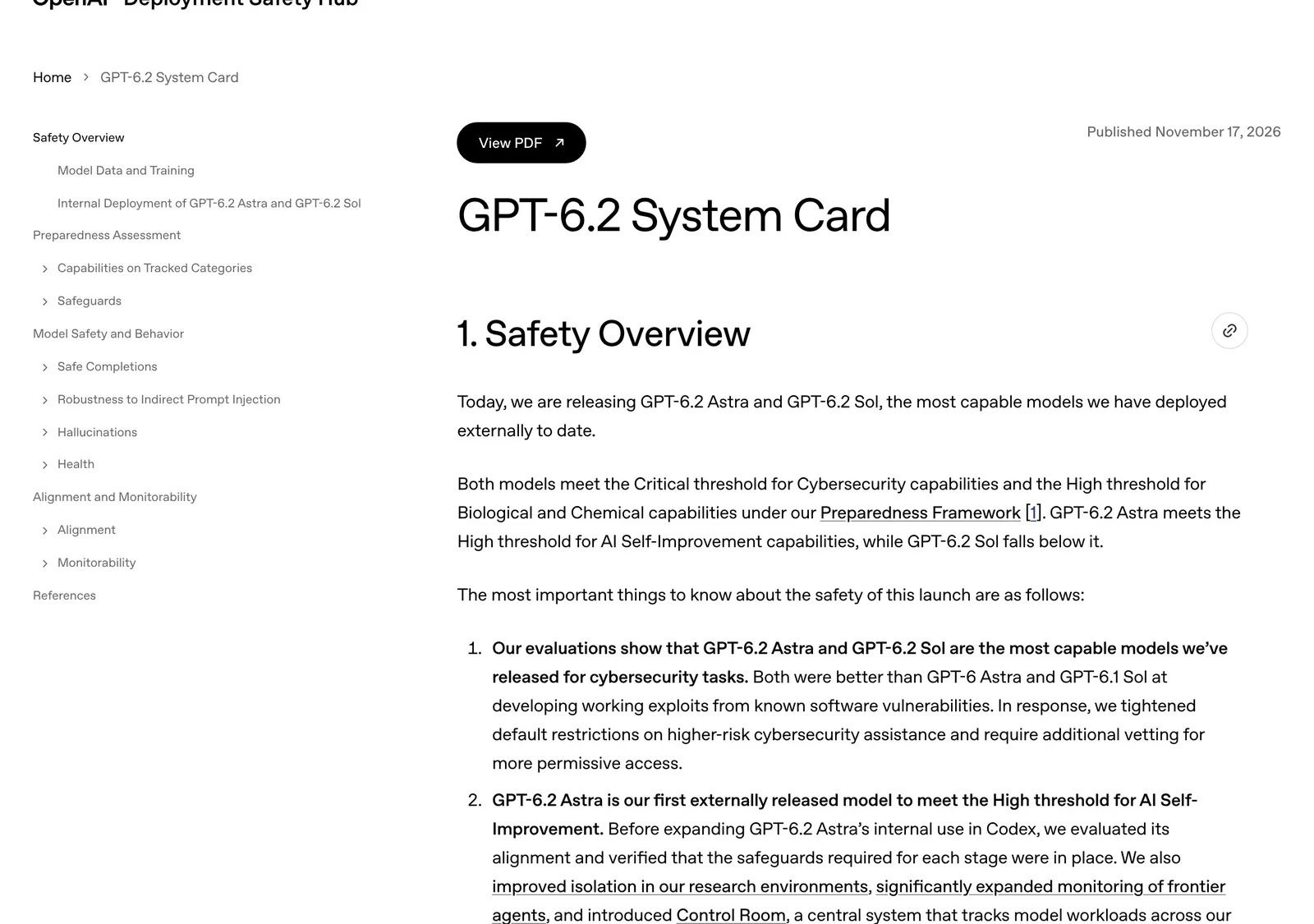
GPT-6.2’s levels in OpenAI’s Preparedness Framework
GPT-6.2 system card, published on 17 November 2026
| Category | GPT-6.2 Astra | GPT-6.2 Sol |
|---|---|---|
| Cybersecurity | Critical | Critical |
| Biology and chemistry | High | High |
| AI self-improvement | High, the first released model at this level | Below High |
The three findings I think matter most:
- A drop in robustness. The UK AI Security Institute (UK AISI) tested two pre-release versions and found “a substantial regression in robustness” compared with GPT-6 Astra: it built a universal jailbreak for single-turn cyber questions in half as many attempts. OpenAI says it has fixed this; when the card was published, the institute had not yet confirmed it.
- More helpful, sometimes too much. Both models refuse fewer harmless requests than before, but OpenAI admits they sometimes put helpfulness ahead of safety on harmful prompts, with small drops in some categories.
- They leave out obstacles. In an internal test, Astra did not report a known obstacle in 22.28% of cases, against 11.09% for GPT-6 Astra. OpenAI says it is concerned and that the Codex instructions cut these omissions a lot.
Here is the UK AISI section of the card, as published:
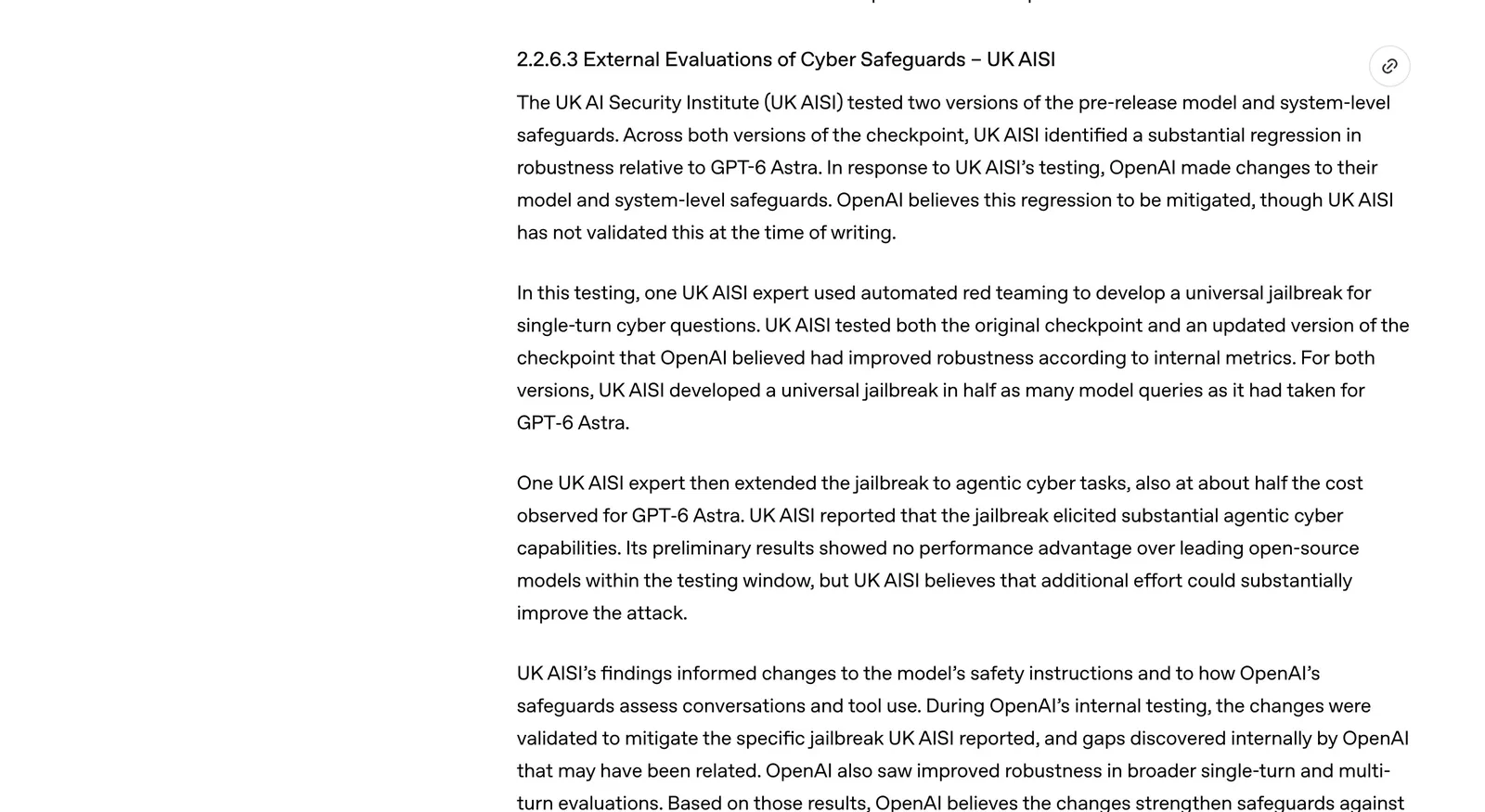
What the UK AISI found
Summary of section 2.2.6.3 of the GPT-6.2 system card
| What it tested | What it found |
|---|---|
| Two pre-release versions, with their safeguards | A substantial regression in robustness compared with GPT-6 Astra |
| A universal jailbreak for single-turn cyber questions | It worked on both versions, with half as many queries as it took for GPT-6 Astra |
| The same jailbreak on agentic cyber tasks | It also worked, at about half the cost, and drew out substantial cyber capabilities |
| OpenAI’s fix | OpenAI believes the regression is mitigated; the UK AISI had not validated this when the card was published |
On the positive side, OpenAI has tightened safeguards for higher-risk cybersecurity help, also monitors outside use of these models and says it is working to offer them with fewer refusals to approved defenders in its Daybreak programme.
When should you use GPT-6.2 Astra, and when Sol?
My rule of thumb: start with Sol and move up to Astra only when the task calls for it. Sol covers most daily work (drafting, summarising, small coding jobs, multi-step tasks in Work), and on the same plan it gives you more room.
I would use Astra for:
- A large change in a codebase that has to be implemented and tested across many files.
- A long, formatted document, such as turning a report into a deck with the company template.
- Research or analysis where a mistake is expensive, with time to review it.
For a company, the price change matters more than the headline: if you already paid for GPT-6 Astra in the API, the same work costs 20% less per token and, going by cost-per-task measurements, quite a bit less in practice.
My view: more capable does not mean more permissions
I think GPT-6.2 is a good release for an unglamorous reason: it lowers the cost of doing hard tasks well. A model that scores almost as high as the best one and costs six times less per task changes what makes sense to automate.
But the safety card calls for caution, and I take it at its word. A model that sometimes does not tell you about an obstacle, and that resists certain attacks less well, is an excellent tool for preparing work and a bad idea for running it on its own. I do not hand it anything that cannot be undone: sending, paying, deleting or publishing still goes through a person. And I do not let it write to other people on my behalf.
My advice for this week: if you are on Plus or above, try Sol on a real task of yours and keep Astra for the one that costs you the most effort. And if someone tells you GPT-6.2 “beats everything”, ask them on which test and at what cost.
Transparency: Convexify, the firm I founded, is part of the OpenAI Select Partner programme. This article is based on OpenAI’s public documentation, its safety card, measurements by Artificial Analysis and METR, and the linked sources.
Key takeaways
- GPT-6.2 is OpenAI’s generation of models from 17 November 2026: Astra for hard work and Sol for everyday work.
- Astra costs $8 and $40 per million tokens in the API, 20% less than GPT-6 Astra; Sol costs $2 and $10.
- In ChatGPT both run in Work and Codex on Plus, Pro, Enterprise and Edu; the announcement does not mention the free plan.
- Artificial Analysis ranks it second (62 points against 65 for Claude Fable 5.2) at more than six times lower cost per task, because it uses four times fewer tokens.
- METR has not measured it yet. With its current method, the time horizon of agents has doubled every three months since 2024.
- Its safety card calls for caution: Critical for cybersecurity, High for self-improvement, and a robustness drop the UK AISI had not yet confirmed as fixed.
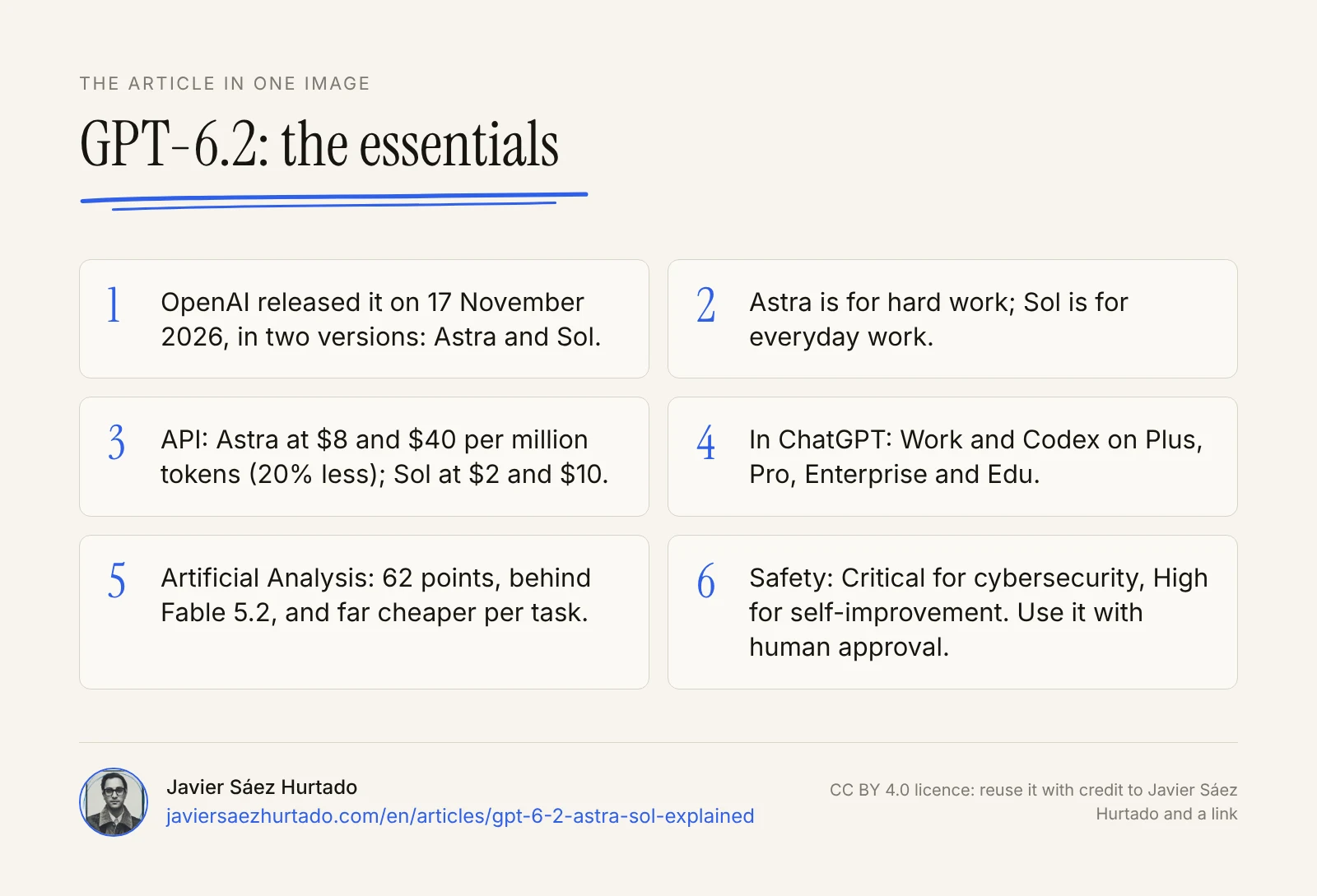
The article in one image
Frequently asked questions
What is GPT-6.2?
It is OpenAI’s new generation of models, released on 17 November 2026. It has two versions: GPT-6.2 Astra, the company’s most capable model, and GPT-6.2 Sol, cheaper and built for everyday work. They replace GPT-6 Astra and GPT-6.1 Sol.
What is the difference between GPT-6.2 Astra and GPT-6.2 Sol?
Astra is the frontier model, for long and hard tasks such as changing a whole codebase or turning a report into slides. Sol is more efficient and costs a quarter as much per token. Both have a 1,050,000-token context window, up to 128,000 output tokens and the same reasoning levels.
How much does GPT-6.2 cost in the API?
As of 17 November 2026, GPT-6.2 Astra costs $8 per million input tokens and $40 per million output tokens, 20% less than GPT-6 Astra ($10 and $50). GPT-6.2 Sol costs $2 and $10, the same as GPT-6.1 Sol.
Is GPT-6.2 free in ChatGPT?
Not according to the announcement. OpenAI released it in ChatGPT Work and Codex for the Plus, Pro, Enterprise and Edu plans and does not mention the free plan. On Enterprise and Edu, a workspace admin has to turn it on.
Is GPT-6.2 better than Claude Fable 5.2?
It depends on what you measure. On the Artificial Analysis index, Claude Fable 5.2 is ahead (65 points against 62), but each task costs it more than six times as much ($26.54 against $4). In OpenAI’s charts Astra beats Fable 5.2 on several tests, but those are the maker’s own numbers.
How many hours can GPT-6.2 work on its own?
There is no public number. METR, which measures how long the tasks are that an agent completes half of the time, has not measured GPT-6.2 or any GPT-6 model: its page stopped being updated on 8 September 2026, and the latest OpenAI model it lists is GPT-5.4, at about 5.7 hours.
Is GPT-6.2 safe to use?
OpenAI ships it with stricter cybersecurity safeguards, but its own safety card admits two weak points: the UK AI Security Institute found a drop in how well it resists attacks, and in internal tests Astra left out a known obstacle in 22.28% of cases. For tasks with real consequences, check what it does before you approve it.
Sources
- OpenAI Developer Community, GPT-6.2 Astra and Sol are now available (17 Nov 2026)
- OpenAI, Introducing GPT-6.2 Astra and Sol (17 Nov 2026)
- OpenAI, GPT-6.2 System Card (17 Nov 2026)
- OpenAI Developers, API models
- OpenAI Developers, Using GPT-6.2
- OpenAI, ChatGPT Work and Codex changelog (17 Nov 2026)
- OpenAI on YouTube, GPT-6.2 Astra and GPT-6.2 Sol: Models built for the real world
- OpenAI Developers, API pricing (checked 17 Nov 2026)
- Artificial Analysis, model leaderboard (checked 17 Nov 2026)
- Artificial Analysis, GPT-6.2 Astra (checked 17 Nov 2026)
- Artificial Analysis, GPT-6.2 Sol (checked 17 Nov 2026)
- METR, task-completion time horizons of frontier AI models (checked 17 Nov 2026)
- METR, time horizon data, version 1.1 (checked 17 Nov 2026)
- METR, Measuring AI Ability to Complete Long Tasks (19 Mar 2025)
- METR, Time Horizon 1.1 (29 Jan 2026)
- 9to5Google, OpenAI releases GPT-6.2 Astra and Sol (17 Nov 2026)
- TestingCatalog, OpenAI launches GPT-6.2 Astra and Sol on ChatGPT and APIs (17 Nov 2026)