GPT-6 Cyber explained: what OpenAI’s security model does and who can use it
GPT-6 Cyber is a version of GPT-6 Astra trained for authorized security work. OpenAI released it on 5 November 2026. It is not in ChatGPT: only approved organizations in the Daybreak Red program can use it, through the API and Codex, at 20 dollars per million input tokens and 100 per million output tokens.
What is GPT-6 Cyber?
GPT-6 Cyber is an OpenAI model built for cybersecurity. It is a version of GPT-6 Astra trained for authorized security work: finding vulnerabilities, writing test exploits and running penetration tests on web apps. OpenAI published its system card on 5 November 2026.
- GPT-6 Cyber
- The version of GPT-6 Astra for authorized offensive and defensive security. It comes after GPT-5.6 Cyber, which is still available in Daybreak Red.
- Daybreak
- OpenAI’s trusted access program for cybersecurity. It has three levels: standard, Daybreak Blue and Daybreak Red.
- Exploit
- A program or a set of steps that uses a bug to do something the system should not allow, such as getting admin rights.
The difference from a normal assistant is not only the model. It is how the model works. GPT-6 Cyber acts as an agent: it gets a goal, uses tools, tries, fails and tries again without a person guiding each step. I described this shift from answering to working in my piece on how OpenAI agents work. In security, that is very powerful. It is also why OpenAI keeps this model far more closed than any other.
What does GPT-6 Cyber do better than GPT-6 Astra?
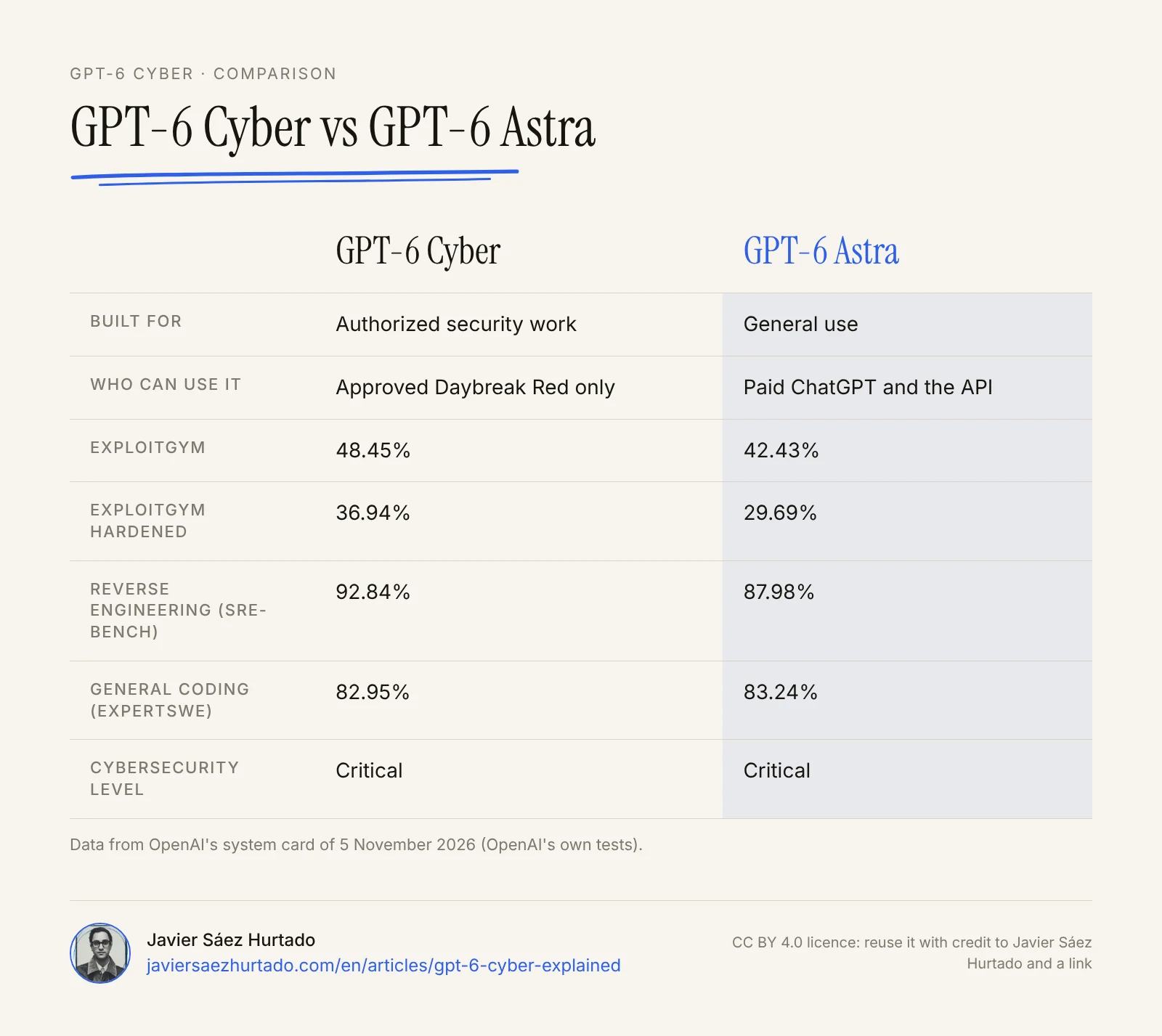
According to the system card, GPT-6 Cyber is clearly better than GPT-5.6 Cyber and somewhat better than GPT-6 Astra on long security tasks. On general coding it is about the same. All figures are OpenAI’s own tests, plus an outside evaluation by the security firm Irregular.
GPT-6 Cyber vs GPT-6 Astra
OpenAI system card, 5 November 2026
| GPT-6 Cyber | GPT-6 Astra | |
|---|---|---|
| ExploitGym (working exploit) | 48.45% | 42.43% |
| ExploitGym Hardened | 36.94% | 29.69% |
| SEC-Bench Pro (JavaScript engines) | 87.02% | 85.38% |
| SRE-Bench (reverse engineering) | 92.84% | 87.98% |
| Irregular CyScenarioBench (scenarios solved) | 11 of 11 | 8 of 11 |
| ExpertSWE (general coding) | 82.95% | 83.24% |
The card admits two limits. First, on Irregular’s FrontierCyber test, GPT-6 Cyber solved 90 of 288 challenges and Astra solved 96. Irregular saw no successful attack on fully hardened targets, and neither model solved the 15 hardest challenges. Second, some tests with older bugs may be contaminated, because those bugs were public when the model was trained.
The biggest change is in behavior. In a test with a decoy target outside the authorized scope, GPT-6 Cyber tried to exploit it in 0.07% of cases without extra instructions. GPT-5.6 Cyber did it in 5.51%. For a model like this, staying inside the scope you set matters as much as raw skill.
What has it found so far in Linux and Firefox?
OpenAI says it used the model in two real campaigns, as reported by IT-Connect and JustGeek on 6 November. In the Linux kernel, it reproduced 1,724 vulnerabilities and wrote working exploits for 948 of them, all local privilege escalation. It sent 304 critical issues to the maintainers with patch proposals.
In Firefox, it found 81 new bugs that Mozilla rated high severity, with reproducible proofs. It also showed that 30 known bugs were worse than people thought. Mozilla has started releasing fixes. According to IT-Connect, the Linux campaign cost a little over 1.2 million dollars in API credits, about 1,279 dollars per exploit.
These figures come from OpenAI, and there is no full independent check yet. Still, the pattern is clear. A model that finds and exploits bugs at this scale is good news for defenders and bad news for anyone who does not patch.
Who can use GPT-6 Cyber?
Only organizations approved for Daybreak Red that also have a separate approval for this model. It is not in ChatGPT, Plus or Pro. You use it through the API, with the model ID gpt-6-cyber, and through Codex.
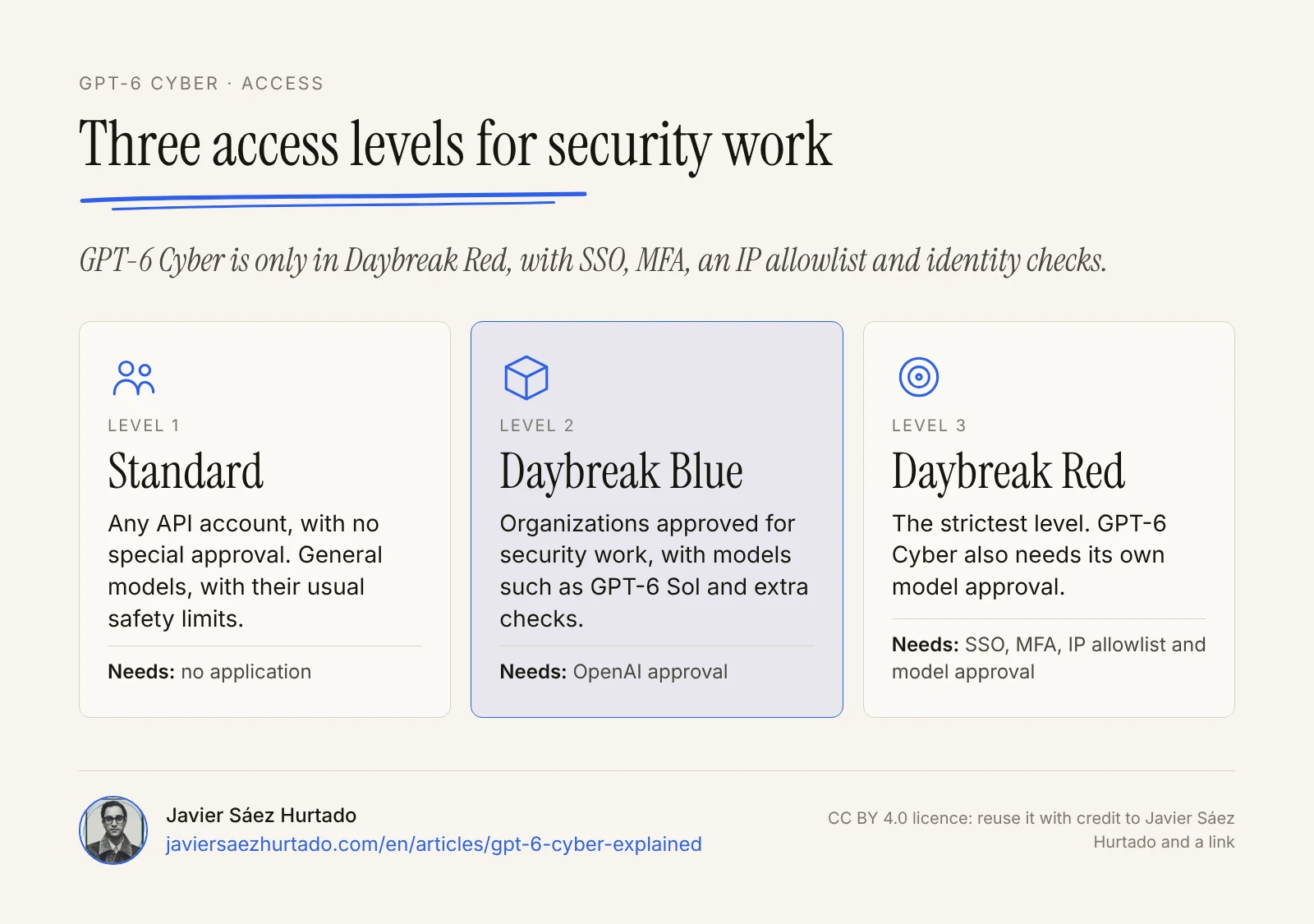
Daybreak has three levels. Standard is what any API account has. Daybreak Blue gives approved organizations access to models such as GPT-6 Sol for security work, with extra checks. Daybreak Red is the strictest, and it is the only level with GPT-6 Cyber.
To join Daybreak Red, OpenAI reviews the organization’s identity, its use case, its security practices and legal commitments about which activities are authorized and who else can get access. Then it requires:
- single sign-on and enforced multi-factor authentication for the whole team;
- managed devices and least-privilege access;
- an IP allowlist for API use;
- monitoring of employee use and reporting of any misuse or compromised account.
Individuals can only join by invitation. They need identity and liveness checks, proof of professional background and at least one physical FIDO2 security key. It is the closest thing to a security clearance I have seen in an AI product.
How much does GPT-6 Cyber cost?
In the API it costs 20 dollars per million input tokens, 2 dollars per million cached input tokens and 100 dollars per million output tokens, according to OpenAI’s documentation checked on 9 November 2026. That is twice what GPT-6 Astra cost at launch (10 and 50 dollars).
It has a context window of 1,050,000 tokens and can write up to 128,000 tokens per answer. It takes text and images and answers in text. It works with the Chat Completions and Responses APIs, with function calling and web search, but not with batch processing or fine-tuning.
Why does OpenAI rate it Critical?
OpenAI’s Preparedness Framework ranks cybersecurity risk in levels. GPT-6 Cyber, like Astra, sits at the highest one: Critical. In practice, this means that with the right tools it can find bugs and write exploits that used to take a lot of specialist work. In biology and chemistry, OpenAI treats it as High, as a precaution.
To contain it, OpenAI describes several safeguards:
- extra blocks for high-risk help against industrial controls, essential services and election systems;
- model monitoring that tells authorized testing apart from out-of-scope actions;
- a cautious biology mode for every user;
- monitoring for stolen API keys;
- and, in Codex, the advice to work in a sandbox, with automatic review and a person approving sensitive steps.
If the model is misused, OpenAI can limit, suspend or revoke access.
Attackers already use agents: what Microsoft reported the same day
On 5 November, the same day as the GPT-6 Cyber system card, Microsoft Threat Intelligence reported that attacker groups use an AI agent attack framework called ARTEX. They use it to search GitHub for exposed keys and credentials, including API keys for AI services. Microsoft has seen this since August 2026.
In one case, the agent went from searching GitHub for secrets to taking data out of an Azure Key Vault in five minutes. When a request failed, the agent fixed the API version and tried again seconds later. Microsoft advises rotating any exposed credential right away, moving apps to managed identities instead of secrets, turning on secret scanning and push protection in GitHub, and giving each service account only the permissions it needs.
Together, the two stories say the same thing. Models that find bugs now exist on both sides. What matters is who reaches the bug first, and that depends more on basic hygiene than on which model you have.
What does it mean for companies in Europe?
For most, GPT-6 Cyber is not something they will use. OpenAI does not publish a list of countries for Daybreak Red. Access is decided per organization and confirmed with its account team. It will mostly go to security firms and large security teams.
What does affect every company is the other side. If bugs are found faster, they also need to be patched faster. In the EU, the NIS2 directive already requires essential and important entities to manage cyber risk, including vulnerability handling and disclosure. The AI Act also requires providers of general-purpose models with systemic risk to assess and reduce those risks, cybersecurity included.
My practical list for this week, whether or not a company has access to these models:
- Search code repositories for keys and passwords, including the history, and rotate any you find.
- Turn on secret scanning and push protection.
- Review the permissions of service accounts and of API keys for AI services.
- Shorten the time between a patch coming out and being applied.
- If you use coding agents, run them in sandboxes, with human approval for anything that cannot be undone.
What I would do with GPT-6 Cyber
I think it is right that OpenAI did not put it in ChatGPT. A model that writes working exploits should sit behind identity checks, hardware keys and monitoring, and Daybreak Red is designed that way.
If an organization has access, I would use it inside a very clear boundary: targets authorized in writing, an isolated environment, a log of everything it does and a person reviewing before any action that touches real systems. A model that stays in scope 99.93% of the time is real progress. But in security, the other 0.07% is exactly where the trouble happens.
And I would not hand it anything that cannot be undone, or connect it to high-value accounts without a human approval at each step. The risks of giving an agent broad access already showed up with Hermes Agent and its approval modes, and with a model like this the cost of a mistake is much higher.
Disclosure: Convexify, the firm I founded, is part of the OpenAI Select Partner program. This article is based on OpenAI’s public system card and documentation, Microsoft’s report and the linked sources.
Key takeaways
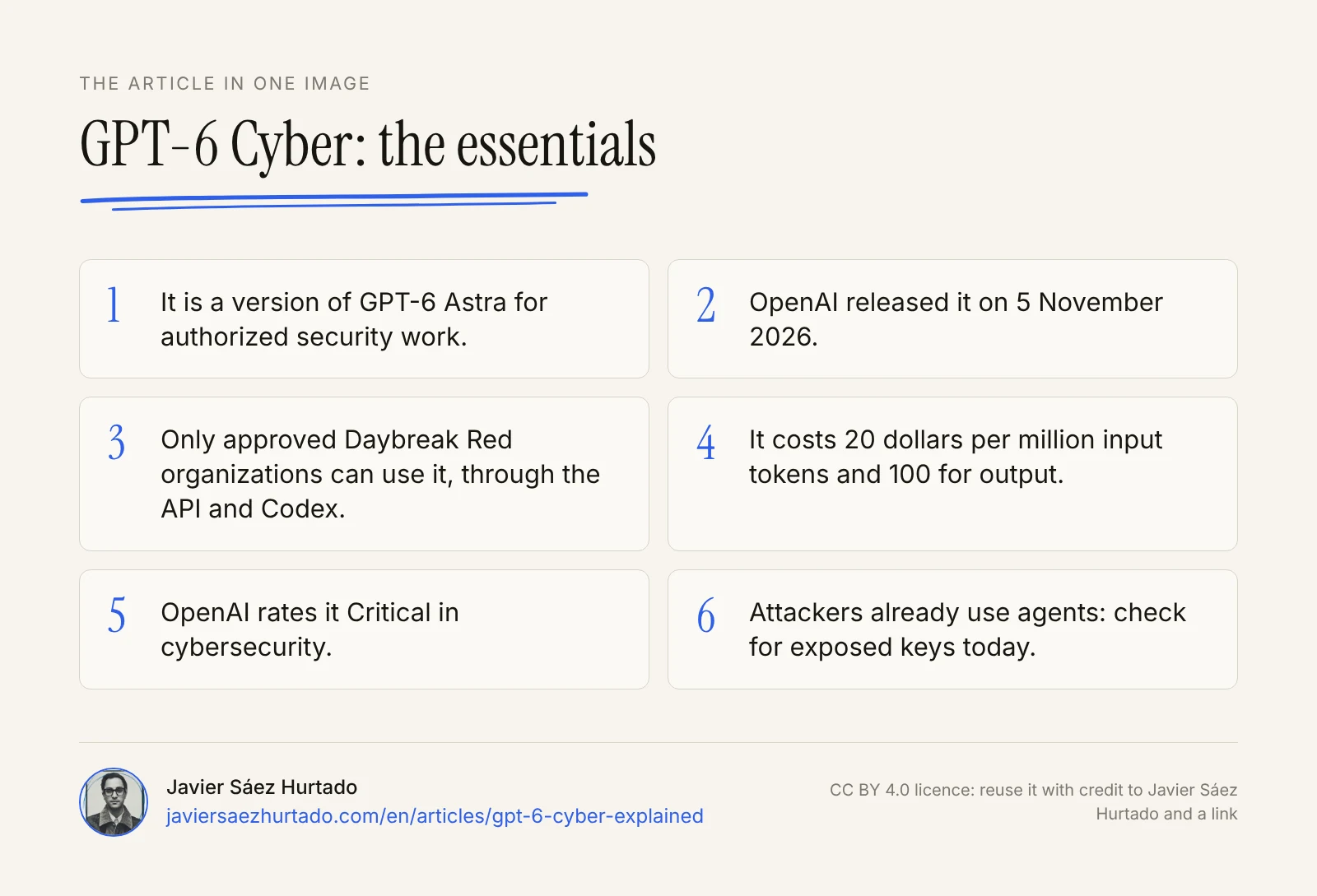
- GPT-6 Cyber is a version of GPT-6 Astra for authorized security work, released on 5 November 2026.
- Only approved Daybreak Red organizations can use it, through the API and Codex. It is not in ChatGPT.
- It costs 20 dollars per million input tokens and 100 per million output tokens.
- OpenAI rates it Critical in cybersecurity and surrounds it with checks and monitoring.
- Attackers already use agents to find exposed keys: checking secrets and permissions is the urgent step for every company.
The article in one image
Frequently asked questions
What is GPT-6 Cyber?
It is an OpenAI model specialized in cybersecurity, based on GPT-6 Astra. It is built for authorized work: finding vulnerabilities, writing test exploits and web penetration testing. OpenAI published its system card on 5 November 2026.
Can I use GPT-6 Cyber in ChatGPT?
No. GPT-6 Cyber is not in ChatGPT, not even in Plus or Pro. Only approved Daybreak Red organizations can use it, through the API and Codex, and they also need a separate approval for this model.
What is Daybreak Red?
It is the strictest level of Daybreak, OpenAI’s trusted access program for cybersecurity. It requires checks on the organization’s identity and use case, single sign-on, enforced multi-factor authentication, an IP allowlist for the API and legal commitments about authorized use.
How much does GPT-6 Cyber cost?
According to OpenAI’s API documentation, checked on 9 November 2026, it costs 20 dollars per million input tokens, 2 dollars per million cached input tokens and 100 dollars per million output tokens.
Is GPT-6 Cyber dangerous?
OpenAI rates it Critical in cybersecurity, the highest level of its Preparedness Framework, like GPT-6 Astra. That is why access is limited to vetted organizations, with usage monitoring, extra blocks around critical infrastructure and the option to revoke access.
Is GPT-6 Cyber available in Europe?
OpenAI does not publish a list of countries for Daybreak Red. Access is decided per organization after a review and confirmed with the OpenAI account team. For most European companies, it is not a real option today.
Sources
- OpenAI, GPT-6 Cyber System Card (5 Nov 2026)
- OpenAI API Docs, GPT-6 Cyber model: price, context and endpoints (checked 9 Nov 2026)
- OpenAI API Docs, Daybreak guide: levels and requirements (checked 9 Nov 2026)
- Microsoft Security Blog, Threat actors use agentic AI tooling to find and abuse exposed secrets (5 Nov 2026)
- IT-Connect, GPT-6 Cyber: exploits on Linux and Firefox (6 Nov 2026, in French)
- JustGeek, GPT-6 Cyber (6 Nov 2026, in French)
- EUR-Lex, Regulation (EU) 2024/1689 on artificial intelligence (AI Act)
- EUR-Lex, Directive (EU) 2022/2555 (NIS2)