GPT-6 Astra: what it is, what it costs and who can use it
GPT-6 Astra is OpenAI’s most capable model, announced on 3 September 2026, with its biggest gains in computer use, coding and professional work. It is not in free ChatGPT, on Plus it only comes in Work and Codex, and in the API it costs 10 dollars per million input tokens and 50 dollars per million output tokens.
What is GPT-6 Astra?
GPT-6 Astra is OpenAI’s most capable AI model. It was announced on 3 September 2026 and, according to OpenAI, it leads in computer use, web browsing, coding, cybersecurity, science and professional work. It is also the model behind dots, the always-on agents in ChatGPT.
- GPT-6 Astra
- The flagship of the GPT-6 family. In the API it is called gpt-6-astra and takes text and images as input, with text as output.
- GPT-6 Pro
- The ChatGPT chat option that runs on Astra, for Pro, Business and Enterprise plans.
- GPT-6.1 Sol
- The model announced at DevDay on 29 September. OpenAI says it comes close to Astra for a fifth of its token price.
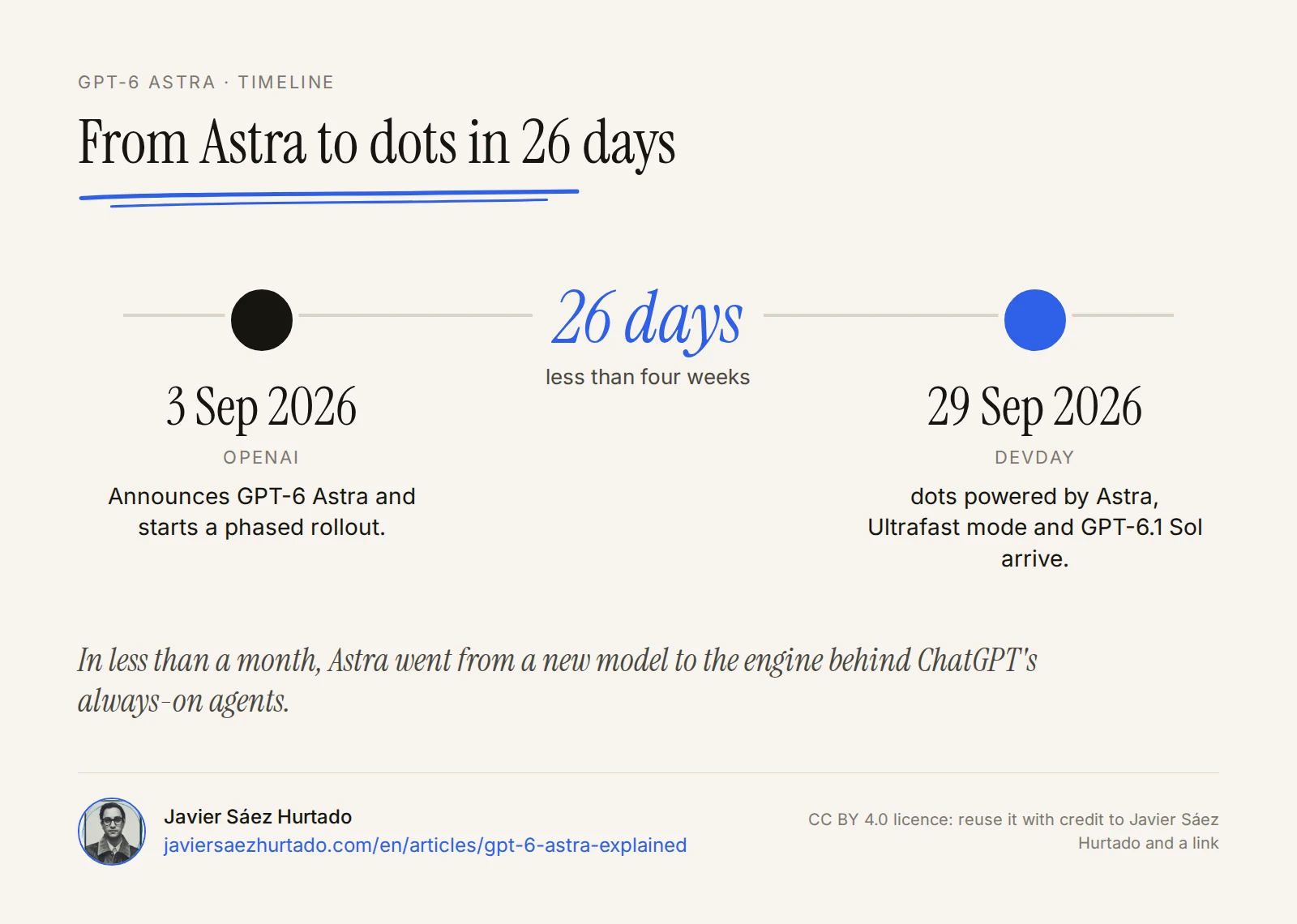
The rollout came in phases: first a limited set of organisations, then, over the following days, ChatGPT Plus, Pro, Business and Enterprise, the OpenAI API, Microsoft Azure and AWS Bedrock. GPT-6 Sol and GPT-6 Luna followed on 22 September, and DevDay brought GPT-6.1 Sol, Ultrafast mode and dots, which I covered in the guide to OpenAI agents.
What does GPT-6 Astra improve over GPT-5.6 Sol?
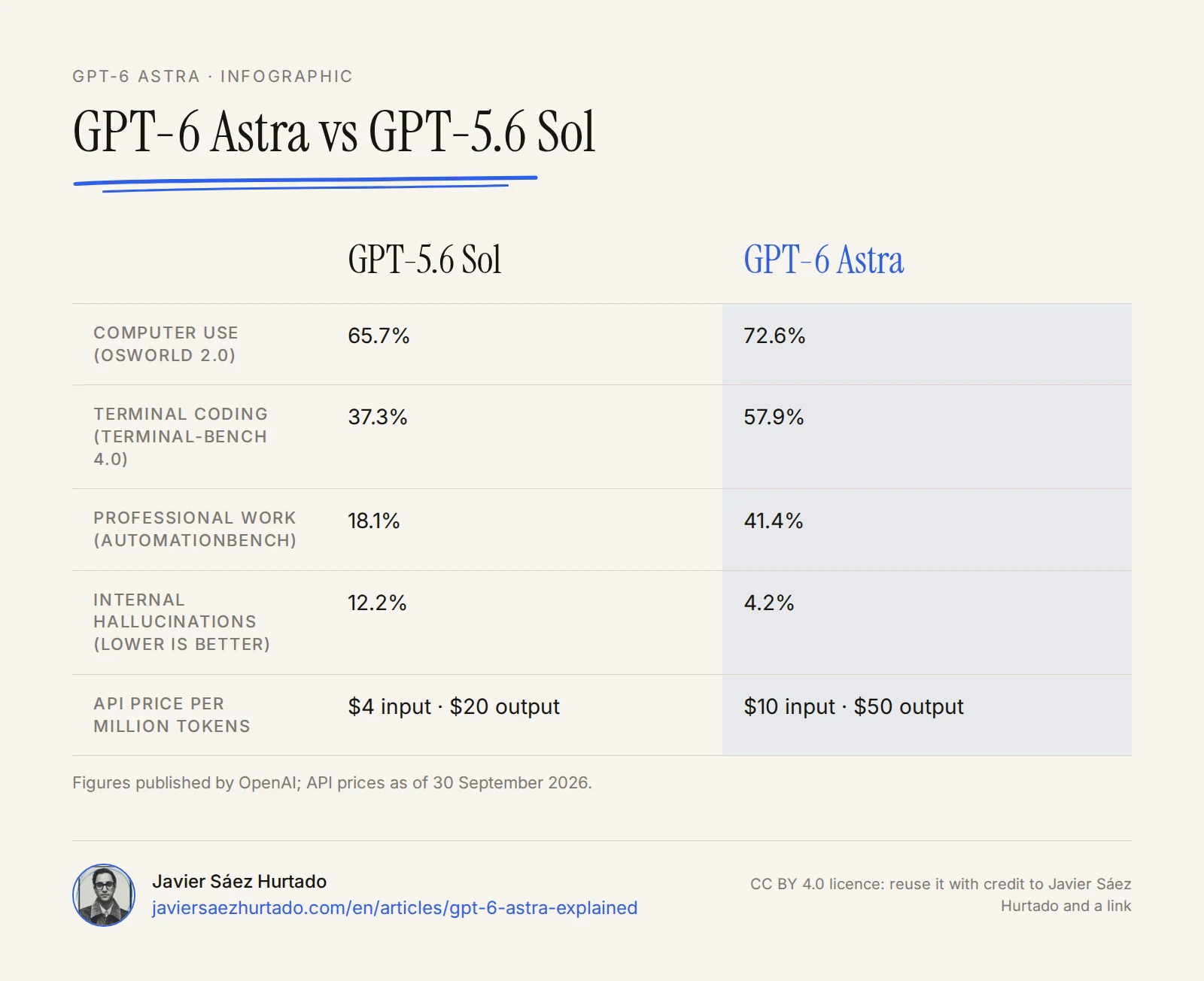
The clearest gains are in work with tools: using a computer, coding in a terminal and finishing multi-step professional tasks. In OpenAI’s published results, Astra goes from 37.3% for GPT-5.6 Sol to 57.9% on Terminal-Bench 4.0, and from 18.1% to 41.4% on AutomationBench, a test of automated professional tasks.
On computer use (OSWorld 2.0), OpenAI reports 72.6% against 65.7%, in about 47% less time per task. It also says that in one internal evaluation Astra is three times less likely than GPT-5.6 Sol to make inaccurate claims about its own capabilities, and its internal hallucination rate drops from 12.2% to 4.2%.
Some numbers stand out, like 99.9% on ARC-AGI-3 and 100% on ExploitBench, which OpenAI says are now saturated tests. Read them for what they are: results published by the company that built the model. The independent evaluation by Artificial Analysis puts Astra level in first place on its intelligence index with Claude Fable 5.1, six points above GPT-5.6 Sol, and notes a drop of about 45 Elo points on GDPval-AA v2, a test of knowledge work tasks.
Is GPT-6 Astra free? Access by ChatGPT plan
It is not free. No official OpenAI page includes it in the free ChatGPT plan, and on paid plans access depends on where you use it: the regular chat, or ChatGPT Work and Codex, the parts of ChatGPT built for handing off tasks.
Where you can use GPT-6 Astra by plan
OpenAI Help Center, checked on 30 September 2026
| Plan | Work and Codex | Chat (GPT-6 Pro) |
|---|---|---|
| Free | No | No |
| Plus | Yes, about 5 to 45 messages every 5 hours | No |
| Pro | Yes, 25 to 900 messages every 5 hours, by tier | Yes, with its own limits |
| Business | Yes, about 5 to 45 messages every 5 hours (Standard) | Yes, on eligible plans |
| Enterprise | Turned on by the admin | Yes, per the company rate card |
The Plus case has drawn complaints on OpenAI’s forum: the announcement said Astra would come to all Plus users, while the help center explains that Plus includes Astra in Work and Codex but not GPT-6 Pro in chat. Ultrafast mode, which OpenAI says generates tokens up to 8 times faster in Codex, is only included in the 500-dollar Pro plan and in eligible Enterprise and Edu workspaces.
How much does GPT-6 Astra cost in the API?
In the OpenAI API, gpt-6-astra costs 10 dollars per million input tokens and 50 dollars per million output tokens at standard rates, with cached input at 1 dollar. I checked this on 30 September 2026. That is about two and a half times the price of GPT-5.6 Sol (4 and 20 dollars).
The key technical and pricing facts:
- Context: 1,050,000 input tokens and up to 128,000 output tokens. Its knowledge runs to 30 April 2026.
- Long requests: above 272,000 input tokens, the whole request is billed at twice the input rate and 1.5 times the output rate.
- Batch and Flex: half price, in exchange for slower responses.
- Fast: up to twice the speed for twice the price.
- Tools: computer use, web search, file search, code interpreter, MCP and skills, among others.
Many tasks will not need Astra. OpenAI’s help center suggests starting with low or medium reasoning effort, and GPT-6.1 Sol promises near-Astra intelligence for a fifth of its token price.
Why is GPT-6 Astra rated Critical for cybersecurity?
Because it is the first OpenAI model to reach the Critical level of cybersecurity capability in its Preparedness Framework. The system card puts it plainly: with the right tools and access, Astra can find previously unknown security flaws and develop new ways to exploit them in well-protected systems without a person guiding each step. In biology and chemistry, OpenAI treats it as High capability as a precaution.
To contain this, OpenAI describes several safeguards: a real-time monitor that reviews the model’s reasoning and actions, adjustable refusal limits in cybersecurity and tiered trusted access for the most sensitive uses. The card also admits limits: not seeing failures does not prove the model is reliable everywhere, and the model sometimes notices it is being tested.
Can you use GPT-6 Astra in Europe?
Yes. I found no exclusion of Spain or the European Economic Area for the model in ChatGPT or the API in OpenAI’s official sources, and both Spain and Andorra are on the list of countries where ChatGPT is available.
The exception is dots, which run on Astra. On the Pro plan, OpenAI offers them for now outside the EEA, Switzerland and the UK, so Pro users in Spain cannot get them. On Business Premium they are available in every region where ChatGPT works. Andorra is not part of the EEA, but OpenAI does not mention it by name. I compare dots with another agent in Grok Bot vs OpenAI dots.
For a company in Europe, this comes down to three practical choices:
- Pick the model for the task. Astra for hard analysis, complex code or research; GPT-6.1 Sol or lighter models for everyday work, which is most of it.
- Check your data setup. The API offers zero data retention for eligible customers and regional data residency endpoints, at a 10% surcharge.
- Keep the model and the agent separate. Using Astra to think is not the same as letting an Astra-powered agent act in your accounts. They are two decisions and it is worth making them one at a time.
What do early independent reviews say?
Early reviews confirm the jump on tasks with tools and add nuance on the rest. Artificial Analysis puts it level in first place on its index, with a lower cost per task than its closest rival, but finds weaker results than GPT-5.6 Sol on knowledge work tasks and presentation quality. Decrypt described it as very strong on agentic tasks and weaker at writing. Google has answered with Gemini 4 Argon, which I compare with Astra in Gemini 4 Argon explained.
The most complete video analysis I have seen is by AI Explained, which goes through the results and what the safety card says:
How I would use GPT-6 Astra
GPT-6 Astra is a real step forward in what I care about most in a model: working with tools on long tasks. I would use it without hesitation to analyse complex documents, review difficult code or prepare research, always with a person checking the result before it is used.
Where I would be more careful is in letting it act. A model its own maker rates Critical for cybersecurity is a good tool in the right hands and one more reason not to give it free access to high-value accounts. I would not let it send messages on my behalf or do anything that cannot be undone without approval, in line with what I wrote in the essay on what you would let an agent do without looking (in Spanish).
One practical tip: do not pay for Astra on everything. Most everyday work comes out just as well on a cheaper model, and keeping Astra for the hard problems is the most sensible way to get value from it.
Transparency: Convexify, the firm I founded, is part of the OpenAI Select Partner programme. This article is based on OpenAI’s public documentation, independent evaluations and the linked sources.
Key takeaways
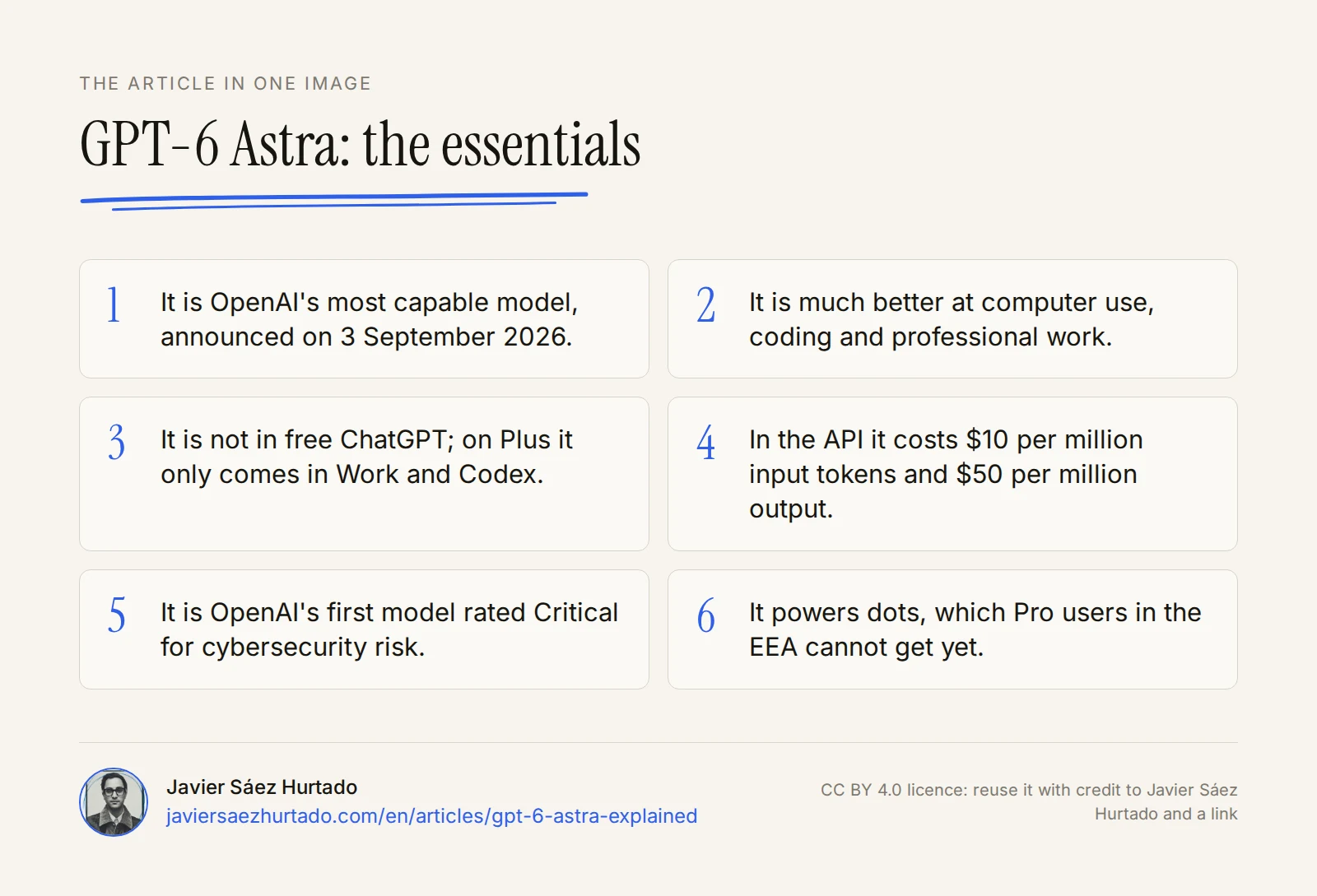
- GPT-6 Astra is OpenAI’s most capable model, announced on 3 September 2026.
- Its biggest gains are in computer use, coding and professional work.
- It is not in free ChatGPT; on Plus it only comes in Work and Codex, and chat with GPT-6 Pro is for Pro, Business and Enterprise.
- In the API it costs 10 dollars per million input tokens and 50 per million output; GPT-6.1 Sol comes close for a fifth of the price.
- It is OpenAI’s first model rated Critical for cybersecurity, and it powers dots, which Pro users in the EEA cannot get yet.
The article in one image
Frequently asked questions
What is GPT-6 Astra?
It is OpenAI’s most capable AI model, announced on 3 September 2026. It is strongest in computer use, browsing, coding, science and professional work, and it powers dots, the always-on agents in ChatGPT.
Is GPT-6 Astra free?
No. No official OpenAI page includes it in the free ChatGPT plan. On Plus you can use it in ChatGPT Work and Codex, with usage limits, and chat with GPT-6 Pro, which runs on Astra, is available on Pro, Business and Enterprise.
How much does GPT-6 Astra cost in the API?
As of 30 September 2026, 10 dollars per million input tokens and 50 dollars per million output tokens at standard rates. Requests with more than 272,000 input tokens cost twice as much for input and 1.5 times for output, and Batch and Flex are half price.
When was GPT-6 Astra released?
OpenAI announced it on 3 September 2026. It first went to a limited set of organisations and, over the following days, to ChatGPT Plus, Pro, Business and Enterprise, the OpenAI API, Microsoft Azure and AWS Bedrock.
Can I use GPT-6 Astra in Europe?
Yes. I found no exclusion of the European Economic Area for the model in OpenAI’s official sources. The exception is dots, which run on Astra: on the Pro plan they are not available in the EEA, Switzerland or the UK.
What is the difference between GPT-6 Astra and GPT-6.1 Sol?
Astra is the most capable and most expensive model. GPT-6.1 Sol, announced at DevDay on 29 September, offers near-Astra intelligence for a fifth of its token prices, according to OpenAI, and it is also available on Plus.
Sources
- OpenAI, GPT-6 Astra: A new generation of intelligence (3 Sep 2026)
- OpenAI, GPT-6 Astra system card (3 Sep 2026, updated)
- OpenAI Developers, gpt-6-astra model
- OpenAI Developers, API pricing
- OpenAI Help Center, managing usage with GPT-6 Astra in Work and Codex
- OpenAI Help Center, getting started with your dot
- OpenAI Help Center, ChatGPT supported countries
- OpenAI, DevDay 2026 recap (29 Sep 2026)
- Artificial Analysis, Benchmarking GPT-6 Astra (9 Sep 2026)
- TechCrunch, OpenAI launches Astra (3 Sep 2026)
- Axios, OpenAI Astra GPT-6 (3 Sep 2026)
- TechCrunch, OpenAI launches GPT-6.1 Sol (29 Sep 2026)