Mistral Large 4 (Le Chonk): what it is, what it costs and how to use it
Mistral Large 4 is Mistral AI’s largest model: 1.05 trillion parameters, text and images, and more than 160 languages, available as a preview on its API since 6 October 2026. The weights are due at the end of the month, so companies will be able to run it on their own servers in Europe.
What is Mistral Large 4?
Mistral Large 4 is the new language model from Mistral AI, the French AI company, and the largest it has built so far. It went live on 6 October 2026 as a public preview on the Mistral API, and the weights are due at the end of the month. Mistral’s nickname for it is “Le Chonk”.
Four terms explain most of what is new:
- Mixture of experts
- A design where the model has many internal “experts” and only uses some of them for each answer. Mistral Large 4 has 1.05 trillion parameters but uses about 49 billion at a time.
- Multimodal
- It reads text and images: documents, charts, photos and, according to Mistral, satellite images and engineering drawings.
- Open weights
- The weights are the model itself. Publishing them means anyone can download it and run it on their own servers, without the maker’s cloud.
- Preview
- A version you can already use, but whose price, behaviour or terms may change before the final release.
Mistral describes it as a hybrid model that either answers directly or reasons step by step, depending on the task. It was trained in Mistral’s own data centres in Europe on about 3,800 Nvidia Grace Blackwell GPUs.
When is Mistral Large 4 out, and when do the weights arrive?
The API has been open since 6 October 2026, as a public preview. Mistral says the weights will follow “at the end of this month”, and The Next Web gives 27 October as the date.
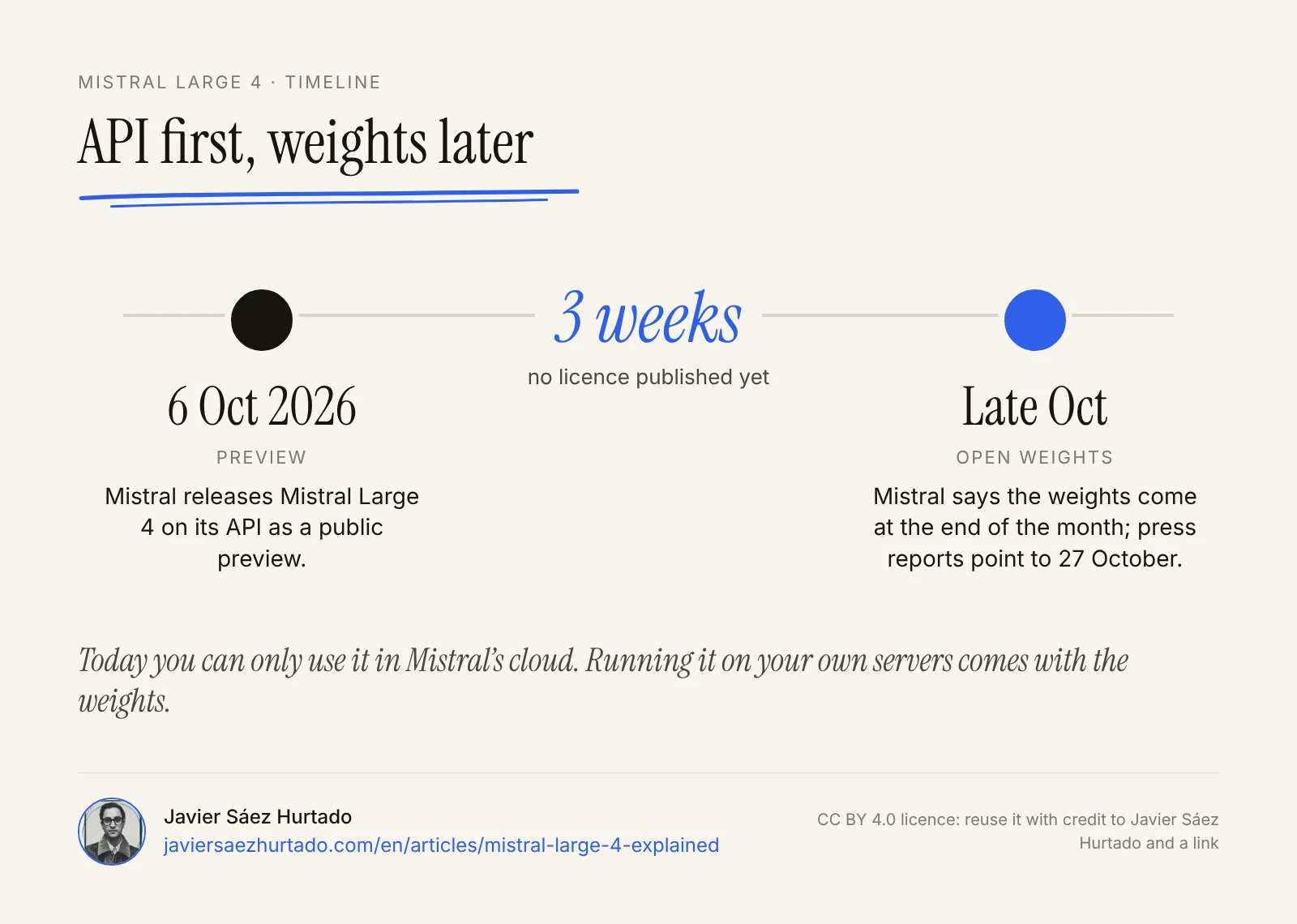
One thing is still missing: the licence. Mistral Large 3 came out under Apache 2.0, which is very permissive, while Mistral Medium 3.5 uses a modified MIT licence. Until the text is out, no one can say for sure what commercial use will be allowed.
What can Mistral Large 4 do?
Mistral pitches it as a general model with four strong areas: security, business work with documents, science and images. The model page lists up to one million tokens of context, function calling, structured outputs and agents with built-in tools.
These are some of the results Mistral itself reports:
- Security: 82% on a test that reproduces and patches vulnerabilities, and 93% on Cybench. It ranks among the first five models on the Artificial Analysis cyber index.
- Business tasks: 59.9% on AutomationBench, which covers 657 real workflows, and better scores than GPT-6 Astra on two finance tests.
- Images: 42% on Dense200, against 41% for GPT-6 Astra.
- Coding: 61.7% on DeepSWE v1.1.
- Model safety: 93.3% resistance to attacks on Lakera’s B3 test.
To see how it fits with the other launches of the past few weeks, read what GPT-6 Astra is and what Gemini 4 Argon is.
Is it better than other models? What independent tests say
It is competitive, but it does not lead everywhere. The numbers above come from Mistral, and the first independent reviews add important detail, above all on coding.
Implicator reports that on DeepSWE the open models GLM-5.3 and Kimi K3 score around 69%, and the closed models from OpenAI, Google and Anthropic around 74%, against 61.7% for Mistral Large 4. Beri cites the Vals Index, a combined score, where Mistral Large 4 gets 48%, behind Kimi K3 (50%) and GLM-5.3 (53.5%). The same source notes that its answers are long, so the cost per task is higher than the token price suggests.
Mistral Large 4 against other models
Published results as of 7 October 2026
| Test | Mistral Large 4 | Reference | Source |
|---|---|---|---|
| Dense200 (images) | 42% | GPT-6 Astra, 41% | Mistral |
| AutomationBench (business) | 59.9% | Ahead of Kimi K3 and DeepSeek V4 Pro | Mistral |
| DeepSWE (coding) | 61.7% | GLM-5.3 and Kimi K3, ~69%; closed models, ~74% | Implicator |
| Vals Index (combined) | 48% | Kimi K3, 50%; GLM-5.3, 53.5% | Beri |
| Human rating (Surge AI) | 3.74 out of 5 | Claude Opus 5, 4.22 | Mistral |
The fair reading is that it is one of the best open models built outside China for documents and security, and that there are better options for code. This independent video asks the question most people have, whether it is worth the cost:
How much does Mistral Large 4 cost?
On the Mistral API, the list price is 1.36 dollars per million input tokens and 4.18 dollars per million output tokens. On 7 October 2026 the model page showed a 50% launch discount: 0.68 dollars for input, 0.07 for cached input and 2.09 for output.
Mistral has not said how long the discount will last, and preview prices can change. For a budget, I would use the list price.
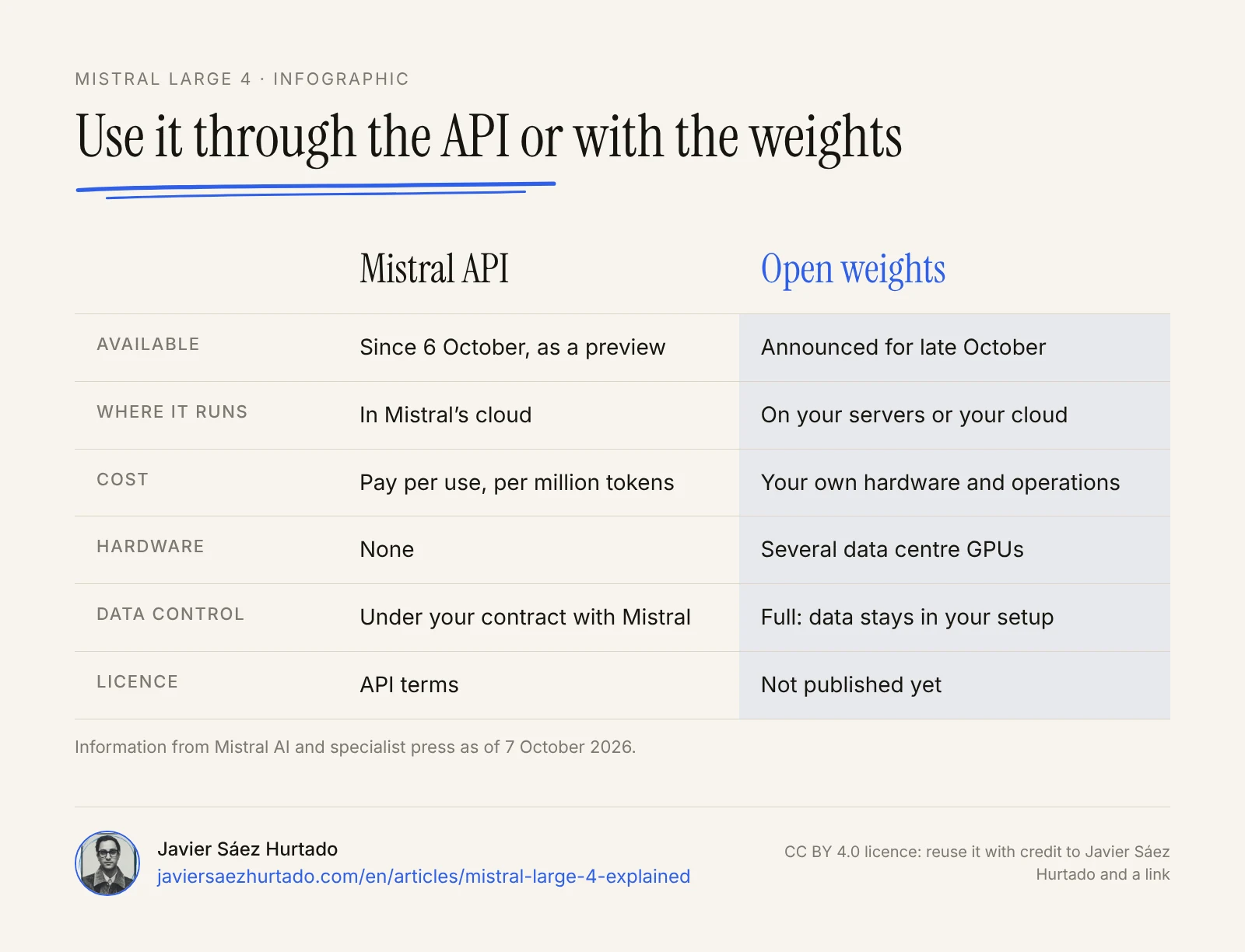
Once the weights are out, running it will not cost tokens, but it will cost hardware. This is not a laptop model: you will need a server with several data centre GPUs. Published estimates of exactly how many cannot be checked until the weights are released.
How do you use Mistral Large 4?
Today, through the Mistral API, from the Mistral Studio console, with the model name mistral-large-4-0. Mistral says it is available in several regions worldwide and lists no country limits.
Mistral has not confirmed in the announcement that it is in Vibe, its consumer assistant that used to be called Le Chat. Its pricing page currently recommends Mistral Medium for most tasks in Vibe.
What does it mean for companies in Europe?
It gives European companies a strong model they can run inside Europe, without relying on a US or Chinese provider. Mistral trained it in its own European data centres and says it can be deployed “under European law”, without going through other digital service providers.
For a company with sensitive data, that opens two paths. The first is the Mistral API, from a European company, under its contract and data terms. The second, once the weights are out, is running it on your own servers or a European cloud, so the data never leaves your setup.
The second path is neither cheap nor simple. It needs expensive hardware, people to run it, and a careful read of the licence. For most small companies the API will remain the practical choice. For banks, public bodies, law firms or industry with regulated data, having that option changes the discussion.
Two more details matter for European users. It works in more than 160 languages, including every official EU language, and Mistral says it built it with companies in finance, engineering, logistics, pharma and the public sector. That is why its strongest results are in long documents, finance and legal work, more than in code.
It can also work with tools and connect to systems such as email or spreadsheets, so it can run agents. Before you give an agent that kind of access, it helps to read what I wrote about DeepSeek Harness, an open-source coding agent, and how its permission modes work.
What we know and what we don’t
We know its size, its list price, that it already works on the API and that it was trained in Europe. We don’t know the licence, the exact date for the weights, how long the discount will last, whether it will reach Vibe, or what hardware it will need in practice.
The security numbers, the most striking part of the announcement, have not been checked by third parties either. Mistral also says it will give governments and security teams early access to versions with fewer security limits, which is worth watching.
My view: when I would use it and when I wouldn’t
I think this is good news for Europe, and not out of pride. A competitive model that you can run in-house gives companies a real option when data cannot leave the building. I would try it on the API now for documents, sample contracts and financial analysis, where it does best.
I would not use it yet for coding if code quality is the priority, and I would not build a project on the weights before reading the licence. And the rule I apply to any model still holds: none of them should send emails or messages in your name or touch high-value accounts without a person approving each action. What cannot be undone stays with a human, whether the model comes from Europe or anywhere else.
Transparency: Convexify, the firm I founded, is part of the OpenAI Select Partner programme. This article compares Mistral Large 4 with OpenAI models and others, and it is based on Mistral’s public documentation and the linked sources.
Key takeaways
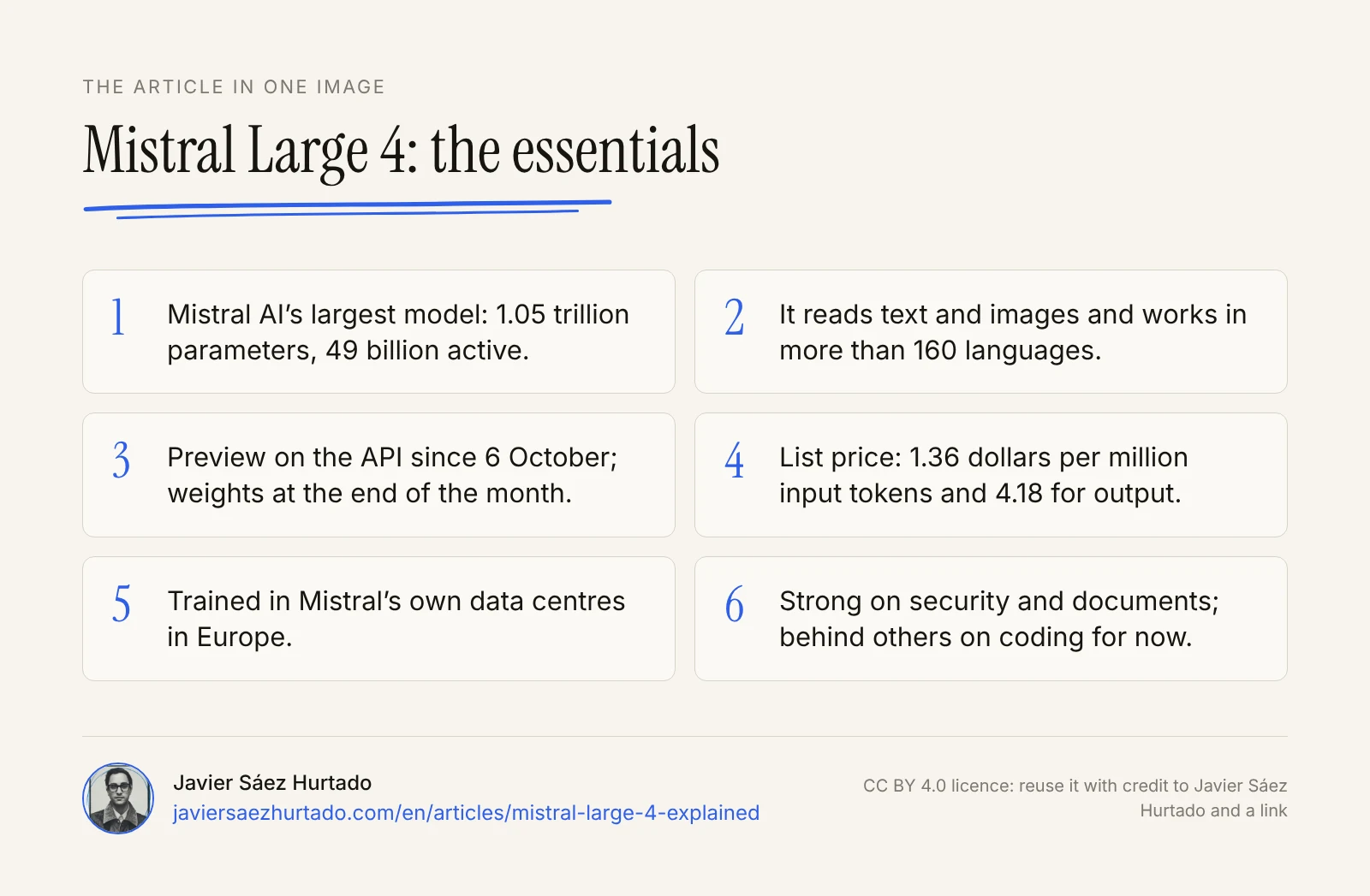
- Mistral Large 4 is Mistral AI’s largest model: 1.05 trillion parameters, about 49 billion active.
- It has been a preview on the API since 6 October 2026; the weights arrive at the end of the month and the licence is still unknown.
- It costs 1.36 dollars per million input tokens and 4.18 for output, with a temporary launch discount.
- It is strong on security, documents and business tasks, and behind other models on coding.
- For European companies, its value is the option to run it inside Europe with full control of the data.
The article in one image
Frequently asked questions
What is Mistral Large 4?
It is Mistral AI’s new language model, announced on 6 October 2026. It is a mixture-of-experts model with 1.05 trillion parameters, it reads text and images, it can answer directly or reason step by step, and it will be released with open weights. Mistral also calls it “Le Chonk”.
Is Mistral Large 4 open source?
Mistral calls it an open-weight model: it will publish the weights so anyone can download and run it. As of 7 October 2026 the weights were not out yet and the licence had not been published, so the terms for commercial use are still unknown.
How much does Mistral Large 4 cost?
On the Mistral API, the list price is 1.36 dollars per million input tokens and 4.18 dollars per million output tokens. On 7 October 2026 the model page showed a launch discount: 0.68 dollars for input, 0.07 for cached input and 2.09 for output. Check it before you plan a budget.
When will the Mistral Large 4 weights be released?
Mistral says at the end of October 2026, and some outlets give 27 October as the date. Until then, you can only use it through the Mistral API, as a public preview.
Is Mistral Large 4 available in Vibe, formerly Le Chat?
Mistral has not confirmed it in the announcement. The confirmed way in is the API, through the Mistral Studio console, with the model name mistral-large-4-0. Vibe, Mistral’s assistant that used to be called Le Chat, currently recommends Mistral Medium for most tasks.
Is Mistral Large 4 better than GPT-6 Astra?
It depends on the task. Mistral reports small wins over GPT-6 Astra on some vision and finance tests, but independent reviews put the closed models from OpenAI, Google and Anthropic ahead on coding. Its main advantage is not the score: it is that you will be able to run it yourself.
Sources
- Mistral AI, Introducing Mistral Large 4 (6 Oct 2026)
- Mistral Docs, Mistral Large 4 model page (checked 7 Oct 2026)
- Mistral Docs, models overview and licences
- Mistral AI, API and Vibe pricing (checked 7 Oct 2026)
- SiliconANGLE, Mistral launches open-source Mistral Large 4 (6 Oct 2026)
- The Next Web, Mistral releases Large 4 (6 Oct 2026)
- MarkTechPost, Mistral AI releases Mistral Large 4 (6 Oct 2026)
- Implicator, Mistral Large 4 preview pitches open weights against lock-in (Oct 2026)
- Beri, Mistral Large 4 vs Kimi K3, Beam and GLM (Oct 2026)