What is Hermes Agent? The open source agent from Nous Research, and what Hermes for Businesses adds
Hermes Agent is an open source AI agent, under the MIT licence, that Nous Research built to learn as you use it: it keeps memory and writes its own skills. It moved twice this week. On 7 October Nous announced 90 million dollars in funding and Hermes for Businesses, and on 13 October it released version 0.22.
What is Hermes Agent?
Hermes Agent is an open source AI agent made by Nous Research. It carries out multi-step tasks with real tools, such as the terminal, the browser, email and your files. Unlike most agents, it is built to learn as you use it: it remembers what it finds out and turns what works into skills it can use again.
- Hermes Agent
- The open source agent from Nous Research, under the MIT licence. Its GitHub tagline is “The agent that grows with you”.
- Nous Research
- An AI lab founded in 2023, known for its Hermes models, which it built by fine-tuning open models.
- Skill
- A saved procedure: step-by-step instructions the agent recalls when it meets a similar task.
- Gateway
- The process that connects the agent to messaging apps such as Telegram, Slack, WhatsApp or Signal.
A chatbot answers and waits. An agent like Hermes does the work, keeps what it learned and can run scheduled jobs without you typing anything. If you want to see how other companies handle that idea, I compared the always-on agents from xAI and OpenAI in Grok Bot vs OpenAI dots.
Nous Research says the project has been cloned more than 24 million times and drives about 2.5% of all AI tokens used worldwide. That second figure is its own internal estimate. As of 14 October 2026, the repository has more than 253,000 stars on GitHub.
What did Nous Research announce this week?
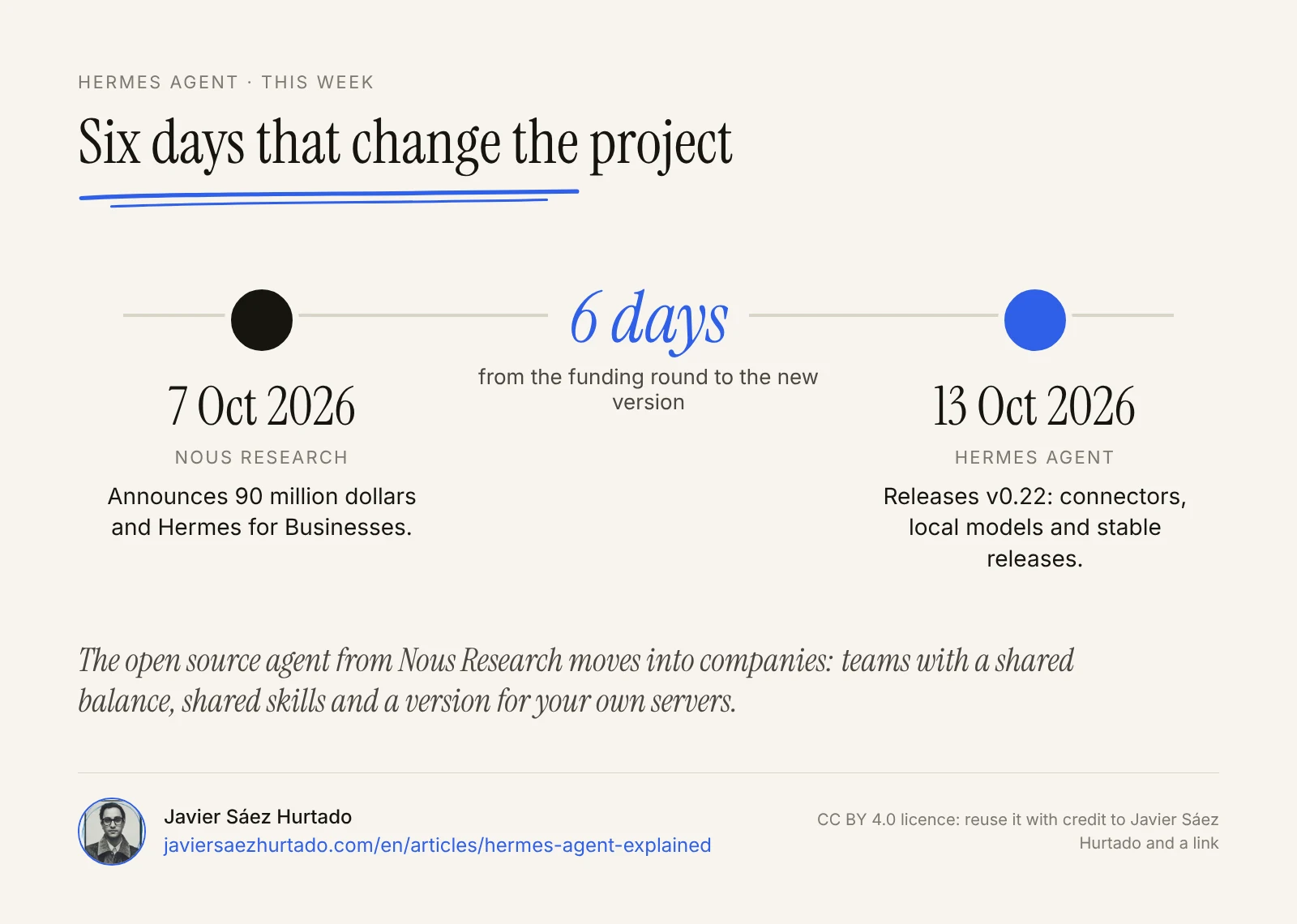
Two things, six days apart. On 7 October, Nous Research said it had raised 90 million dollars and would use the money to build Hermes for Businesses. On 13 October it released Hermes Agent 0.22, the largest release so far according to its notes.
In its note, Nous lists NVIDIA, Microsoft’s M12, Samsung, Robot Ventures, Union Square Ventures, Y Combinator and Menlo Ventures among its investors. TechCrunch adds that Robot Ventures led the round, that the company is valued at 1.5 billion dollars and that it has raised 158 million dollars in total. The Wall Street Journal, quoted by TechCrunch, reported an annual revenue run rate of about 36 million dollars in mid-September.
Version 0.22 brings four changes that matter if you are starting out:
- Connectors. The agent can work in apps such as Gmail, Linear or Notion. You sign in once in your browser and the tool is ready.
- One-click local models. It installs and updates llama.cpp, checks your memory and graphics card, and picks an open model that fits your machine. No account or key needed.
- Stable releases. Each release is tested on every operating system before it goes out, and installs now follow stable releases by default instead of every code change.
- Passwords kept from the model. The agent’s browser can sign in with 1Password, Bitwarden or its own encrypted vault, and the model never sees the password. Card details at checkout need your confirmation.
How does Hermes Agent work?
Think of Hermes as a small work crew on your computer or server. A language model decides what to do, a set of tools carries it out, and a memory and skills system keeps what it learned for next time. These are the main parts:
- Memory. It stores facts about you, your projects and your preferences, and brings them back when they matter. It can also search past conversations.
- Skills. It stores procedures. After a complex task, the agent can write a new skill and improve it the next time it uses it. It follows the open agentskills.io standard.
- Models. It is not tied to one provider. It works with any OpenAI-compatible API, from Nous Portal or OpenRouter to OpenAI, Anthropic, Google, or a local model through Ollama or llama.cpp.
- Channels. You can use it from a terminal interface, a desktop app for Windows and macOS, or from Telegram, Discord, Slack, WhatsApp and Signal through a single gateway.
- Scheduled jobs and subagents. It has a built-in scheduler for daily reports or weekly checks, and it can split work across isolated subagents.
- Where it runs. Seven backends: local, Docker, SSH, Singularity, Modal, Daytona and Vercel Sandbox. The project says a 5 dollar a month server is enough.
What is Hermes for Businesses, and how much does it cost?
Hermes for Businesses is the team version of Hermes. It comes in two forms. Business runs on Nous infrastructure and you set it up yourself. Enterprise runs on your own infrastructure. The key idea is that skills one team member creates go into a shared library, so everyone’s agent can use them.
Hermes Business and Hermes Enterprise
From the official Nous Research page as of 14 October 2026
| Business | Enterprise | |
|---|---|---|
| Where it runs | Nous infrastructure | Customer infrastructure (own servers or private cloud) |
| Setup | Self-serve | Tailored, with onboarding support |
| Data | An isolated tenant per team at Nous | On the customer’s infrastructure |
| Payment | Shared balance with spending caps per person | By contract |
| Access | Email invites and roles | Single sign-on (SSO) and service agreements |
| Models | Models on the Nous API plus your own keys | Depends on the deployment |
Nous does not publish a price per seat. The team tops up one shared balance, each member spends from it up to a cap set by an admin, and the portal shows where every dollar goes. Team integrations are Discord, Telegram, Slack and WhatsApp, plus the terminal, the desktop app and the cloud.
The shared skills are the most interesting part, and the part I would watch most closely. A good skill makes the whole team better. A badly written or tampered skill also reaches everyone.
How is it different from OpenClaw?
Hermes and OpenClaw are alike in the basics. Both are open source under the MIT licence, both work through messaging apps, both use skills and both connect to the model you choose. The difference is in what each one puts first and who is behind it.
Hermes Agent and OpenClaw, point by point
Public documentation of each project, October 2026
| Hermes Agent | OpenClaw | |
|---|---|---|
| Who maintains it | Nous Research, a company | The OpenClaw Foundation |
| Licence | MIT | MIT |
| Main trait | It learns: writes and improves skills from what it does | Heartbeat: it wakes up on its own to check tasks |
| Extensions | A catalogue of 600 reviewed plugins | The ClawHub community marketplace |
| Approvals | Smart, manual and off modes | Depend on how you set it up |
| Origin | Released by Nous Research under MIT in February 2026 | Personal project by Peter Steinberger, late 2025 |
If you are choosing between the two, the useful question is not which one has more features. It is which one your team can set up and watch more closely. For another open agent with a different approach, I explained DeepSeek Harness and its sandbox modes.
Is Hermes Agent safe?
Hermes has a layered security model, but the person who sets it up has the final say. Its documentation describes eight layers. They include user allowlists, approval for dangerous commands, container isolation, credential filtering for MCP servers and scanning project files for hidden instructions.
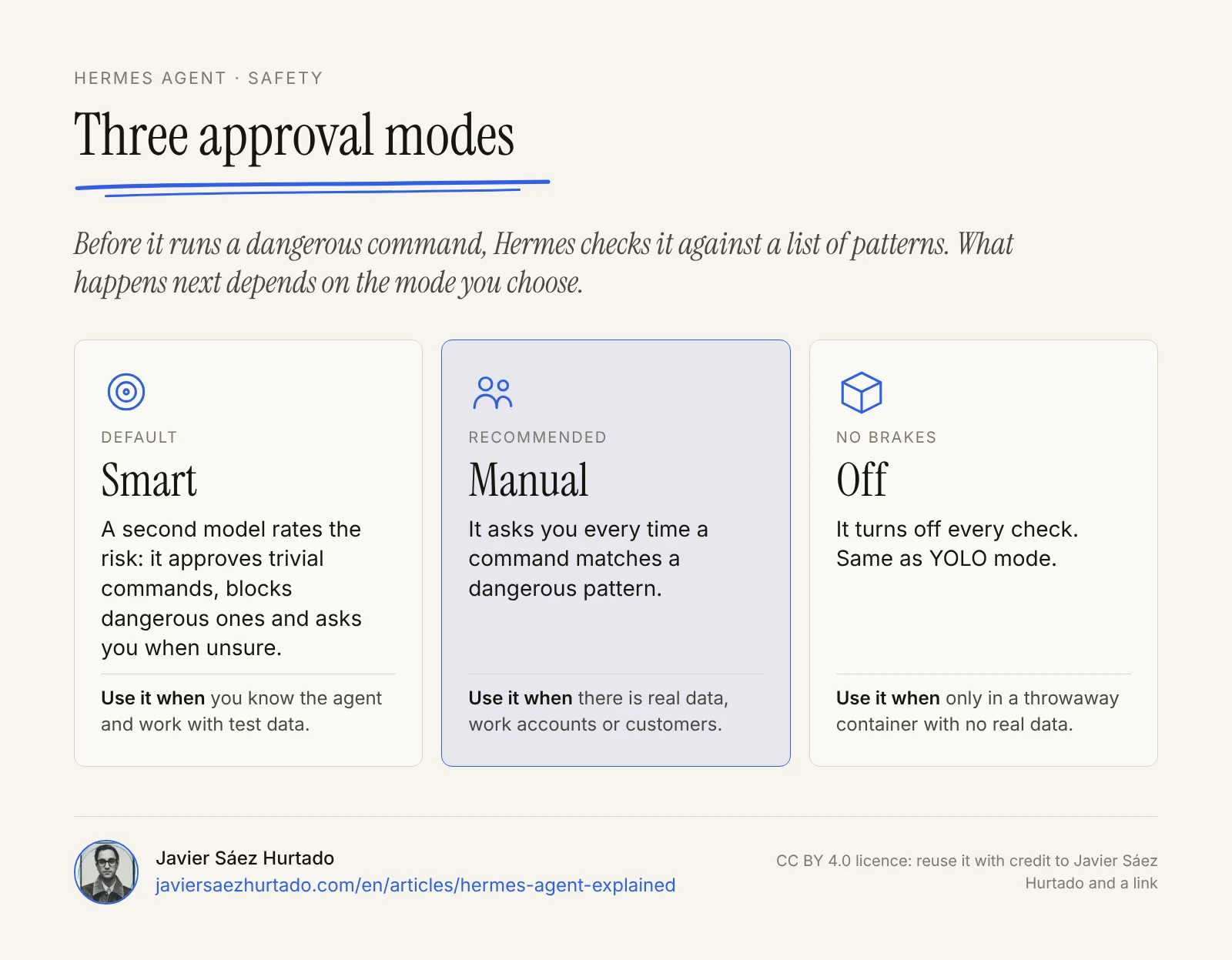
The default mode is “smart”. A second model rates the risk, approves trivial commands, blocks dangerous ones and asks you when it is unsure. “Manual” mode always asks. “Off” mode, also called YOLO, removes every check, and the documentation itself says to use it only in trusted environments. One good detail: scheduled jobs and sessions with nobody watching block dangerous commands by default instead of approving them.
Layers do not mean there are no flaws. On 24 May 2026 the US National Vulnerability Database (NVD) published CVE-2026-9353, an injection flaw in the component that checks skills. It was rated 7.3 out of 10 and affected versions up to 2026.4.23. OpenClaw went through the same thing: the more people use an open agent, the more people look for its weak spots.
What does it mean for companies in Europe?
For a European company, the key question is where the data goes. With Hermes, that depends on how you use it. For the version you install yourself, the documentation says the software sends no telemetry, and your conversations, memory and skills stay on your machine. The only thing that leaves is the calls to the model provider you pick.
- On your machine or server, you are in control. If you connect it to a provider outside the EU, check its data policy as you would for any other tool.
- With personal or customer data, use a provider that processes data in the EU and signs a data processing agreement, or an open model on your own servers. I covered that option in my piece on Mistral Large 4.
- With Hermes Business, your data sits in an isolated tenant on Nous infrastructure. As of 14 October, the page does not say in which region, so ask in writing before you add personal data.
- With Enterprise, the data stays on your infrastructure. That fits GDPR best, if you have a team to run it.
In every case, the company is still the data controller, not the agent or the people who built it.
My view: where I would use it and where I would not
I think it is good news that one of the most used open agents now has a company with money and a business plan behind it. It gives stability to a project many people already rely on. Stable releases and keeping passwords away from the model are steps in the right direction.
I would use it for internal, repetitive work: preparing reports, sorting documents, reviewing code in an isolated setup or running searches that I then check myself. I would start in Docker, with approval set to manual, with accounts and keys created only for the agent, and with no customer data until I had weeks of tests.
I would not let Hermes, or any other agent, handle anything that means talking to other people in my name, or anything that touches high-value accounts such as banking or payments. I would not turn on YOLO mode outside a throwaway container either. Autonomy should be earned with evidence, and what cannot be undone should not be handed off.
In a company, I would add one more rule: shared skills go through a human review before they reach the whole team. Learning on its own is the agent’s biggest strength, and that is exactly why you want to know what it learned.
Key takeaways
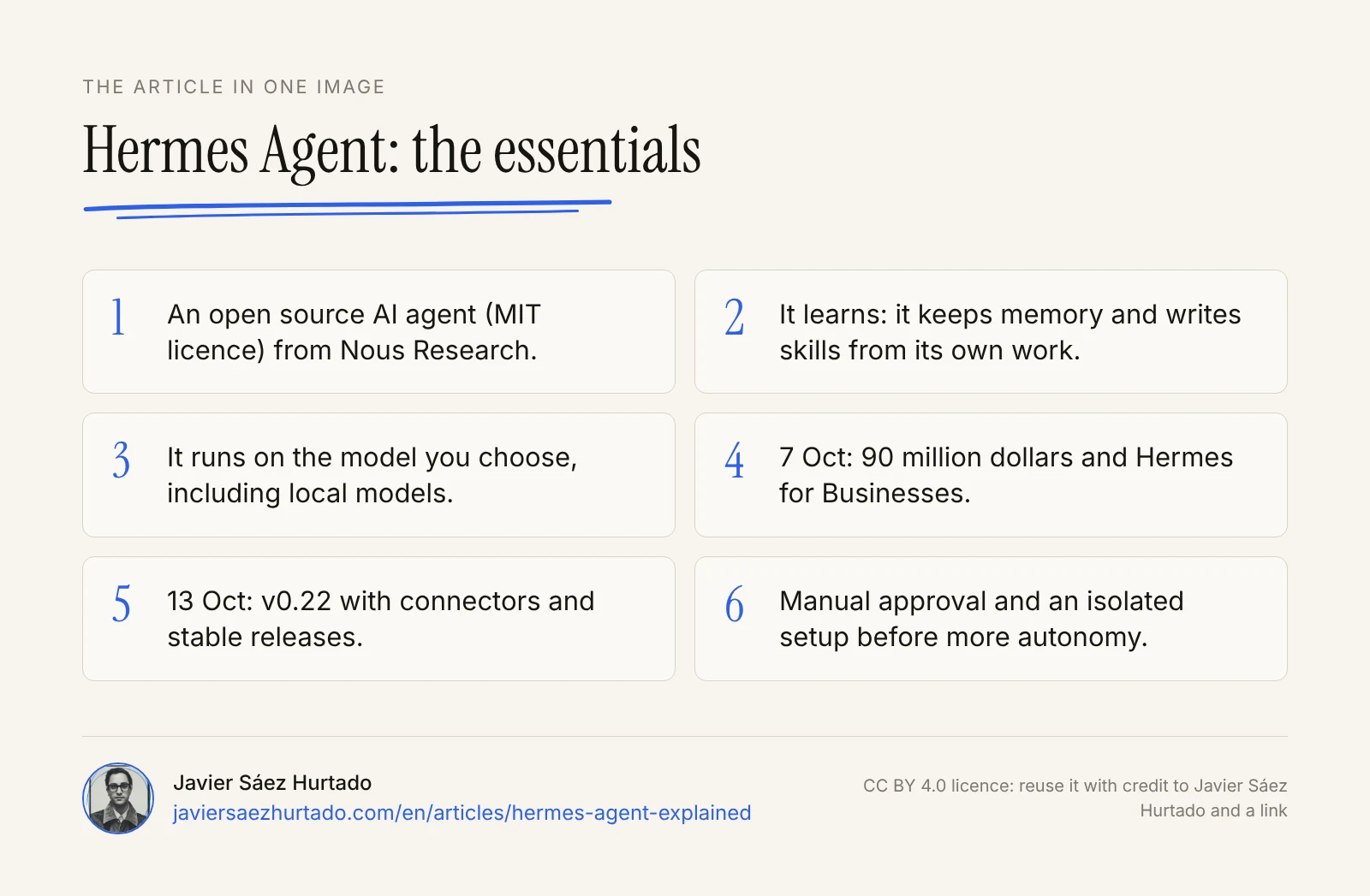
- Hermes Agent is an open source AI agent (MIT) from Nous Research that keeps memory and writes its own skills.
- It runs on the model you choose, including local models, and you can use it from a terminal, a desktop app or messaging apps.
- On 7 October Nous announced 90 million dollars and Hermes for Businesses, with a shared balance and shared skills per team.
- Version 0.22, from 13 October, adds connectors, one-click local models and stable releases.
- For real work: manual approval, an isolated setup, current versions and human review of shared skills.
The article in one image
Frequently asked questions
What is Hermes Agent?
It is an open source AI agent built by Nous Research. It carries out multi-step tasks with tools such as the terminal, the browser or email, remembers what it learns between sessions and writes reusable skills from its own work. You can use it from a terminal, a desktop app or apps such as Telegram, Slack or WhatsApp.
Is Hermes Agent free?
The software is. It is open source under the MIT licence, so you can use, change and share it. What you pay for is the language model behind it, at the price of the provider you choose. A local model on your own machine has no usage cost, only the hardware.
Is Hermes Agent open source?
Yes. The code is on GitHub under the MIT licence. Nous Research also sells Hermes for Businesses, a hosted team version, and Hermes Enterprise, which runs on the customer’s own infrastructure.
What is the difference between Hermes Agent and OpenClaw?
Both are open source agents under the MIT licence that you can control through messaging apps and extend with skills. Hermes focuses on learning by itself: it writes and improves skills from what it does. OpenClaw is known for its heartbeat, which wakes the agent up on a schedule to check its task list. Both have had published security flaws, so setup matters as much as features.
What is Hermes for Businesses?
It is the company offer from Nous Research, announced on 7 October 2026. The Business plan gives each team member a hosted agent, with one shared balance, spending caps per person and skills that spread through a team library. The Enterprise plan runs on the customer’s infrastructure, with single sign-on and service agreements.
Is Hermes Agent safe to use?
It has several layers of protection, such as approval for dangerous commands, container isolation and user allowlists. None of them is perfect: in May 2026 an injection flaw rated 7.3 out of 10 was published. The careful setup is manual approval, an isolated environment and up-to-date versions.
Sources
- Nous Research, A Note on Our Fundraise (7 Oct 2026)
- Nous Research, Hermes for your Business (checked on 14 Oct 2026)
- Hermes Agent, GitHub repository
- Hermes Agent, v0.22.0 release notes (13 Oct 2026)
- Hermes Agent Docs, security
- Hermes Agent Docs, FAQ
- TechCrunch, Nous Research confirms it hit $1.5B valuation, launches AI agents for business users (7 Oct 2026)
- The AI Insider, Nous Research secures $90M Series B (8 Oct 2026)
- NVD, CVE-2026-9353 (hermes-agent, Skills Guard)